The original (Spanish) version of this article can be found here.
As you surely know, the hottest topic of the week is the debate over the impact and regulation of AI. From Steve Bannon, Donald Trump’s malevolent spin doctor, to the Pope himself, everyone seems to have something to say.
That this is happening right now is because — as I wrote here a few weeks ago — the first AI bubble has already burst. The speculative moment that promised “singularity,” “superintelligence,” and “the replacement of the human species” has given way to one in which AI has stopped being a dream and become flesh.
A couple of days ago, the Financial Times ran a front-page piece titled “The Impossible Math of the AI Boom,” reporting something that some of us have been saying for years: that this technology has no business model capable of justifying the stratospheric valuations of these companies, and that therefore “the IPOs of the major players in the sector are probably nothing more than a transfer of investment risk onto retail investors.”
So it looks like the financial bubble is on its way to resolving itself, one way or another.
And yet the other great bubble this technology is producing — the political bubble — keeps growing. So much so that last week, the first US presidential visit to China in nine years revolved entirely around “AI supremacy,” and even the Pope is declaring that we are living through the “fourth industrial revolution.”
Today, the governments of the world — along with analysts and consultants — live inside a bubble of expectations in which the belief in a new “industrial revolution” plays the same role that “singularity” played in financial markets. That promise of an extraordinary future event that will pull the world out of twenty-five years of economic stagnation has become the excuse that allows political elites to park the problems they should be confronting — pension sustainability, the housing bubble, inequality — behind the justification that we are right on the verge, right on the very verge, of a new steam engine arriving that will change everything.
This article aims to burst that other bubble. To demonstrate that neither AI, nor any other digital technology, can produce another industrial revolution. On the contrary — what it will do is deepen the phenomenon we have been observing for thirty years. The one economists call “the productivity puzzle,” when they should really call it by its proper name: the first industrial involution.
Buckle up — here we go!
But first, an announcement!
Tomorrow, June 2nd, and again on Monday the 8th, I’ll be signing copies of Hijos del optimismo (Children of optimism) at the Feria del Libro de Madrid (Madrid Book Fair) — my first time! — and I’d love to see you there.

Tokenomics
What exactly is the business model of AI companies? This week, Sam Altman — founder of OpenAI and supreme leader of this whole thing — explained it at BlackRock’s annual forum, the world’s largest investment fund:
“Fundamentally, our business, and I think the business of every other model provider is going to look like selling tokens. They may come from bigger or smaller models, which makes them more or less expensive. They may use more or less reasoning, which also makes them more or less expensive. They may be running all the time in the background trying to help you out. They may run only when you need them if you want to pay less. They may work super hard, spend tens of millions, hundreds of millions, someday billions of dollars on a single problem that's really valuable.
But we see a future where intelligence is a utility like electricity or water and people buy it from us on a meter and use it for whatever they want to use it for.”
When you ask something of ChatGPT or Claude, what happens internally is not unlike what happens when you do a Google search: you type a question, the system searches through an enormous database, and it returns a response. The difference is that instead of giving you a list of web pages, the return is an already-written answer.1
“Tokens” are the fragments into which the model breaks down text in order to perform that search. The phrase “Hello, World!”, for example, is not eleven letters and two symbols — it’s five tokens: [”Hel”], [”lo,”], [” Wo”], [”rld”], [”!”]. Every time the model reads or writes something, what it is actually doing is processing those tiny pieces, one after another, using processor cycles. That is why the token has become the unit used to measure how much work you have asked the model to do. Just as electricity is measured in kilowatts and water in cubic meters, these companies intend for artificial intelligence to be a flow measured in tokens. And what Altman — and the entire industry — is saying is that their business is selling those tokens.
Notice how absurd this is. It is as if the owner of Toyota said their company was in the business of selling refined petroleum. Or if Apple thought its business was transforming watts. It would be a very strange thing: nobody buys a car to consume petrol, and nobody buys a phone to consume electricity. We buy what that technology is capable of doing with that fuel — the technology itself.
But AI companies have an enormous problem. Unlike car or smartphone manufacturers, they cannot charge for their technology: they cannot sell it.
Do you know why?
Because the equivalent of the Ford Focus or the iPhone 14 in AI is those “models” — Claude Opus 4.7, ChatGPT 5. They are versions of software. Code. Text. A bunch of lines in a file. Information: knowledge. And as forms of knowledge, they are infinitely replicable.
Since Adam Smith described them, economists have known that there is a type of good that cannot be traded in markets: those that can be consumed without depriving anyone else of consuming them, and from which no one can be excluded. These are called public goods — though I prefer to call them abundant goods, because the word “public” creates confusion, giving the impression that these goods must be state-owned when that isn’t the case. Radio waves, national security, the light from a lighthouse, languages — these are classic examples.
You cannot sell the word “tomato,” just as there can be no market for the laws of biology. Nobody can trade in the idea that in a right triangle the square of the hypotenuse equals the sum of the squares of the other two sides — because the day Pythagoras stated that theorem, he placed it at the disposal of all humanity: from that moment on, no one could ever prevent another person from using it freely. Knowledge is the public good par excellence.
The problem AI companies face is that their product — the technology behind these models — is the same as the Pythagorean theorem: a form of knowledge that can be copied and redistributed, and from which no one can be excluded. That is why there are already hundreds of different AI models today. Some are even open source, free for anyone to use.
As the technology matures, if it succeeds, there will be many more. Perhaps every company — and even every individual — will end up having their own. And while some will be better than others, it is also to be expected that over time they will converge in capability, because that is what happens to all technologies when they become widespread.
There can therefore be no market for AI models. Altman cannot sell ChatGPT because there can be infinitely many ChatGPTs.
All he can do is put a meter on it — and perhaps not even that.
The “New Industrial Revolution” Bubble
What is fascinating about all of this is that it reveals the economic problem of our time — and why it arises.
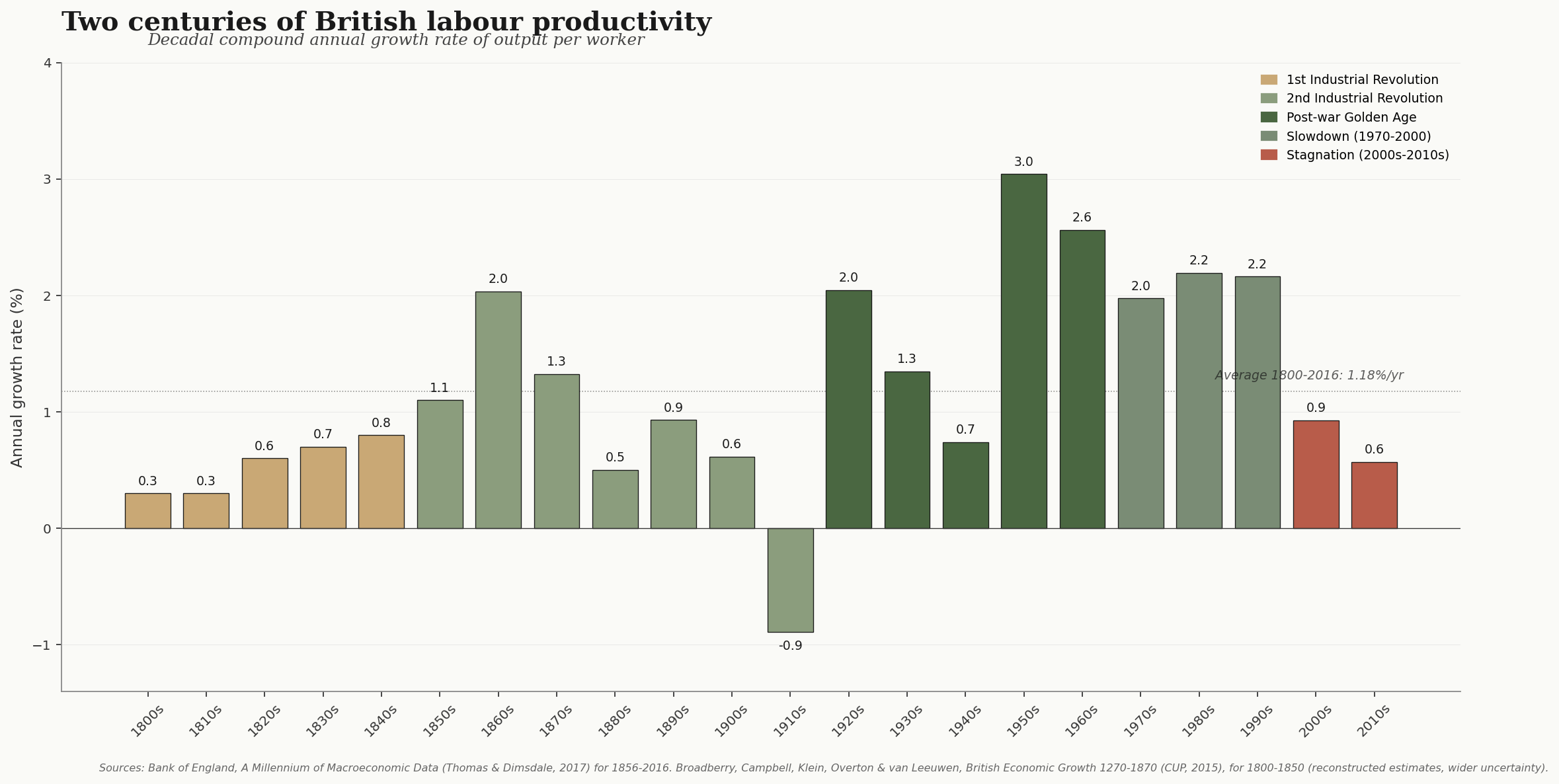
For fifteen years we have known that the economy is slowing down. The constant of our era, since the Industrial Revolution, had been that economic productivity never stopped growing. Between the end of World War II and the 1990s, it reached rates of three percent per year. But since 2000, that figure has fallen to 0.5% — a pace not seen since the Napoleonic Wars. And economists don’t know exactly why.
Some attribute it to demographics, to the exhaustion of the great inventions of the twentieth century, to a lack of investment, or to excessive regulation. Others say it is a “measurement problem” — though what difference does it make if the impact on employment, wages, public finances, and people’s lives is the same? The truth is that no economist has been able to fully explain it. That is why they call it the productivity puzzle: not because we are about to solve it, but because it is a mystery they don’t even fully understand.
.
Until a few years ago, there was genuine concern about this among the political class. Gordon Brown, for instance — former UK Prime Minister and Chancellor of the Exchequer — identified it as the cause of the rise of the far right:
A low-growth economy creates a doom loop as pessimism begets a blame culture – and the more we blame others, the more pessimistic we become. Once people convince themselves that the state of their economy is so weak that they can only improve their lot at someone else’s expense, they vote for parties that specialise in targeting those they think are holding them back – immigrants, foreigners and minorities. These parties offer nothing in terms of economic policies to generate long-term growth. The result is that zero-sum politics exacerbates the downward economic trends, and this, in turn, intensifies and widens the appeal of zero-sum thinking.
But none of the initiatives that were tried — Biden’s industrial subsidies, Trump’s tariffs — seemed to work, and governments found themselves in a hellish position: facing millions of people increasingly angry at the deterioration of their prospects, with nothing to offer them.
And then AI arrived.
Its apostles began to proclaim it would be the most important productivity revolution ever experienced. Just months after the launch of ChatGPT, Goldman Sachs announced with great fanfare that this technology “would boost global productivity by 1.5% per year,” and Bill Gates declared it would be “as important as the internet.”
Politics saw the opportunity and pounced on it like a man just released from prison. Since then, parties have clung to the idea that now — finally, this time for real — a technology has arrived that will pull us out of this civilizational clusterfuck.
That is why there is also a political bubble in AI, alongside the financial one. That is why Trump has wrapped himself in the idea that it will bring a new “renaissance” and flew to Beijing surrounded by the owners of the sector’s leading companies. That is why the debate rages over whether Europe will fall behind in the technological race. And that is why even the Pope is writing encyclicals declaring this to be the “fourth industrial revolution.”
The First Industrial Involution
My view is that the productivity puzzle is not actually a puzzle — if you look at it from the right angle.
The economy is slowing because it no longer produces scarce, exchangeable goods — it produces abundant goods that cannot be traded in markets, as we are seeing with AI. Every time a need finds an public good that satisfies it, that need stops being resolved through the market (or is resolved at a far lower price).
Twenty years ago, getting a roll of film developed cost twelve euros. You paid a fifty-euro annual subscription to National Geographic to see photographs of the world. If you wanted portraits of your wedding, you hired a professional photographer for a thousand. Today, digital photography has made almost all of that market disappear: we take millions of photos a day, view them on Instagram, and only preserve some nostalgic residue of that industry. Travel agencies disappeared when Skyscanner, Booking, and Google Flights made free the work a human being used to do for commission. Wikipedia liquidated encyclopedias — which in the 1990s were a multimillion-dollar business; Britannica cost the equivalent of two thousand euros in today’s money. Netflix and Spotify finished off video rental shops and record stores, which between them employed over a hundred thousand people in Spain alone. Google Maps made an entire industry of physical maps, road guides, and school atlases disappear.
In every case, today we have vastly more of everything: more photography, more music, more knowledge, more opportunities to travel. Productivity has increased — but not in the economy. Outside it, in a domain that goes unmeasured and that I call “Plutonomy.”
Because economic value lies neither in producing many things, nor in producing very useful things. It lies in being able to sell what you produce. And there are different ways of understanding this in economics, but they all arrive at the same point: all economic value is measured by prices. So for something to be valuable, it must be exchangeable.
What we observe in this AI affair is that a product can have incalculable social value and zero economic value. What is happening with this technology is that it is apparently generating enormous value in society — but its proponents are unable to “monetize” it, that is, to convert it into economic value.
AI is not the exception. It is the norm of our time. Every innovation of the past twenty-five years — email, GPS, digital photography, search algorithms, video codecs, the protocols that organize the internet, data science, SSH and modern cryptography, all the goods that have made this century possible — share this characteristic.
Everything I’ve described so far is, more or less, a consensus. But this is where the experts take the wrong turn: economists think this is a phenomenon tied to digital technology, or to the internet. And they trust that at some point a technology “of the old kind” will arrive to put us back on the path of growth. That is what they believe will happen with AI — somehow.
I argue that it won’t. The substitution of private goods — scarce and exchangeable — by abundant public goods is a property of the knowledge society, not of any specific area of the economy.
The difference between 2026 and 1996 is that today knowledge is universal. In the last thirty years, hundreds of millions of people have accessed higher education. That is why all technologies born today spread at full speed.
If OpenAI had been founded in 1995, like Google, it would be another Google today — because it would have enjoyed a monopoly over its technology that it cannot have now. And it cannot have it now because today there are hundreds of millions of software engineers, whereas in 1996 there were very few.
Conversely, if Google’s search technology were invented today, Google would never have existed: because there would have been millions of different search engines within a few months, and Google would never have been able to consolidate the search monopoly that built its dominant position and customer base.
The same is true of Facebook, Twitter, and Airbnb. None of these companies possesses a technology that everyone else doesn’t also have. What they had, at a specific moment in time, was the opportunity to achieve a monopolistic position — because there weren’t enough engineers capable of competing with them, or financiers willing to embark on that kind of venture. And so, by the time potential competition could react, the so-called network effects had already turned them into monopolies. And that was an insurmountable barrier.
All of this applies to physical goods too. If drones had been invented in 1900, like cars, there would have been a “Ford” of drones that would have monopolized the technology and produced the illusion of productivity for whichever country it called home.
But in the 2010s, drones were born already commoditized — the technology is universal — and today they are manufactured anywhere, sold for next to nothing, and even a country devastated by war like Ukraine can build its own drone industry from scratch.
And the reverse is equally true. If the car and all the other innovations of the Industrial Revolution had been invented in 2020, Ford and Bell Labs would never have existed. The same thing would have happened as with drones: hundreds of companies would have rushed to copy each other and would have collapsed prices within months. That, precisely, is what is happening with electric cars today.
Here is the thing: the sustained and extraordinary productivity growth of the industrial era emanated from a historical anomaly. Those two hundred years were a unique moment in which knowledge — an abundant good with which one cannot normally trade — became scarce. Only certain companies and certain countries possessed that knowledge, and they could trade it under conditions of monopoly. The “industrial economy” was an enormous mechanism for buying and selling restricted knowledge.
And knowledge was scarce in those years not because of any administrative constraint, nor because of its nature, but for a very deep social reason: there were not enough people in the world capable of transmitting and managing it.
When the children of optimism — the first generation to attend university en masse — came of age, they broke that monopoly and brought the industrial economy to an end.
What we are living through is the dismantling of the system we had known. And the reason there appears to be a “productivity puzzle” is that we are navigating the first industrial involution.
That is why AI — despite being among us for four years now — has not produced so much as a notch in productivity statistics, just as none of the digital technologies of the twenty-first century have.
And if his proposal succeeds, it will be even worse. If it manages to write software, produce consulting reports, drive cars, wait tables, write journalism, do graphic design and translations on its own — each of those things will also become an abundant public good that ceases to carry economic value.
The Real Business Model of AI
So what exactly are AI companies selling? And how much truth is there in what Altman says about putting a meter on it?
A token is not a product. It is a unit of measurement. And he wants us to believe that intelligence is a substance — like water — or a flow — like energy — that can be metered. But it isn’t.
What exactly does a “token” measure?
Electricity, in reality. What they are measuring in tokens is the energy required to run a processor and cool it. The irony of life: the metaphorical transformer of LLMs has turned out to be a literal transformer.
It’s not that artificial intelligence is going to be “the new electricity.” It’s that, from an economic standpoint, it is plain and simply electricity — the same electricity as always.
That is why — because selling electricity doesn’t seem like an extraordinary business at this stage of the game — what AI companies are actually doing with all this data center and token frenzy is something very different: they are trying to become the landlords of a rentier economy, cornering all the computational real estate in order to rent it out. Nothing more.
That is why the financial AI bubble will burst. Because there is no business here, no new economic value in this technology. The only question is whether it will happen before or after the institutional investors manage to offload the risk onto retail investors through the IPOs.
And after that, it will be our turn to figure out what the hell we do when the political bubble deflates too.
If this article has made you see reality differently, Hijos del optimismo (Children of optimism) will take you much further. It is the book on which this newsletter is based, and it contains a complete framework for understanding the world through a radically different lens.