


Puedes encontrar la versión original (en español) de este artículo aquí.
I shouldn’t be here. I had decided to take a break from this newsletter to watch the World Cup, work on a business project I’m getting off the ground, and write a series of articles I’ll be publishing next month that are going to be very good.
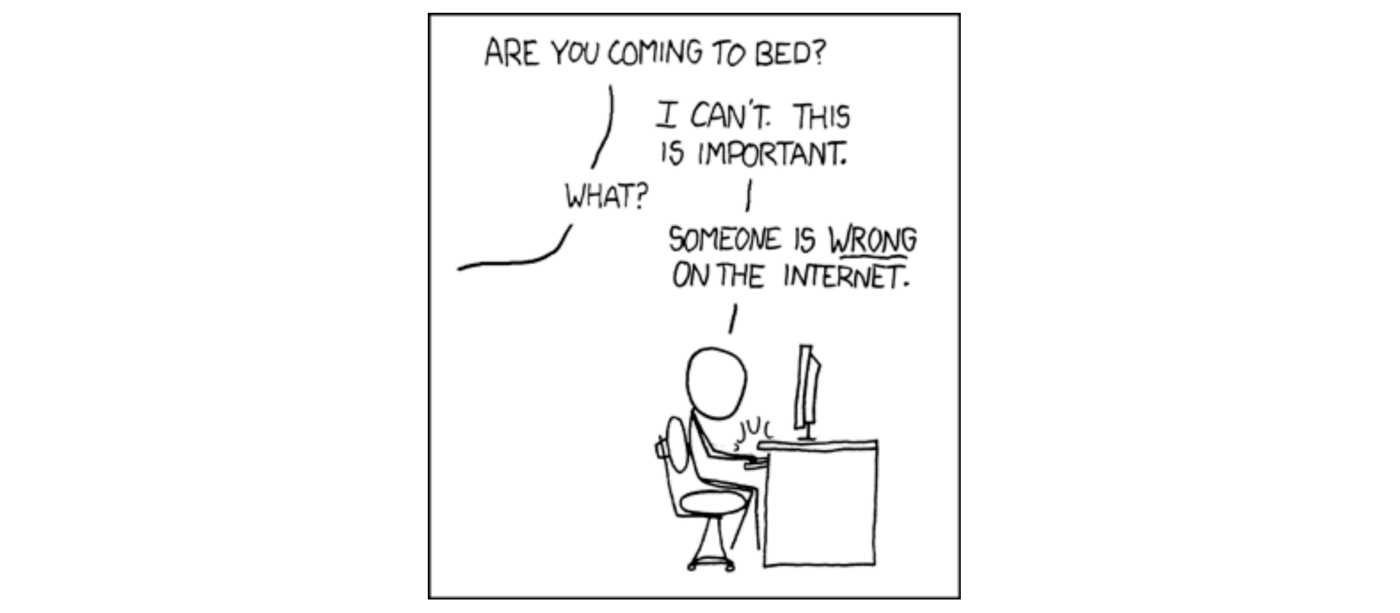
But it turns out sixteen Nobel laureates, plus another two hundred economists and experts, have just published a manifesto on AI. And I’ve spent the whole week squirming in my chair, trying to resist the urge to become that guy from the meme who can’t go to sleep because someone is wrong on the internet.
Without success.
Because it turns out that the signatories of this manifesto — among them Paul Krugman, Joseph Stiglitz, former Fed Governor Ben Bernanke, and Daron Acemoglu — are not just “some people”: they are the bloody intellectual elite. They are the most cited, most read, and most revered intellectuals in the entire world; the people who run the institutions that generate knowledge, shape global opinion, and make political and economic decisions. They are the gears of the global understanding machine. If anyone is supposed to understand what is happening with AI and explain it, it’s them.
Well, no.
The manifesto is brief enough that I can reproduce it in full. It reads as follows (the bold text is mine):
AI could become radically more powerful in the next 10 years.
This could drive an unprecedented transformation of our economy, greater than the Industrial Revolution, but deployed over a much shorter timeframe. It could bring risks, such as massive job displacement, as well as opportunities, including substantial improvements in living standards.
Economists, policymakers, and technology leaders must act now to understand the economics of transformative AI and build the incentives, safeguards, and institutions needed to direct AI in a direction that complements humans and benefits society.
What do you mean, “could”? Sixteen frigging Nobel laureates, and the best you can offer is “could”?!
Of course. And someone could wake up tomorrow and publish the paper that opens the floodgates of quantum computing. Or someone could prove string theory, or the Riemann hypothesis. Someone could discover the mechanism that finally makes nuclear fission viable, or allows us to reverse aging. AI is not the only field where enormous numbers of people are doing research — for fuck’s sake, we are living through an ongoing scientific revolution! All of those other things are just as possible as a step-change in AI. And all of them, if they happened, would have equally incalculable economic and social effects.
Why does nobody write manifestos about those things? Why doesn’t the entire global intellectual community gather to discuss the consequences — wild ones, trust me, I’ll tell you about them one day — of quantum computing? Very simple: because there is no point in calculating the derivatives of something that hasn’t happened, because the things that could happen are infinite and our time is not.
Is there any reason to think AI is more likely to be a revolutionary phenomenon than these other advances?
No.
If anything, the opposite: the misleadingly named “AI” has spent four years breaking every promise it ever made. It was going to replace 300 million jobs (it didn’t), cure cancer (nope), replace all programmers (there are more of them now than ever), and boost productivity (it hasn’t). It was going to create autonomous armies (anyone?) and bring the “singularity” — the end of history, the moment when a superintelligence would render the human race unnecessary. Where is that creature today? Nowhere to be found.
If anything should have taught us something over these four years of hype, it’s not to trust its promoters. And yet here we are: beguiled, entranced, still giving oxygen to this nonsense. Small wonder, when the people who ought to be bringing sanity to this madhouse busy themselves publishing manifestos about industrial revolutions that could (or could not) happen.
How can it be that with all the intelligence in the world, we still can’t understand what is going to happen with a technology? How can it be that this manifesto is incapable of offering a concrete diagnosis and proposing something beyond “acting to understand the economics of AI”? Who, if not its signatories, is supposed to “act to understand”?
At what point did the understanding machine break down?
Wait — but we can. Of course we can! There are of course people who have spent a long time explaining that AI is not what its promoters claim; that no technology limited to computing language can actually reason; that the probabilistic nature of LLMs makes it impossible for them to stop hallucinating, and that for this reason they fit very poorly into the productive system, which needs certainty; that there are no barriers to entry that would allow this technology to be monopolized the way other tech giants managed in the past; and that it is not possible to generate a profitable business model for AI companies, much less one that justifies the trillion-dollar valuations of some of them.
As a consequence, what is happening in the financial markets can only be understood as an immense bubble of expectations in which money moves in circles among a handful of companies without ever finding a real customer. It is the latest version of a bubble that has been inflating since the internet changed the nature of society.
Unlike the prophecies of AI, all of these truths have done nothing but confirm themselves since 2022. It is not true that we cannot understand. The truth — wink, wink :p— is out there. The reason that manifesto retreats into “coulds” and “must-do-somethings” is not that we can’t understand what’s happening: it’s that we don’t want to admit it. We don’t want to acknowledge that there is no industrial revolution in the making. That no technology is going to come and pull us out of the civilizational impasse we’re in, and that we have no choice but to face the end of the industrial era with all its consequences.
The emperor has no clothes. Many people have been saying it — I’ve been saying it — for years. What is truly alarming is that today, when that truth — scientific, demonstrable, widely shared — collides with the interests of AI companies, Silicon Valley, and the governments of the United States and China, the global understanding machine seizes up and stops working. It surrenders.
From that surrender comes this three-paragraph “manifesto” that manifests nothing — empty, barely inhabited by two “coulds” and a “someone-must-do-something (but we don’t know what).”
Why has the understanding machine broken down?
Within hours of the text’s publication, one of the signatories appeared on Twitter to offer some explanation. Daron Acemoglu says he is “not convinced” by the comparison to the Industrial Revolution, and remains “unconvinced that we’re going to see the enormous productivity gains that industry insiders predict” — but things could happen (”again, with no certainty whatsoever, just ‘could’”).


So why has Daron Acemoglu signed a manifesto that amounts to saying absolutely nothing? Here is the crux of the matter: because “finding a statement that reflected the shared views of several AI researchers, economists, and social scientists was important.”
Even if it says nothing? Even if it validates theses that haven’t just gone unproven, but are being discredited with every passing day? Even if it points us in the wrong direction?!
This, dear friends, is not science. Science is the pursuit of truth — whether or not the other researchers share it. Whether or not it’s the consensus view. Whether or not you are the only person on the face of the earth holding it. When what one is looking for is a “shared view”; when it matters more to be on the same page as the other distinguished people in the room than to say something true — we don’t call that science. We call it something else: “herd mentality”, an endemic disease of our time that runs in equal measure through academia, journalism, and politics.
Debates in the AI Cloud
Do you know what the problem is? When sixteen Nobel laureates, plus two hundred economists and experts, validate the hypothesis that this technology is going to be revolutionary, they also lend legitimacy to an entire political and economic landscape spending its time discussing that topic the way Thomas Aquinas once debated how many angels could fit on the head of a pin.
Case in point. Since the manifesto was published, at least one other prominent economist, Noah Smith, has come out to explain that he decided not to sign it because he’s worried his name would be used to endorse subsequent arguments he doesn’t agree with, as those Acemoglu puts forward in his book “Power and Progress”:
I think “directing” AI is a bad policy idea. The first reason is that it’s basically impossible: no one really knows, at the time of invention, how a technology will complement or replace human labor. Inventors don’t know how companies will end up using their inventions — and the more general-purpose a technology, the less they know. Could James Watt, in 1765, have predicted most of the applications of steam power? Absolutely not. So he had no way of knowing whether the steam engine would ultimately create more jobs than it destroyed.
And at least one other star of the digital political firmament, Henry Farrell , has taken the opportunity to rebut Smith’s review of “Power and Process” and respond to him:
When Acemoglu and Johnson talk about “directing,” what they’re suggesting is that it’s better not to leave crucially important decisions in the hands of techbros, but to make them democratically, through processes that give ordinary people some countervailing power against elites. The downside of democracy is that it’s slow, conflictual, and a monumental hassle. The upside is that it allows people with different interests to advocate for those interests, and that diverse ways of understanding the world can be collectively used to map out a more complex landscape of possible futures. And when you’re making decisions that might lock in patterns for a very long time, what you really want is for those who will be affected by those decisions to have a voice.
Bubble: minute and result
Maybe this seems to you like a very relevant debate — because we’re all very anxious about the role techbros will play in our lives if the dystopias promised by artificial intelligence materialize. But what if they don’t? What if there is no fourth industrial revolution?
My thesis is this: I think what is truly terrifying is not that AI will boost productivity and free us from work. Not even if it destroys a lot of jobs along the way. What actually terrifies us is the possibility that none of it happens.
This year, the investment driving the AI bubble accounts for 92% of US GDP growth. Meanwhile, the Chinese economy is showing alarming signs of exhaustion. In other words, beyond the bubble, there is no growth. If AI doesn’t produce the transformations we’ve been anticipating, we will find ourselves in a stagnant world with no project of progress — at a moment of maximum polarization. That is what is truly terrifying.
What’s more, how can this manifesto not even mention the possibility that the bubble could burst in the coming weeks or months? Today, most analysts agree that it will. What will we do afterward? Will we tell people again, as we did in 2008, that it couldn’t have been foreseen? That we didn’t see it coming?
While we are distracted, the markets keep shaking. In the past week alone, IBM has had the worst day in its 115-year history — a 25% drop in a single session; SpaceX shares — sold just a month ago as the generational opportunity to get rich by investing — have fallen 40% and are now trading below their IPO price; the South Korean stock exchange — where several of the hardware manufacturers AI depends on are listed — has lost 25% of its value in a month; and American chip makers have followed in the latest round of panic that has been rattling indices for weeks. The bubble, if it hasn’t burst, is certainly hissing.
On the horizon, a succession of ever-higher obstacles: in August, all the tech companies will report results. On the previous occasions, shares of one or all of them fell sharply immediately afterward, even when the numbers were excellent. Also in the first week of the month, another 20% of SpaceX shares will begin trading, and given the current trajectory, everyone expects it to be a bloodbath. Amid all this, OpenAI and Anthropic are preparing their own IPOs — perhaps one in October.
The final boss appears in November, when the United States holds its elections. The most likely outcome is that Trump loses control of at least the House. And if that happens, the bulls — those betting that stocks will keep going up — would be left without the person who has been propping up valuations by manufacturing events and headlines every time they threatened to collapse.
How to Fix the Understanding Machine
I have said many times that we are in the final stretch of a twenty-five-year process. I have argued that we are in a moment identical to the one that drove us into the Great Depression in 1929. I believe that in the coming years we will pass through a profound existential crisis.
And what worries me even more than the economy is that the mechanisms we had built for ourselves to understand the world — unable to stand up to the economic and political hype — have broken down. They have left us without an intellectual structure capable of looking honestly and rigorously at the changes we are living through, and at the real challenges we face.

We need to fix the understanding machine. And the best tool for repairing it is the old craft of disagreeing: saying what you have verified even if nobody else will sign off on it — especially if nobody else will sign off on it. Because Meredith Whittaker is right: renouncing the truth makes us stupid, not just as individuals, but as a society. And to get through this extraordinary, brilliant, and fearsome moment we have been given to live through, we are going to need every bit of our intelligence.
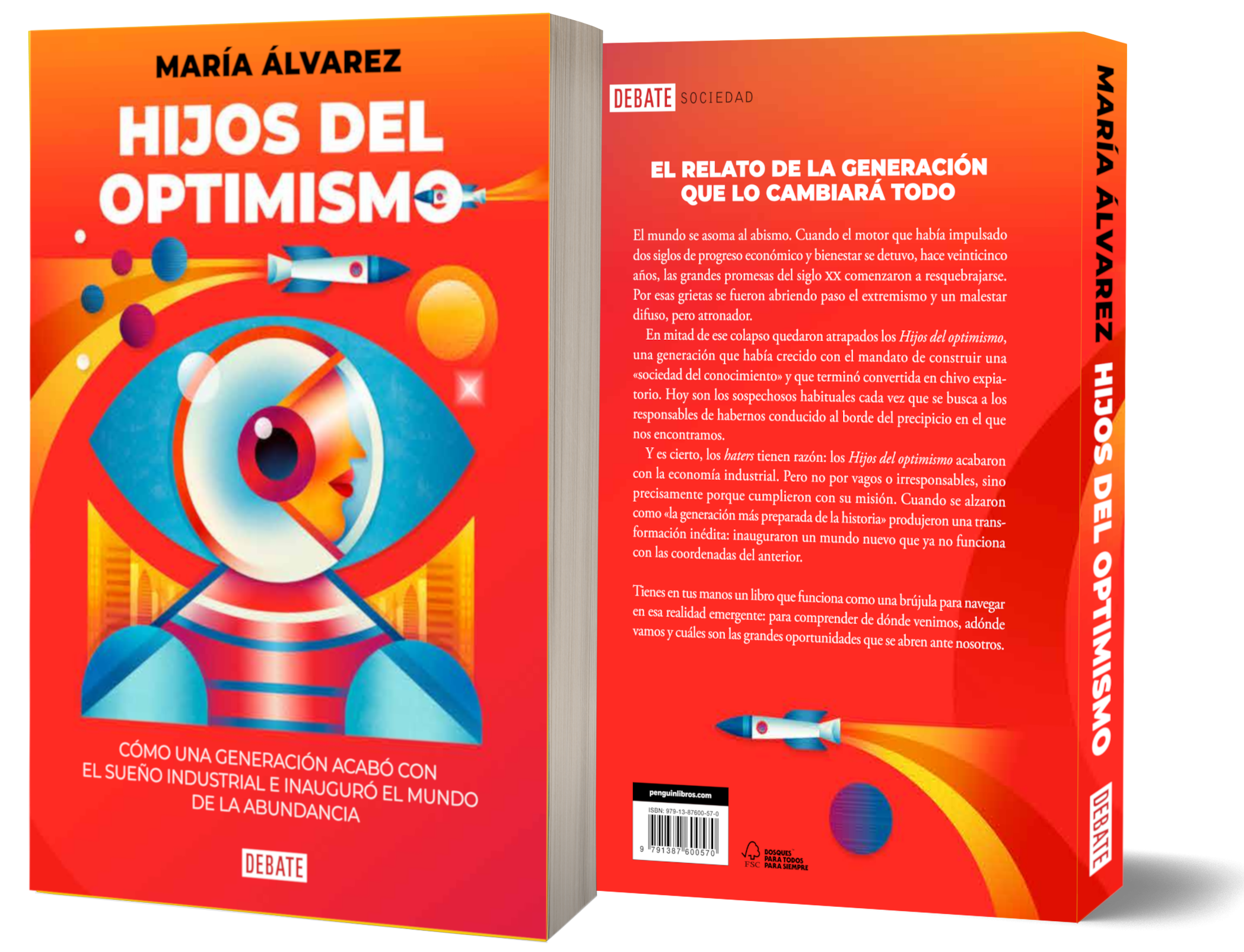
If you want to understand this historical moment, I invite you to read Hijos del optimismo (Children of Optimism). It’s my first book, written as a guide for navigating this age of change. It will change the way you see the world
.