


The original (Spanish) version of this article can be found here.
At the heart of our time lies a mystery. An inexplicable contradiction.
On one hand, we are living in the best moment in human history.
Over the past 25 years, 1.5 billion people have been lifted out of extreme poverty, GDP per capita has risen from $13,000 to $20,000, life expectancy has increased by 17 years, and child mortality has been cut by two thirds.
Today, two in three people on the planet are connected to the internet, and we publish four times more books per year than in 2000 — over 2.2 million new titles annually. As if that weren’t enough, we are close to making cancer a chronic, manageable condition, and the rollout of renewable energy allows us to imagine not just a solution to climate change, but the prospect of a future of clean, abundant energy.
And yet, we are in crisis.
Two in three people on this planet feel that “society is broken,” that the economy is rigged in favor of the powerful, and that a widening gulf separates ordinary citizens from political and economic elites. Meanwhile, 40% of humanity believes their economy will be worse next year and that there will be more violence. Many people report “great worry” (39%), “stress” (37%), and “anger” (22%).
The result is that today, populist parties — with Donald Trump at the helm — sit in government in one third of OECD countries.
How can this be?

At the moment of greatest abundance in history, what we feel is fear and a gnawing sense of scarcity.
How can this be?!
The answer to that question is a powerful one: it explains why Trump sits in the Oval Office, why there is a housing bubble, and why there is another bubble in “AI.”
This 3,000-word newsletter unlike anything you’ll read anywhere else lands in your inbox for free — because information wants to be free. But producing it takes work. You can help me prove that abundant goods can still be sustainable by choosing a premium subscription or picking up my first book, Hijos del Optimismo (Children of optimism).
Don’t Look Up!
The most remarkable thing about this mystery is that it isn’t one. Every government in the world knows what is happening. But the phenomenon behind the discontent is so terrifying that no one dares say it out loud, for fear of making it fully real. Like the movie where a meteor is about to destroy the Earth but everyone looks the other way — we’ve spent fifteen years watching the impact coming, without ever finding the courage to talk about it.
What is happening is this: the economic engine that brought us here — the one that made us the society we are, the one we call the “industrial economy,” or “capitalism” — stopped working 25 years ago.
And nobody knows why. Or how to fix it.
What we do know is this:
Human societies have always had some form of economy. But until a couple of centuries ago, it was essentially a survival mechanism. What turned the industrial economy into the cornerstone of modern society was its extraordinary ability to transform our lives by relentlessly creating new goods to replace old ones — the way the car replaced the horse, oil replaced coal, or the telephone replaced the telegraph.
But that engine had a problem: it concealed a death drive. When goods became obsolete, old industries lost their purpose and disappeared. Financial bubbles and waves of unemployment followed — the kind that swept through communities after coal mines were shuttered or car factories closed across the United States. To stay alive, the industrial economy had to keep devouring itself.
The natural, expected end would have been death by success — eventually creating every product a person could want and exhausting its own mechanism of constant change. Yet by the mid-twentieth century, the industrial economy had been running at full capacity for 150 years, and none of that seemed to be happening.
So in 1942, someone offered an explanation: the destruction produced by capitalism was “creative” — and you really have to admire economists for their naming instincts. The labor and capital that became unnecessary when industries died turned into the fertile ground where the next ones were born. Better yet, because the new companies were more productive and innovative, the jobs and investment opportunities they offered were more plentiful and more rewarding.
And so “creative destruction” became far more than the engine of capitalism — it became the founding myth that organized all of modern life. For 50 years it was the truth that allowed generations of people without university degrees to dream that their children might become architects. It was also the story through which society believed it would pay for pensions, build infrastructure, pay down public debt, own a beach house, and go on holiday every summer.
Twenty-five years ago, that engine stopped.
Since the late 1990s, the “destructive” side of the economy has only accelerated, sweeping away entire industries — but the “creative” function has gone missing in action. The new industries of the twenty-first century have been unable to absorb either the capital or the labor that the old ones used to employ.
The mobile phone, for instance, obliterated entire sectors of activity: neighborhood retail and bank branches; CDs and film cameras and newspaper kiosks. As had happened before, jobs and investment opportunities in each of these sectors were destroyed.
But the primordial broth of surplus labor and capital that was supposed to generate new sectors of activity never delivered. Instead, the world split in two: on one side, a handful of companies and certain categories of workers — engineers, programmers, finance professionals, parts of marketing — continued to enjoy good conditions and strong prospects; on the other, a vacuum emerged, steadily filling with precarious, low-status, low-productivity, poorly paid work — hospitality, delivery drivers, gig workers.
The macroeconomic consequence is that countries are growing more slowly. Some highly productive industries still exist, but average real wages have stagnated as precarity has spread. Government revenues — also designed for a world where employment would always grow — have come under strain. And so the tensions emerge: who should pay for public services, and how much.
The One That Must Not Be Named
So the first great mystery of the modern world is no mystery at all. It is well understood that the inability of today’s economy to sustain the myths and institutions of the twentieth century is what is driving the eruptions of discontent everywhere. That is why they are happening all over the world at the same time.
The crisis of the middle class — the frustration of young men, especially those without higher education — stems from the fact that the jobs that gave them a central place in society disappeared and were never replaced by equivalent ones. And if there is a global housing bubble, it is because capital, lacking productive alternatives in which to invest, has retreated into the last asset from which it can still extract returns.
In the collective subconscious, all of this crystallizes into the feeling that “society is broken.”
But nobody has a plan to fix it — because the true mystery of our time, the one for which no one actually has an answer, is:
Why has the engine of capitalism stalled?
Since nobody fully understands it, and nobody has a solution to offer, no leader wants to touch the subject. The politics of the past ten years resembles the faculty of Hogwarts, collectively determined not to name the one who must not be named. Instead, parties busy themselves finding plausible — but false — scapegoats, ones that let them keep their base in line while deflecting blame. Depending on which side you’re on, the culprit is:
immigrants,
or billionaires,
or politicians — who favor immigrants or billionaires, depending on who’s pointing the finger —,
or social media, filling people’s heads with garbage.
And despite the different villains, the proposed solution always seems to be the same: go back. From Trump’s Make America Great Again to the nostalgic nationalism of the European far right and the reindustrialization programs of social democrats, every ideology is inventing its own particular version of a return to the moment when all of this seemed to work.
The Truth at the End of Capitalism
A few years ago, I set out to write a book that would answer this question:
Why did the engine of capitalism stop?
Not because I want to do forensic science. Not because I want to be a catastrophist. Quite the opposite. If there is a way out of this dead end — and there is — it runs through understanding that we cannot go back. We have moved beyond the industrial era. We are already in a new time, and once the shock and the initial fright have been absorbed, the only thing we can do is look forward. There is no point trying to return to a world that no longer exists — it is impossible, and that ambition can only lead us toward hatred and war, as we are seeing everywhere these days.
The great tragedies of history do not arise from transformation itself. They arise from society’s inability to adapt to it. It is when profound change overwhelms existing norms, and institutions fail to keep pace, that conflict takes hold.
‘Hijos del Optimismo’ (Children of Optimism) argues that 25 years ago, a transformation took place that dismantled the industrial system. To understand it, we need to set aside the classic categories and think about the economy from a different angle — one more suited to the reality of the twenty-first century: the exchange of knowledge.
The Industrial Revolution is usually told as a story about our capacity to manufacture. The combination of capital and labor made us vastly more productive, and that is why we are so much wealthier. But producing something, if you have no one to sell it to, counts for little. What truly changed the world was the expansion of trade — which from 1800 onward had grown far faster than population or production, and which, coinciding with the stalling of capitalism’s engine, flatlined.
Which leads to the next question: what exactly do human beings exchange with one another? And why are we doing less of it?
The answer is less obvious than it seems. We’ve grown accustomed to thinking about what we buy and sell as objects — as the heavy, countable output of a material world. But they never were. When we buy a car, a medicine, or a phone, it’s because we don’t have the knowledge needed to make it ourselves. What we exchange, therefore, is knowledge. The goods traded by the industrial economy were fragments of knowledge pressed into products.
So the next question is: what happened to the human knowledge that produced the greatest economic expansion in history? And what happened afterward?
A Brief History of Human Knowledge
For most of our existence, knowledge advanced at geological speed. Thousands of years passed between the mastery of fire and the emergence of symbolic language, and thousands more between the Agricultural Revolution and the first formal mathematical systems. Several thousand more had to pass before those systems culminated, in the seventeenth century, in the scientific method and Galileo.
Throughout all that time — just as with other animal species similar to our own — knowledge spread from individual to individual until it reached the limits of each population, exactly like a virus. If one person knew how to use fire, or build a windmill, that knowledge replicated organically — the way elephants pass knowledge to each other, or macaques — until it reached the entire social group.
This meant that trading in knowledge was not possible, because everyone had the same knowledge. That is why commerce throughout history was always marginal, and only in cases where political power exercised rigid control over its distribution — as China did to protect its silk industry, or the medieval guilds did in Europe — was trade in knowledge even conceivable.
But during the Industrial Revolution, something extraordinary happened. All the accumulated knowledge that had been building since the Scientific Revolution, two centuries earlier, crystallized into a cascade of discoveries: the steam engine, the railway, electricity, the internal combustion engine, the telephone, antibiotics, anesthesia, vaccines, the airplane, television, plastics, synthetic fertilizers, nuclear fission, the transistor, computers, the internet, GPS, genome sequencing, and smartphones.
That acceleration produced a historical anomaly: there were barely enough people capable of managing it.
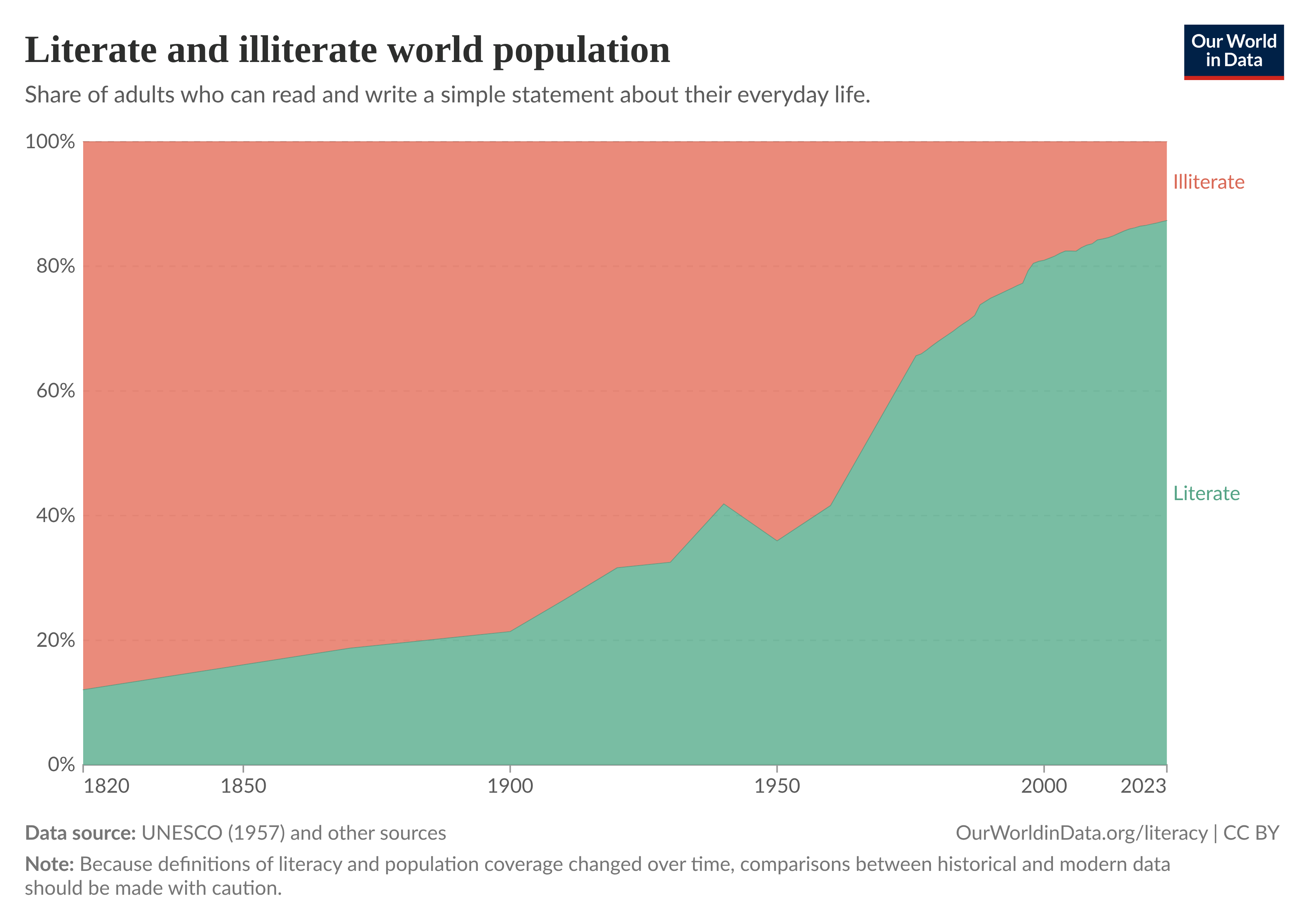
At the dawn of the Industrial Revolution, fewer than 10% of the world’s population could read and write. There were very few universities, and most were more devoted to the study of religion than science. In the decades that followed, despite the breakneck pace of technological progress, it was still driven by very few people — perhaps a few thousand, in Europe and the United States.
Meanwhile, the rest of humanity was just as illiterate in 1920 as it had been in the Middle Ages. There were not enough engineers, mathematicians, or teachers in the world for knowledge to become universal as it had been for millennia. Complex ideas could not circulate beyond those tiny circles — simply because there weren’t enough people capable of understanding them.
For that reason, for two centuries, the entire world depended on the elites of a handful of countries to manufacture cars, extract oil, maintain supply chains, synthesize medicines, build infrastructure, write software, and launch satellites into space. What’s more, even in Western countries, most of the population could not make consumer decisions on its own.
What we call “capitalism” or the “industrial economy” was, therefore, a colossal mechanism designed to allow vast numbers of people — who lacked the necessary education — to enjoy things like home appliances, financial products, fossil fuels, and international travel that would never otherwise have been within their reach.
That is what made the “industrial era” possible. For a couple of centuries, the monopoly on knowledge allowed a handful of companies in a handful of countries to sell it — packaged in consumer goods — first to the rest of society, and then to the rest of the planet.
Meanwhile, in 1950, two thirds of the world’s population still could not read or write.
The Age of Optimism
Until, in the second half of the twentieth century, everything changed. At the end of the Second World War, the world made a colossal effort to extend the benefits of welfare and progress to the majority — including education.
First, in the 1950s, 60s, and 70s, billions of people gained access to basic schooling. Illiteracy plummeted — collapsing within a matter of decades. Then, in the closing chapters of the century, a new promise emerged: a “knowledge society” would be born.
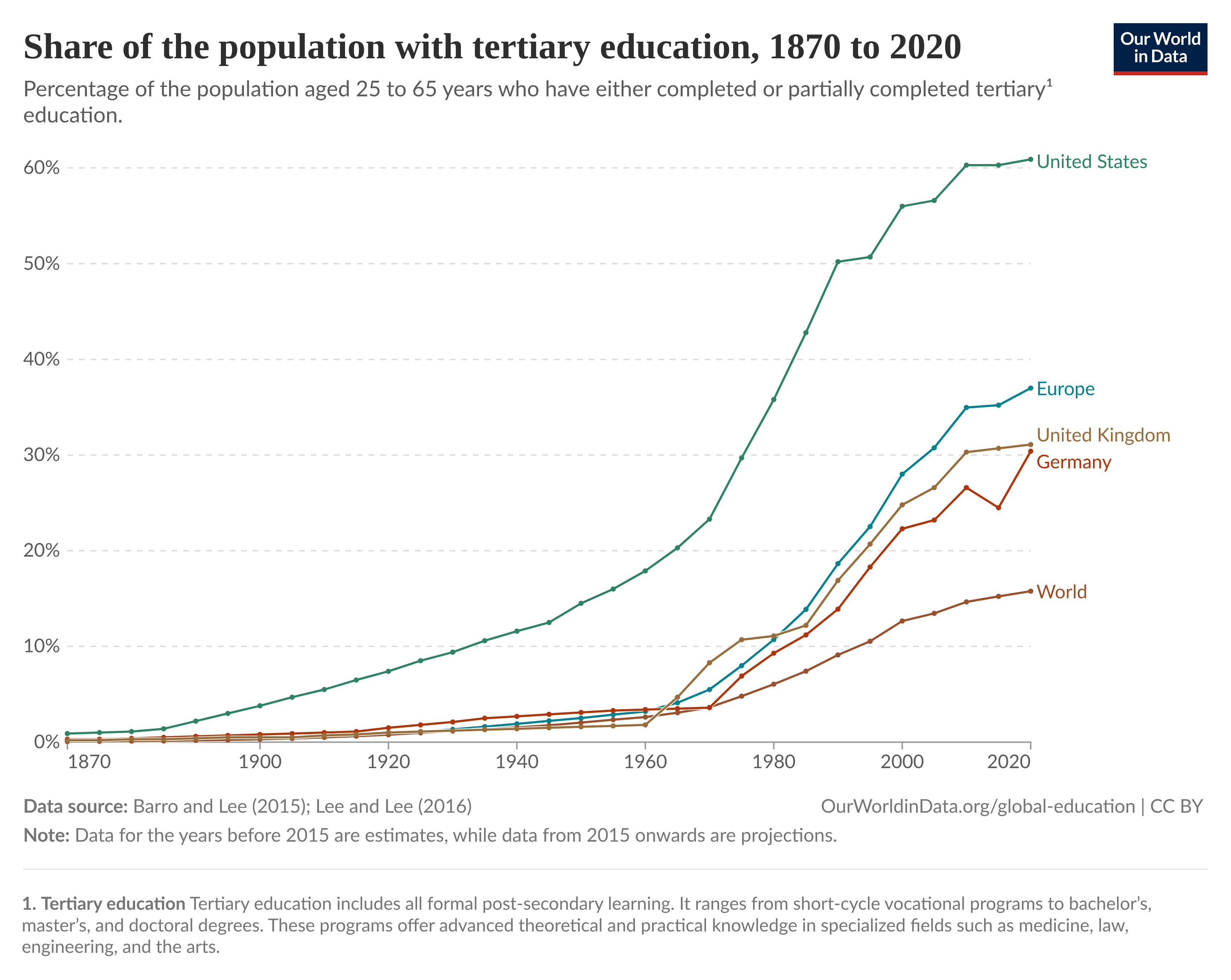
Making that dream possible would require more than oil and machines. It would need a new kind of capital: “human capital.” The future needed engineers, lawyers, and doctors; scientists and philosophers; publishers, writers, and creators; sociologists, political scientists, and linguists. Astronauts.
And so the world conspired to produce an unprecedented experiment. A generation — hundreds of millions of young people — would go to university, and emerge from it as a different kind of human being: infinitely more capable of transforming reality than any of their predecessors, equipped with a backpack full of self-belief and the assignment to build the future.
Those children are — we are — the children of optimism of the twentieth century.
And just as our parents — who had been the first or second generation in their families to attend school — gave rise to television and newspapers to satisfy their curiosity, the children of optimism created our own medium, tailored to our ambitions: the Internet.
A Change of Era
It’s been said so many times it feels tedious to repeat — but it’s true: we are living through a change of era. A thousand years from now, when future historians explain the moment we lived through, they will say it was an extraordinary one, a historical inflection point.
The dream of the knowledge society blew apart the chains that had kept knowledge restricted for 200 years. For the first time, hundreds of millions of people could command a volume of knowledge that, just a few decades earlier, would have been considered revolutionary.
The impact was enormous — as if a million scientific revolutions had hit us simultaneously. Within just a few years, the structures that had served to maintain the monopoly of knowledge in a world of illiterates began to crumble.
First, the great newspapers, the unions, and the mass political parties — the great intermediary institutions of contemporary society — began to fade. Political scientists and sociologists, who understand this phenomenon well, call it “political disintermediation” and are acutely aware that it represents a paradigm shift. What we have not yet fully grasped is the impact it had on the economy.
The Shrinking Economy
In the twentieth century, music was a scarce good. It required very specific — and carefully restricted — knowledge to manufacture CDs, produce them at scale, and distribute them. Precisely for this reason, a market could exist that sold billions of units and sustained entire distribution chains employing millions of people. In major cities, entire shopping centers were built around the trade of this particular form of entertainment.
The children of optimism stopped needing those intermediaries. An entire sector of the economy disappeared. Then the same thing happened to newspapers. Then to travel agencies, hotel chains, retail stores, bank branches, administrative workers, insurance brokers, video rental shops, employment agencies, television, and radio.
Just as it happened to the mass political parties, with each good that no longer required intermediaries, entire economic sectors vanished — along with millions of jobs and investment opportunities. The “destructive” side of capitalism was rendering them obsolete.
This is the simplest — and most condensed — explanation for the great mystery of our time: the children of optimism, realizing the dream their parents had for them, dismantled the industrial world and inaugurated a new one.
The economy we had known — the one that carried us to the threshold of the twenty-first century — was not the natural, inevitable continuation of our species. It was an exception; an anomaly; an ephemeral moment that arose at the confluence of exceptional historical circumstances, and that depended on a single condition: that knowledge remained restricted and controlled by a few people in a few countries.
And it is not coming back.
Abundance or Barbarism
The paradox of the present is this: we have convinced ourselves that we live in a time of scarcity, when the only truth is the opposite. Our world is becoming more abundant by the day. We are increasingly capable not only of producing material goods, but of satisfying our needs in far more sophisticated ways than through the possession of objects. (This is what we mean when we talk about “digitalization.”)
The problem is that the rules of our society are not designed for abundance. Quite the contrary. Solving the “economic problem” — scarcity — has been our primary occupation, not just for the past few centuries, but throughout our entire existence, and throughout the history of life itself. Even today, society is precisely this: a system designed to produce and allocate limited goods. A mechanism that expects all of its members to contribute to alleviating that age-old scarcity by contributing effort (labor) or sacrifice (capital), and that assigns each person a position in the social order based on the results of that contribution.
So every time knowledge threatens to make another corner of existence abundant, we find ourselves at the same crossroads: if we want music to be abundant, how do we pay the artists? If we buy products cheaply in places with no sales staff (like Amazon or big-box stores), what will the neighborhood shopkeepers do? If knowledge collapses the price of food, how will farmers live well? If technology frees us from work, what will we live on?
What we have called “artificial intelligence” is the most extreme expression of the same phenomenon. Generative AI promises to make intelligence abundant. But if that happens, what will happen to the workers it displaces? What will happen to the business owners whose companies go under?
And just when it seemed it couldn’t go further, that million simultaneous scientific revolutions is now reaching the very root of scarcity itself: energy. What for centuries appeared to be a limited resource has proven increasingly abundant, thanks to renewables.
That is why the debate between abundance and scarcity is the defining political struggle of our time. Because there are only two paths: either we remain stuck in a scarcity paradigm, defending the trenches of the twentieth century (labor, effort, sacrifice) — or we accept that the world is, in fact, a place of abundance, and begin transforming our institutions to take advantage of its opportunities.
humanity’s coming of age
“That is quite definitely the answer. I think the problem, to be quite honest with you,
is that you’ve never actually known what the question is”.
Douglas Adams, The Hitchhiker’s Guide To The Galaxy
So the premise of Hijos del Optimismo (Children of optimism). is this: abundance is not the answer to our problems — it is not the end of a road we need to travel. Abundance is the question. How do we live in a world that is no longer ordered by scarcity? How do we decide who is valuable and who is not? How do we distribute power in an abundant world? How do we produce public goods — which are themselves abundant? What does it mean to contribute to society when work is no longer necessary?
What is happening to us, at its core, is that we have grown up. Like children who have become adults — capable of making their own way in the world — we have no choice but to confront the promise and the demand of our own freedom.
What will we do with it?
While you think it over, you can always pick up Hijos del Optimismo (Children of optimism) on Amazon, at Casa del Libro, on the Debate website, or at your favorite local bookshop.