


Puedes encontrar la versión original (en español) de este artículo aquí.
Yesterday was the Fourth of July, and the United States celebrated the 250th anniversary of its Declaration of Independence. As if destiny had decided to join the party, three events converged this week: US public debt has reached 100% of GDP for the first time since the Second World War; the share of the population working or looking for work has hit its lowest level in 50 years outside the COVID era; and the leading artificial intelligence company has offered to give the US government a 5% stake in itself — worth something in the region of $40 billion — to “clear away the political obstacles” that might stand in its path.
These don’t look like great headlines for a country that still considers itself the leader of the free world. And yet the tone of the celebrations coming from across the Atlantic — which include a gladiatorial tournament in the White House garden — is one of almost hysterical euphoria. Riding high on the AI hype, the American establishment believes it is ushering in a fourth industrial revolution that will put it back at the head of progress.
It has been said many times that this exuberance among its leaders is the symptom of a bubble similar to the one that burst in 2000 with the dot-coms. But I have a different theory. I think the current moment looks much more like a different point in history — a darker one. More dangerous. Also less well known. I think we are living through a moment identical to the 1929 crash: the one that first produced the Great Depression and then the Second World War.
And I know that sounds terrifying — but it isn’t. Because this time we have the opportunity to understand it in time, and to get ahead of it.
Here’s the thing:
I’m the white rabbit. Follow me:
Bluesky — Twitter — Instagram — TikTok — WhatsApp
:: (Hijos del optimismo) Children of Optimism ::
1929
The decade of the 1920s of the last century, just like this one, was a time of enthusiasm. With the First World War behind them, the spread of cars, radio, electricity, aviation, and the first home appliances seemed to herald a genuine futuristic utopia (1). The world was changing at full speed, and nobody could imagine how far it would go — but what was clear was that the fortunate inhabitants of the wealthy countries were going to be the winners of that particular game. They were the “Roaring Twenties” in the US, the “Années folles” in France, and the “Golden 20s” in Germany.
Beneath that euphoria, the advances in technology had been accompanied, without announcement, by new agricultural production techniques that had multiplied the productivity of the land (2). Under normal circumstances, that should have produced a reduction in demand and a fall in prices that would have begun strangling the economy well before 1929. But those were not normal circumstances, and what actually happened was the opposite: for the duration of the First World War, to supply Europe, American farmers saw demand for their goods soar.
When the war ended and Europe returned to managing its own production, the world was flooded with increasingly cheap raw materials and agricultural products. Prices began to collapse, and with them, rural wages. Many farms had to close, and many others had to take on enormous debt (3) to survive. People began buying on credit long before 1929.
The fall in wages put the brakes on consumer demand (4) Whoever could afford to buy a refrigerator or a car at 1925 prices had already done so. Those who couldn’t, still couldn’t in 1929. House prices (5), which had risen sharply in the early 1920s, began to fall in 1926, leaving many people trapped — in debt for more than their homes were worth.
Meanwhile, the American stock market was surging (6), disconnected from the increasingly difficult reality (7) of ordinary citizens, and drunk — as now — on expectations of infinite growth that the new technology seemed to promise. Dazzled by what appeared to be a money-making machine, thousands of ordinary people were pouring their savings into the financial markets right and left. If they didn’t have savings, it didn’t matter: they took out a loan to buy shares. It couldn’t be a bad idea at a moment when the market seemed like it would never stop going up.
The story goes that Joseph P. Kennedy — father of the future US president — stopped one day in October 1929 to have his shoes shined in the street. To his astonishment, he listened as the shoeshine boy began giving him advice about which stocks to buy and which ones were going to rise. Kennedy concluded that if even that young man had opinions about the market, the bubble was about to burst (8). So he sold his positions, emerged unscathed from the worst crash in Wall Street’s history, and passed into legend with that little anecdote.
2026
Today’s world resembles 1929 so closely that it’s almost frightening to think about.
(1) Just as then, AI is presented as a techno-optimistic utopia that is about to change everything.
(2) Today, too, we are living through a gigantic overproduction crisis that is collapsing prices. The only difference is that it isn’t agriculture or raw material extraction that is wavering, but industry. In wealthy countries, over the past twenty-five years, the price of objects has fallen or stagnated. Everything produced industrially has become cheaper in relative terms, and we are inundated with ever-cheaper products.
No data should be needed to understand this phenomenon. It is evident to anyone who has noticed the avalanche of discount shops that occupy ever-more space in major cities, or the hurricane that has been Temu, AliExpress, and TikTok Shop. What is happening is that industrial products are following the same path that food once traveled: from a craftsman industry, meticulously organized to waste nothing, to a mass-scale one where supermarkets sell more and more at ever-lower prices. Electronic goods today are not far from where tomatoes are.
No data should be needed — but data exists too. A recent Financial Times piece explains it with great clarity.
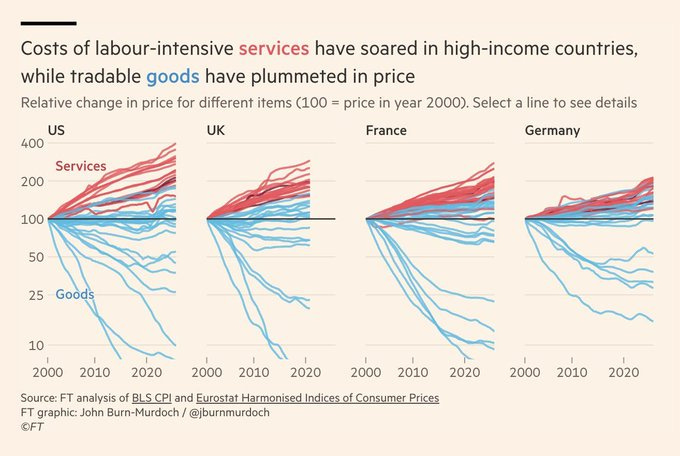
Just as the First World War did last century, the COVID pandemic, the invasion of Ukraine, the Iran war, and the other spectacles Donald Trump has accustomed us to are obscuring the economic reality and preventing us from seeing that, beneath the supply crises and the AI bubble, what we are living through is a profound deceleration.
(3) Today, just as then, the world has been forced into debt to compensate for the declining returns of industry. Only this time it hasn’t been farmers who have borne the weight of that debt — it has been states.
Public debt in wealthy countries has risen from approximately 70% of GDP in 2000 to 110% in 2026. The United States began this century owing 33% of its GDP — Clinton actually dreamed of paying off the entire debt — and has just crossed the 100% threshold. China owed 22%; today — if you count what its local governments conceal — it exceeds 125% and is heading toward 150%. The major industrial countries have spent a quarter of a century going into debt to subsidize an industry that can no longer produce sufficient returns.
(4) The stagnation of wages in the West, now in its third decade, has today the same consequences as in 1929: markets cannot grow without demand that grows with them. You can produce more and more, ever more cheaply, but you cannot sell to people who have no money to buy with. Industries are trapped within the perimeter of their existing customers, condemned to fight over a pie that is no longer growing.
(5) House prices have been stagnant or falling across most of the West for several years. Spain and Portugal are the two outliers on this, but in the US — as in other developed countries — it is an obvious and well-known phenomenon.
(6) Despite all these indicators pointing toward caution, American stock markets have been running wild for nearly four years, growing almost vertically on the sole promise that AI is going to transform the world.
(7) Meanwhile, citizens don’t seem nearly as convinced that this transformation is going to be in their favor. While the S&P 500 keeps hitting new highs, consumer confidence is at historic lows.
(8) And the shoeshine boys? For weeks, the major hedge funds have been exiting AI companies, and very serious people are warning that this latest stock market rally is nothing more than the transfer of risk from professional investors to amateurs. Meanwhile, Twitter today is a hive of wannabe investors, delighted to have caught this wave and always ready to tell you about it.
The only problem is that they don’t shine your shoes while they explain it.
From the British Century to the American Century
1929 marked the end of one cycle and the beginning of another. The commodity trade had characterized the economy of the first part of the industrial era, under British dominance. That supremacy gradually exhausted itself during the first thirty years of the twentieth century and finally collapsed with the crash. Then began — through war and great effort — what someone called “the American century”: the second great stage of that era.
Unlike the British century, the American century was the age of mass production, of Fordism, of work as social contribution and consumption as the engine of growth; of welfare states and homeownership. What was later called the “American dream” of prosperity.
That era, that century, is what is dying today.
The Marxists in the room will say that these are nothing more than the crises of overproduction that Marx predicted 150 years ago. The neoclassicists will argue that they are a healthy exercise in the creative destruction inherent in capitalism — a form of systemic detox.
Regardless of how each person interprets it, the fact is that after 1929, the world spent the next ten years on juice — the duration of the Great Depression. And not content with that cleanse, in 1939 it found itself in war. And the risk we face today is something similar.
And I would say that threat is there whether the bubble bursts violently or not. It is already happening, in truth. For a long time now we have known that the manufacture and consumption of industrial goods cannot be the engine of society — that it is no longer a sufficient aspiration to set everyone walking in the same direction. Industrial employment is an ever-smaller share of the total in Western countries, and even in China it seems to have stagnated. As a result of the diffusion of knowledge, new technologies are born already commoditized and can no longer produce the immense returns of twentieth-century industry. Beyond the numbers, new generations show an obvious rejection of serial work and mass consumption. Whichever way you look at it, the American century is dying. Trump and the current administration’s drift are the symptom.
Every moment we take to react is like those years when American farmworkers were showing obvious signs of distress, and the elites in Washington and Wall Street weren’t paying them the slightest attention.
A Survival Manual for a Recession
Economic historians generally say that the Great Depression happened because the response to the 1929 crash was wrong. To defend the gold standard, central banks raised interest rates and reduced the money supply precisely when the economy needed the opposite. Governments, obsessed with balanced budgets, cut spending and raised taxes in the middle of a freefall. They also let thousands of banks fail, considering it immoral to rescue them. The spirit of the moment was one of purification. “The rottenness must be purged from the system,” Treasury Secretary Andrew Mellon is said to have declared — even if that meant “liquidating stocks, farms, and workers.” To cap it off, every country raised tariffs against the others and between them all unleashed a trade war that sank world commerce. Each government tried to save itself alone, and they all ended up sinking together.
But I think there was something more important.
In 1930, the world had no alternative plan. Not just for growth — it had none for offering each person work that paid enough to sustain the economy, still less for giving every citizen a place in the world. Extracting and transporting raw materials no longer required as much labor or capital as before. The Great Depression happened above all because the British model was no longer adequate to organize society. And it took fifteen years and a war for something to emerge to replace it.
Then three ideas came together to found the American century: Fordism — which meant making cars, but also paying workers enough to be able to buy them; welfare states, which translated that logic into the social contract; and a new idea of society in which every person would have a role in the world.
Now, as then, I suspect that the way out of the impasse we find ourselves in will require the same ingredients.
The first we have used before and know works: working less. The recovery from the 1929 crisis involved a drastic reduction in working hours — from the sixty-hour weeks that were normal in 1930 to today’s forty. Out of the liberated hours came mass education, free time, and paid holidays — and from those, everything else. An entire generation was able to study. Then another went to university and produced the great transformation of our time. (If you don’t know what I’m referring to, you haven’t read my first book, Hijos del optimismo (Children of Optimism), and that needs to change.)
The reduction of working hours in the 1930s is perhaps the most important transformation of the twentieth century — one that gave rise to a different kind of society. And today we need something very similar. We could start with the four-day work week.
The second ingredient is letting out of the closet the society we actually are. I have argued many times that I believe we are in a genuine “knowledge society” — but one that has spent twenty-five years gagged in a back room, because we’re terrified of letting it fully out, of confronting the idea that effort is no longer the source of value: ingenuity is. That’s why we prefer to keep pretending we’re in an industrial era — one where the economy is measured in hours and sweat (or in productivity, which amounts to the same thing), where factories are still the center of the world. But what actually produces value today — software, science, data, ideas, brands, trends, ways of life — doesn’t behave according to those rules, no matter how hard our institutions refuse to acknowledge it.
The third is understanding what it means to build a welfare state for the knowledge era. The twentieth-century welfare state extended material wellbeing: healthcare, pensions, housing, the guarantee that nobody was left out of the industrial distribution. There will be no knowledge society without its equivalent: the extension of intellectual wellbeing. The possibility of understanding — of participating, of living as an active part of the twenty-first-century world rather than being dragged along by alien and incomprehensible currents. In 1950, the deal was that every worker could afford to buy what they made. The deal that is coming will have to be that every citizen can understand — and use and debate — what knowledge produces.
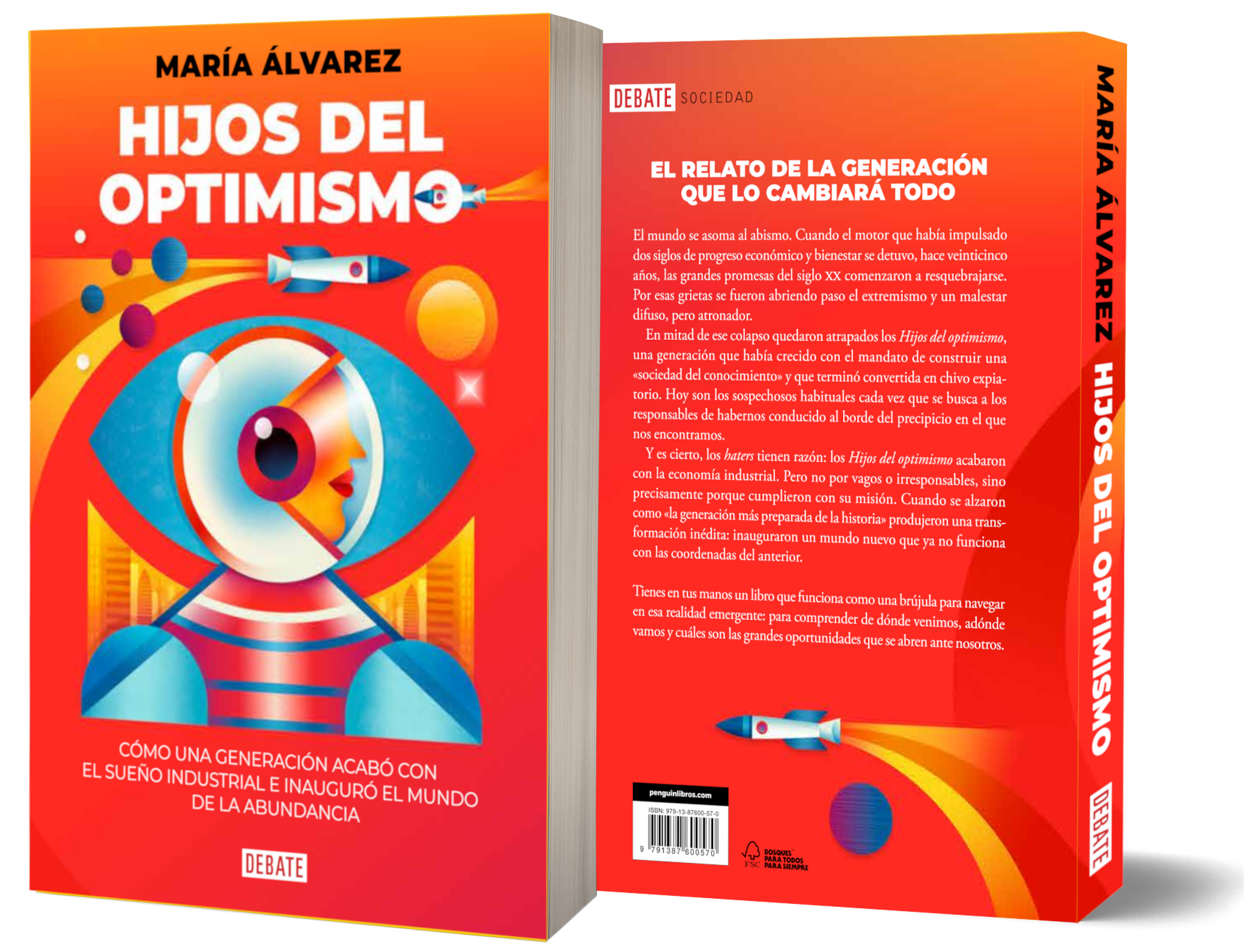
If this article interests you, you cannot afford to miss Hijos del optimismo (Children of Optimism). It is my first book and the best explanation I have been able to put together of the transformations happening in the world
.