


The original (Spanish) version of this article can be found here.
A couple of weeks ago, something unprecedented happened in the global economy. In the middle of a war that still threatens to drive up fuel prices — and, by extension, the price of everything else — and while economic data from the US, Germany, and China grows gloomier by the day, the American stock market hit all-time highs.
The story was told in the apparent contradiction between two indicators: at the very moment the S&P 500 surpassed its previous peak, consumer confidence — the signal that tells us whether people feel things are going well or badly — was hitting its lowest point in years, even below the levels recorded in 2008.
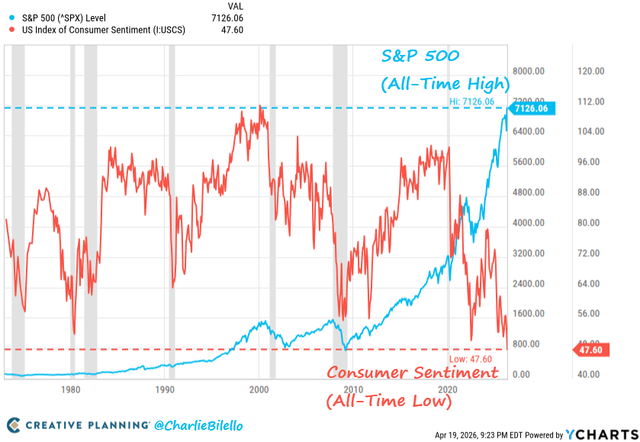
Until 2020, both indicators had moved in tandem. That makes sense. Companies do well when people spend, invest, and borrow — when they trust the future. So that survey has long been a fairly reliable compass for anticipating whether the economy is expanding or contracting.
But in recent years we are seeing a new pattern: the stock market keeps climbing — it has doubled in value in five years — even in these months when economists broadly agree that the global economy is slowing down.
The answer lies, in large part, in the AI bubble. The fear of missing out on the astronomical profits that tech companies promise to reap from this technology is driving markets into a kind of exuberance I no longer know whether to call irrational or simply stupid.
But I think there is something more — something far deeper. What we are witnessing is not just an isolated bubble, but a shift in mindset. Among those who move capital, a conviction has taken hold: that the economy as a whole is going to grow less — or stop growing altogether — and that value creation will concentrate in a handful of companies capable of capturing whatever diminishing growth remains.
This is the undercurrent running beneath all the apocalyptic AI narratives: that this technology will boost the productivity of a few companies, but at the cost of destroying many others.
The outcome of that equation is well known — it has been repeating itself for 25 years. When digital technologies spread, they automate tasks that previously required human workers. In doing so, they sweep away entire sectors of the economy, along with all the jobs associated with them. With no new sectors rising to replace them, the net result is that the economy shrinks. Every indicator we look at points toward the same conclusion: the current trajectory of AI will hurt the economy as a whole.
So everyone turns out to be right at the same time: consumers have reasons to believe things will get worse for them, and investors have reasons to believe markets will do very well.
We are witnessing the divorce between the stock market and real life.
The End of Capitalism

This 3,000-word newsletter unlike anything you'll read anywhere else lands in your inbox for free — because information wants to be free. But producing it takes work. You can help me prove that abundant goods can still be sustainable by choosing a premium subscription or picking up my first book,
A couple of days ago, Mark Zuckerberg announced that Meta will lay off 10% of its workforce — 8,000 people — in order to spend that money on data centers. It was the latest in a series of decisions made along the same lines at Oracle (30,000 people), Accenture (11,000), and Amazon (approximately 30,000), among others.
One might think that announcing layoffs in order to spend more on capital is a terrible idea that seriously damages your company’s reputation. But that was true in the era when having many employees made you a well-regarded company. And that is precisely what is changing at breakneck speed. For the first time, explicitly, major companies are saying that the future will be decided by the substitution of labor with technological capital — and that they, for one, have no intention of ending up on the losing side of the new cycle.
Workers for tokens. That is the real great replacement in today’s economy.
One might think this is a tragedy: what will all those workers do when they lose their jobs? How will they live? How will they feed their children?
The truth is, that is the least of our problems. In 2026, there are more than enough resources in the world to take care of the entire population, even if it doesn’t work.
The real problem is different: if this new turn of the digital screw — combined with the more than likely bursting of the AI bubble — forces us to finally confront the wretched elephant in the room of contemporary society, which is the end of work…
How do we decide who contributes, who is trustworthy, who deserves our attention, and who belongs to the commons? What will replace employment as the mechanism of recognition, hierarchy, and social legitimacy? How does a society organize itself when work ceases to be the measure of a person’s worth?
This is the question of our time.
And you — do you have an answer?
I’ll be reading your thoughts — very carefully — in the comments.
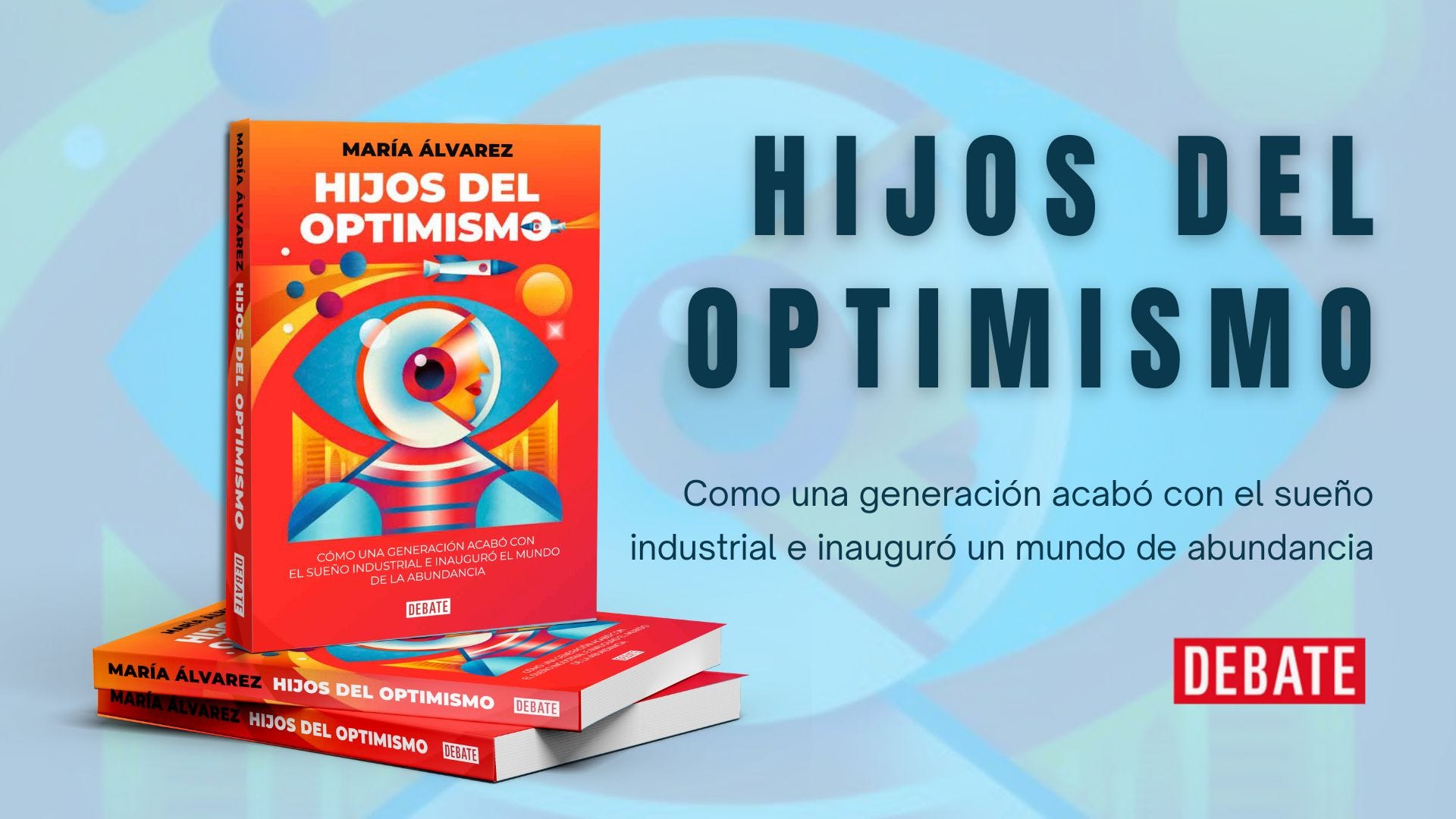
If this content interests you, you’ll love my first book, Hijos del Optimismo (Children of Optimism). It traces all the changes that have taken place across these decades of the knowledge society and points toward ideas for moving forward
.