


The original (Spanish) version of this article can be found here.
Lately, there has been a type of article that causes a furor: those that come to explain that what has happened was already happening before, that nothing has changed, and that we can understand what is happening by placing it in one of the categories we already had on the shelf. “It’s the old battle for control of oil,” “we’re returning to the Cold War,” “it’s imperialism.”
Human beings, who have neither claws to fight nor wings to fly, need to understand; that is our singular survival mechanism.
“There is no terror in the bang, only in the anticipation of it,” Hitchcock said. In other words, understanding takes away our fear. Once we know what is happening, our brain finds a way to adapt to it and, in some way, regains control. But, oh, the uncertainty! That is the stuff of human terror. That’s why movie directors never show you the monster in the first scene.
And since it also happens that we are at the top of the food chain and don’t have many enemies in the animal kingdom, “for modern humans, controlling the world means controlling other humans. And that means understanding them.”1
That’s why when something like what happened yesterday in Venezuela happens, we all go back a little to that place; to that first scene of every horror movie where something is going to happen that we don’t fully understand, and we can’t take our eyes off the screen until we know what’s going on. And every message that repeats that this phenomenon is something we already knew is like a balm that relaxes the contracture that the uncertainty produces in us. As they say, better the devil you know.
And this is how we often buy the illusion of understanding, but at a very high price: it is the price of not really finding out anything.
For example, the oil in this whole story makes no sense. As several energy experts have explained, neither the United States needs oil, nor is Venezuelan crude good, and besides, oil is on the way out, overwhelmed by the electrification of almost everything.
And it doesn’t seem that Trump is pursuing a regime change either. At this hour, it is already known that he has not left any troops on Venezuelan soil. He is not going to take control of the country, nor is there any invasion. It will be Maduro’s vice president, Delcy Rodríguez, who will continue to lead the government.
And if we are returning to the Cold War and bloc politics, one would say that the idea of putting yourself against all your allies to remove a gentleman from a government that doesn’t concern you at all doesn’t seem like the best of strategies.
So, except to fulfill that desire we have to explain the present by resorting to the past, it doesn’t seem that all these recurring themes of 20th-century international politics are useful to us today. Reality does not fit the old categories. In no way.
So this is going to be an article for those who are not looking for that form of complacency, for those who want new answers to old questions, even if they are not very reassuring.
These are ten lessons we can draw from what happened yesterday to understand the world of tomorrow.
//First Lesson
Donald Trump is only concerned about one thing.
And that thing is the attention of others.
Trump has no plan. He is not moving in a direction towards any predetermined destination. Throughout his life, he has shown no other aspiration than to have, every day of his life, the attention of as many people as possible.
This was the case while he built those huge golden towers in the center of Manhattan; while he was the protagonist of “The Apprentice” for 11 years; throughout his first term aand so far during his second term. All his projects, more typical of a pharaoh than a modern businessman, convey the same message:
I- W -A- N-T -A-T-T-E-N-T-I-O-N.
It’s not that he’s stupid: it works for him, it’s that the human experience is a limited set of moments of attention and if someone manages to capture them all, they win the game. Let’s imagine two competing companies. One sells the best watches in the world at a very good price. The other sells shitty watches at an outrageous price, but controls 100% of the advertising. Which company will sell more watches?
“Of course, but when people realize that the competitor’s watches are better, the word will spread.” But by then, so much time will have passed that Trump will have won (if he runs) the next election. Or so he thinks. In any case, that will be a problem for the Trump of the future. In politics, only the present moment counts. Or as Keynes said, “in the long run, we are all dead.”
Each and every one of Trump’s actions can be explained with the answer “To gain attention.”
—Why did he threaten to impose crazy tariffs on half the world?
To gain attention.
—Why did he withdraw them later, with great fanfare?
To gain attention.
—Why does he threaten all his allies one by one?
...
—Why does he order a paramilitary force of masked men to stop ordinary people on the street, just because they look Latino?
...
—Why does he threaten to invade Greenland?
...
—Why does he release a photo of Maduro handcuffed and bandaged?
...
//Second Lesson
It is all a lie
It is all a magic trick.
Yesterday, Trump made us believe he was taking control of Venezuela, but he did not leave a single soldier on the ground. He said he was going to “run” the country, but he has no way of doing so. He pretended to kidnap Maduro, but it is not so clear that there was not some kind of deal whereby Chavismo would remain in power in exchange for the dictator and his wife leaving the country alive. He pretended he was going to restore democracy, but he dismissed the opposition candidate and left the existing government in power. He says that American companies will invest in Caracas’ oil, but it is doubtful that this is a good business deal. And even Venezuela’s Supreme Court now claims that the president’s absence is ‘temporary’. As with tariffs, or when he promised to build a wall with Mexico, nothing is ever what it seems in Trump’s actions.
The president literally behaves like a conjurer: he waves his hands around a lot, pulls out a handkerchief, forces us to look in one direction and makes us believe that something has happened that has not really happened.
//Lesson three
In the war for attention, effort is worthless.
Donald Trump is not lazy.
One day he negotiates peace in Ukraine with Putin, and the next he kidnaps the president of another country. He imposes tariffs. He removes them. He reinstates them. He pardons a drug trafficker. He threatens to invade Greenland. Or Canada. He insults his allies. He embraces his enemies. He declares trade wars in the morning and deactivates them in the afternoon. He fires half the government on Twitter. He promises to build a resort in Gaza. And he talks about peace.
He does none of these things well. The vast majority of them turn out badly or worse. Nor does he do anything that a previous president could not have done. The difference between Trump and his predecessors is that he gets up in the morning and does them. Again and again and again. He is like a fly. He is neither very efficient nor very effective, but he never stops moving.
It is a very simple lesson, but one that we find very difficult to understand, because for centuries—even millennia—we have believed that effort was the key to success. So we had convinced ourselves that the important thing was to concentrate on a task, isolate ourselves from distractions, and work with our heads down until we achieved the most perfect product we were capable of producing. On the day of judgement, the judges (voters, employers, or whoever) would rationally choose the best product and place their trust in it.
So success belonged to those who worked hard. Those who did not drop out during their studies and achieved the best grades after five years, or companies that spent years designing the best product model, or parties that spent a long time rigorously crafting an unquestionable government programme. In politics, the idea that leaders had to speak as little as possible “so as not to burn themselves out” even prevailed.
Networks change that. Today, issues are exhausted in a day, and the day of judgement occurs every few minutes. The key to success is not effort, but stamina: the ability to stay in the race, every day, doing amazing things.
As my friend and guru Jorge García Castaño says, politics today is not about simmering a programme over many hours; it is about “bringing home the bacon every day”. It’s about having something to say every time the previous topic loses momentum, before your opponent has time to bring up theirs. It’s about occupying a little piece of humanity’s mental space every minute.
// Lesson Four
The law of conservation of energy.
One cannot continue in the race doing surprising things if one tries to sprint and give it one’s all constantly. Contemporary politics is a marathon where the important thing is to conserve energy.
That is why all of Trump’s actions remain strictly necessary to produce the desired effects on people’s attention.
The best example is the case of the fictitious agreement with NVIDIA. A few months ago, Trump announced an agreement whereby NVIDIA, the world’s largest company, would give 15% of its sales in China to the US government. Over the weeks, doubts began to arise. Was it a percentage of profits or revenue? Would it be the same for all companies? Was the US going to become a commission agent for its own companies around the world?
It never happened. Trump and the CEO of NVIDIA had not, in fact, signed anything. All they needed was to announce a lie to get thousands of headlines around the world, starting with the front page of the New York Times.
For that very reason, he has not invaded Venezuela on this occasion, nor will he do so. Invading a country costs a fortune, results in hundreds or thousands of casualties among your own soldiers, and is a huge logistical exercise that will not bring him any more headlines than the hit-and-runs we are used to seeing from him.
// Lesson Five
Curiosity.
Trump lives permanently in that first scene of the film where we have not yet seen the monster.
That is why his press conferences are chaotic, he contradicts himself, he is hard to understand, he beats around the bush and never finishes his sentences. That is why yesterday at the press conference he seemed to confuse Delcy Rodríguez with Maria Corina Machado. Because he wants us to keep watching, mesmerised, trying to understand. Chaos is his tool for keeping the attention on him.
It is not a bug, it is a feature. He is confusing and impenetrable by design. Like lingerie, he wants to reveal, but just enough, to be mysterious, to always leave things unknown, because if attention is the stuff human existence is made of, curiosity is the force that drives us in life.
// Lesson Six
The power of outrage (on the left).
Trump knows that the left controls the entire public debate because very few people on the right want to be journalists, writers or authors. Even the right-wing media (also in Spain) is full of progressive people.
So he uses the left to leverage his messages. That is why he constantly seeks to provoke outrage and terror among Democrats and European progressives in many ways. The first is by touching on all the issues that are sacred to them (women, migrants, human rights). If he does not achieve this with messages, he uses political spectacles with a tiny impact on the macro level but enormous communicative significance, such as paramilitary militias organising raids on racialised people.
In the best tradition of internet trolls, it uses outrage as a weapon of mass communication. His target is not his voters, but to flood the public space, get 100% of the publicity by outraging leftists and get free publicity from their media. This is why even Trump himself exploits the left’s image of the big bad wolf: he himself says that yesterday’s events are an invasion and that it is all about oil.
// Lesson Seven
There is no strategy.
Trump, like Pedro Sánchez, is a basketball player, not a chess player. He does not have a long-term plan where one event follows another. It is not that he is dumber than the great strategists of the 20th century, it’s that he is playing a different game. Rather, he has a few moves he knows how to make and a vision of the board. When he thinks he has bad cards, he breaks the deck, does something unexpected and forces them to be dealt again.

For his opponents, this pace is as exhausting as if a chess player had to keep up with a basketball player.
// Lesson eight
But there are objectives.
The absence of strategy does not mean there are no objectives. It is just that Trump understands that his objectives are not achieved through a succession of controlled and linked events, but rather by remaining faithful to an image and a brand that can be imprinted in people’s minds.
To a certain extent, Trump has the same modus operandi as Loewe: he repeats his brand over and over again, season after season, to continue reinforcing the imprint it has on people’s imaginations through a succession of ‘brand impacts’, such as Loewe’s advertisements or catwalks, or the collections they bring out.
Another way of understanding this is in line with Amador Fernández-Savater’s explanation (and this is one of my Roman empires, please be sure to read the article) of the Chinese idea of efficiency:
“According to Julien, the Chinese think about strategy in a completely different way. They do not divide the world into what is and what should be. In other words, they do not start from a model or plan, but from the course of reality itself. Reality is not formless or chaotic matter waiting to be organised by us: it is already organised. It has tendencies, inclinations and slopes that can be detected and exploited. This is what Jullien calls “facilitating factors” or “situational potentials”. The job of a good strategist is not to model and plan first, then implement, but rather to listen, evaluate, accompany and develop situational potentials. Not to act, but to be acted upon. Not forcing: supporting. Not directly pursuing a goal, but exploiting a propensity. Because the effects are contained within it. It’s like surfing a wave: it’s not about taming it, but about going together to the same place. Letting yourself go. The world is only resistance and obstacle from the perspective of control.
// Lesson Nine
The headlong rush forward.
Despite everything, Trump’s approach has a huge problem. Hate and fear, unlike love or desire, produce diminishing returns, because no one wants to revisit something that has frightened them and that they have already overcome. So Loewe can do more or less the same thing every year to continue dazzling its buyers, but Trump needs to do something even more outrageous each time to get the same amount of attention. He is like an addict who needs a higher dose with each high.
The umpteenth time he threatened tariffs on a country, no one paid any attention to him, and he had to move to the international stage in search of more relevant nonsense, such as pretending to give Gaza to the Saudis or invading Venezuela. That is why it is very likely that he will never talk about tariffs again. On the contrary, I would not rule out him ending up threatening Greenland even more, because I have no doubt that the final phase of this headlong rush can only be a head-on confrontation with the European Union.
// Lesson Ten
People are like frogs.
No man hits you on the first date.
All predators, abusers, paedophiles and manipulators share a modus operandi. They play with the truth to test your limits. What if one day they laugh at you? What if the next day they give you an order? What if one day they force you to do something small, but something you don’t want to do? What if they then try something bigger?
With each step, they push the limits of what you want to happen, until they shape your reality to suit them. Before you know it, you are living with an abuser and cannot leave the relationship because even you justify it. Like frogs, which allow themselves to be boiled alive as long as the temperature does not rise suddenly, people are very vulnerable to subtle but constant changes in the wrong direction. We do not know how and where to stop them.
With every gesture in which Trump seems to do something, but does not quite do it — like this kidnapping of Maduro — he is testing and pushing the limits of what the international consensus considers acceptable in order to give himself more room to manoeuvre. Pushing the boundaries of what he can do until one day, not too far in the future, we can’t help but wonder how we got here.
Yesterday, it was appalling to read the weak, shamefully submissive responses of many European leaders, who remained silent in the face of a scandalous violation of international law. Along with Maduro, what Donald Trump is hijacking is our ability to oppose evil.
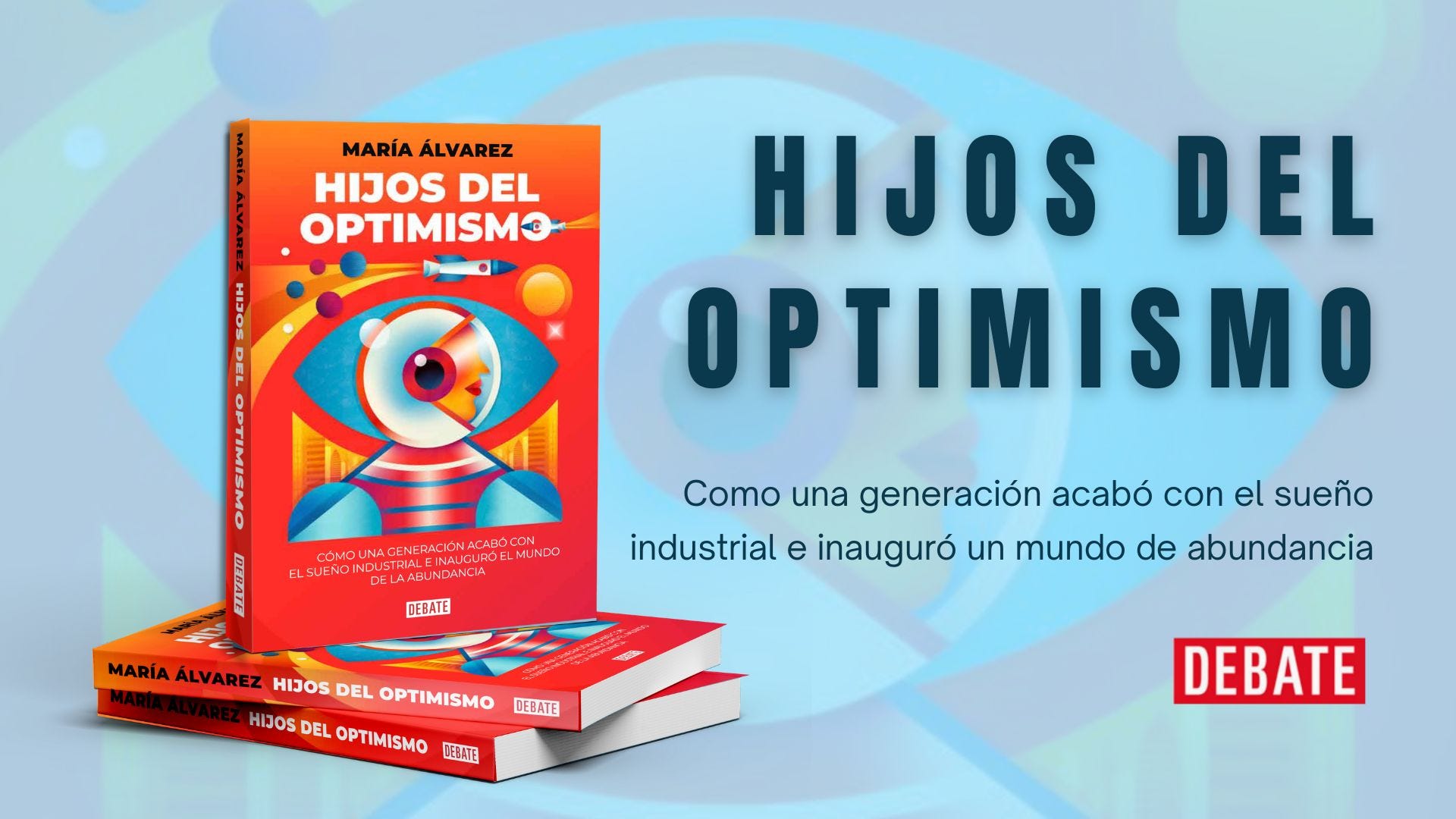
If you are looking for new answers to understand what is happening, you will like my first book: Hijos del Optimismo (Children of Optimism). It is an invitation to understand and trust in the future (and in ourselves) again.
You can already order Hijos del Optimismo on Amazon, La Casa del Libro, El Corte Inglés and the publisher’s website, Debate.
You can also read more about me and the story that inspired me to write it.
The quote is from one of my favourite books, ‘La ciencia de contar historias’ by Will Storr.
The photo is from Unsplash.