The original (Spanish) version of this article can be found here.
I don’t like talking about “fascism” at all. It’s a word that has been used so many times to delegitimise and dehumanise other people that it should be banned from the dictionary unless accompanied by a disclaimer (like this one).
But the fact is that there is an American political scientist’s approach to the study of this phenomenon that reveals exactly where Donald Trump is heading today and what we can expect in the coming months from this man who is putting the world in check.

In ‘Anatomía del Facismo’, Robert Paxton rightly argues that fascism is not an ideology. It is not, like communism or socialism, a relatively coherent doctrine that someone can adhere to. It is a phenomenon, a historical occurrence that seems to arise when certain circumstances are present and that always develops in the same stages and in the same way.
This approach has two virtues. The first is that it decriminalises thought. A person or a party cannot be fascist because of their ideas. There is no “fascist” way of thinking; rather, fascism is a series of linked events or acts.
The second virtue is that it allows us to understand where Trumpism is headed – its roots, its evolution and its possible futures – without getting bogged down in ideological trenches.
If we strip away the layer of ideology and look at the facts, I believe it is undeniable that what is happening in the United States shares, if not all, then most of the characteristics of fascism proposed by Paxton in this definition:
“Fascism is a form of political behaviour marked by an obsessive concern with the decline of the community, humiliation or a sense of victimhood, and compensatory cults of unity, energy and purity. In it, a mass party composed of committed nationalist militants, acting in tense but effective collaboration with traditional elites, abandons democratic freedoms and pursues, through violence presented as redemptive and without ethical or legal restrictions, goals of internal purification and external expansion.”
The idea that the country is in ‘decline’ (‘the American decline’) is an omnipresent element in American symbolic culture. Some of the most vocal religious congregations in the country are descended from Protestants (Puritans and Pilgrims) who emigrated from Europe in the 17th and 18th centuries fleeing religious persecution in the Church of England. These groups always found that the rest of the population did not live up to their expectations of purity, and therefore ‘moral decline’ has been a trope of American Christian culture since its founding.
When Barack Obama’s victory—which coincided with the subprime crisis—caught part of the Republican public opinion in a moment of total confusion, this framework became hegemonic and became the main—and almost only—issue for the right [1, 2, 3, 4, 5, 6].
Obama had enjoyed a meteoric rise to power. At the end of 2004, just two years before announcing his candidacy for the Democratic Party primaries, he was still an unknown state representative in Illinois. For much of the primary campaign, it seemed almost impossible that he would stand a chance against Hillary Clinton, who was a sacred cow in the party. A few months later, that unknown figure became President of the United States.
Part of the Republican electorate could not understand how a proudly black, Hawaiian, Ivy League candidate could be ahead of their own in the polls. So much so that during the campaign, Obama’s opponent, John McCain (who, incidentally, was a giant), had to interrupt his rallies on several occasions to stop the racist insults that the audience was hurling at the Democrat, or to contradict his own voters and explain to them amid boos that no, Obama was not a Muslim, he was not a terrorist, and he was not a bad man. And they had no reason to be ‘scared’.
In the years that followed, the Tea Party and some agitators, such as Steve Bannon, took advantage of this discontent to shake up the political landscape in a very short time. They did so by reviving the latent notion of the country’s decline and transferring it to the economy and the mainstream.
Trump’s big message, ‘Make America Great Again,’ is a response to that perception of national decline and a promise of a return to purity. Riding on the back of the racial dispute that began with Obama, the Republican encouraged a victim mentality in part of the electorate by repeating ad nauseam that white people are discriminated against and have been ‘treated very badly’ by progressivism.
In the absence of a mass party, Trump was able to organise during his first term the nationalist militants of far-right and white supremacist groups, who stormed the Capitol on 6 January 2021 to prevent Joe Biden’s inauguration. With his other hand, Trump began to forge another alliance with the economic and Republican establishment, which seems to prefer him over other more moderate but less effective candidates.
As if he wanted to fit Paxton’s definition like a glove, in his second term Trump has been eroding democratic freedoms both inside and outside the country, as we have seen in the creation of a violent paramilitary force within ICE. Even his own definition of power has taken on a tone indistinguishable from classic fascism. In a recent interview with The New York Times a few days ago, he asserted that the only limit to his global authority is ‘his own morality’ and that he does not need to comply with international law as an effective restraint on his actions.
This rhetoric, together with his constant references to territorial expansion and annexations—from Canada to Venezuela and Greenland—close the circle that allows us to affirm that Trumpism behaves exactly like other fascist movements.
From here, Paxton identifies five stages of fascism as a phenomenon, of which we have already experienced four: intellectual exploration, rooting, rise to power, and exercise of power. The last, which is just beginning, has two sides: radicalisation or entropy.
Intellectual Exploration, in which disillusionment with mass democracy manifests in debates over the loss of national vigor.
As we have seen, from 2008 onward, conservative media cultivated a narrative of national “decline” that, in the wake of the economic crisis and the sweeping transformations of the twenty-first century, became hegemonic on the right. Confronted with this perceived decline, a segment of public opinion absorbed into its worldview the very themes that would later underpin Trump’s anti-democratic behavior.
Roots, when a fascist movement, aided by political gridlock and polarization, becomes a consequential actor on the national stage.
In my view, this moment was Trump’s first term (2016–2020). The two-party system (first-past-the-post) makes it exceedingly difficult for a third party to reach power — or even the mainstream — in the United States. Yet Trump’s first term effectively installed a Trumpist party within the Republican Party, one that took root and became normalized in popular culture over those four years. During that period, Trump steadily empowered certain far-right groups — the Proud Boys among them — which coalesced into a kind of organization (armed, in many cases; digital, in others) that supports his actions entirely outside the boundaries of party consensus.
Seizure of Power, when conservative sectors, in their attempt to contain the rise of left-wing opposition, invite the fascists to share power.
Trump was not the party’s automatic candidate for his second term. A new primary process unfolded in which the various factions negotiated their accommodation to an already unmistakably Trumpist reality. The ascent to power of a fascist Trump thus lies in precisely that pact — one in which a Trump now commanding an entirely new political force struck a deal with the different factions of the Republican Party to secure their support.
Exercise of Power, in which the movement and its charismatic leader control the state in equilibrium with state institutions such as the police and with traditional elites such as the clergy and major business figures.
This phase coincides with the second term — with the present moment. It is characterized by Trumpism’s alliances with various sectors, most visibly with the Silicon Valley establishment (Elon Musk, Peter Thiel, Mark Zuckerberg, JD Vance, and others), which not only provided campaign funding but placed the Vice President and Musk, for a time, inside the government itself.
One might say that until a few weeks ago we found ourselves in this fourth phase — a period of relative equilibrium in power. Yet something has shifted in recent months, pushing Trumpism toward the final and definitive stage of fascism, which can unfold in one of two ways:
Radicalization or Entropy, in which the state either grows increasingly radical — as occurred in Nazi Germany — or drifts toward traditional authoritarianism, as happened in Fascist Italy.
Fascist parties either settle and “relax” into power (as Franco’s Spain illustrates) or tend toward relentless radicalization. The difference, Paxton argues, lies in the nature of the cult they have constructed — whether it has conditioned the public to expect constant displays of violence or action — and, crucially, in the fragility of the regime itself.
It is evident that Trump is today moving toward greater radicalization. What unfolded in Venezuela, and his reaction to the cold-blooded murder of a white mother at the hands of ICE agents in Minneapolis, are telling examples. Yet nowhere is this tendency more clearly visible than in the escalating dispute Trump has been waging against Federal Reserve Chairman Jerome Powell.
Central bank independence was, until very recently, the sacred cornerstone of neoliberalism and of the political right. Monetary policy, the argument went, must not be left in the hands of executive power, since the temptation to manipulate interest rates for political gain is simply too great.
Trump, by contrast, believes the Federal Reserve should be placed at the service of his political agenda, and has been pressuring the Chairman from the very outset of his term to cut interest rates — a move that would stimulate economic activity — even as the bank’s own technical staff advise the opposite.
Until now, the tensions had, as far as we know, remained verbal. But last Friday, Powell received a judicial summons to testify in an alleged corruption case concerning renovations carried out at the Fed’s headquarters. In an extraordinary statement, the most powerful figure in global finance accused Trump of pursuing judicial harassment as a means of wresting control of the Federal Reserve from him.
Why does Trump behave this way? In all likelihood, because he is afraid. Only days ago, at a public event, he repeated once more that if the Democrats win the midterm elections this year and retake control of both the Senate and the House, they will ultimately have him imprisoned.
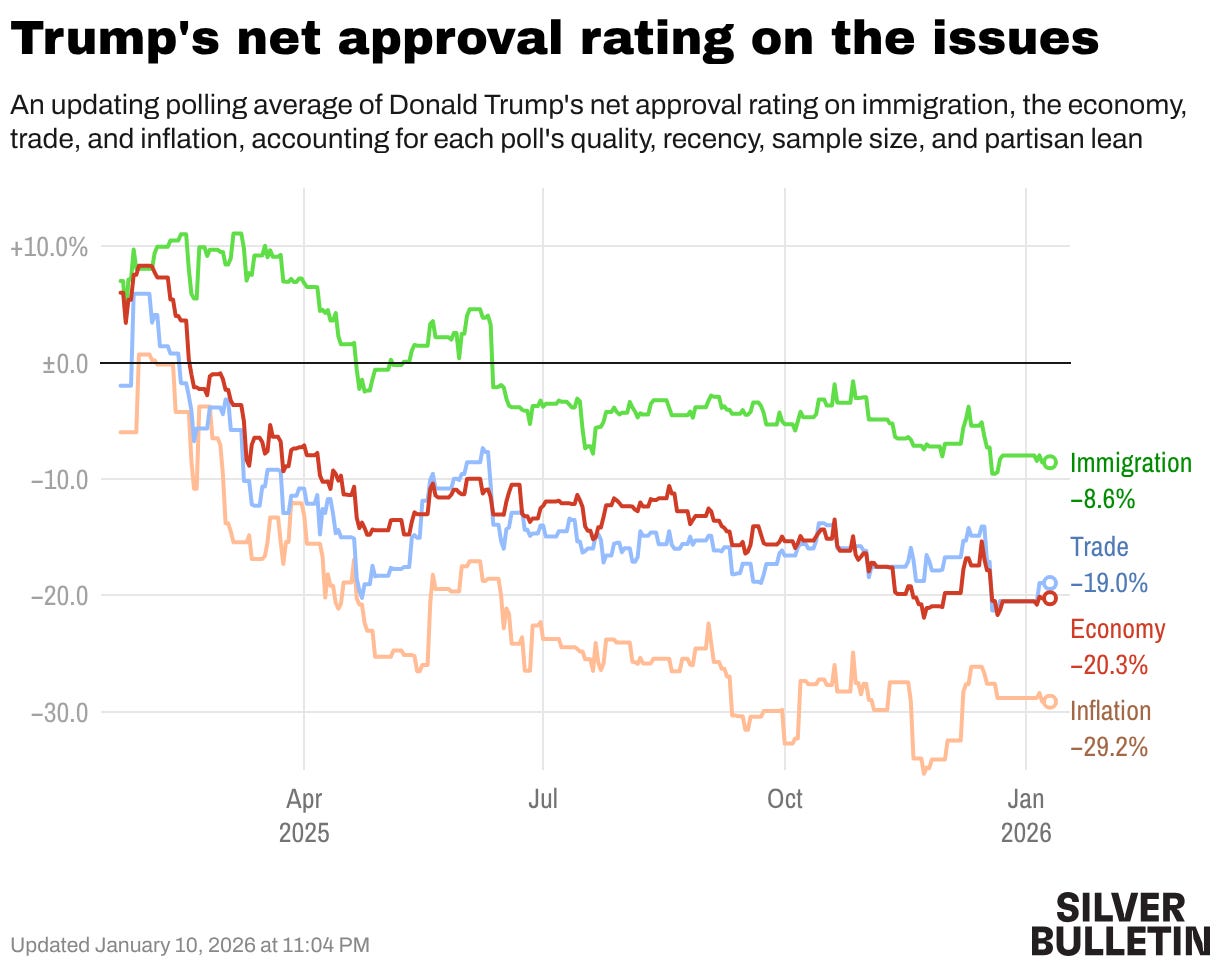
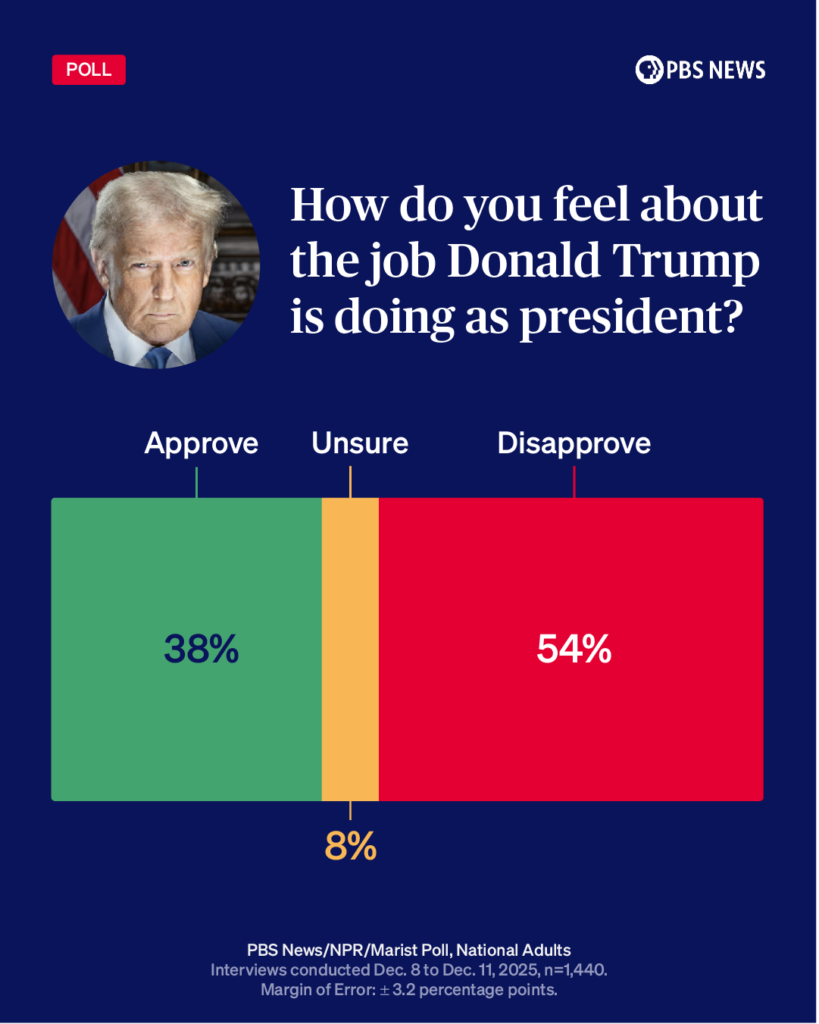
And the odds are stacked against him. His poll numbers are in free fall across all voter groups — including Republicans. His handling of every major issue — immigration, the economy, trade, and inflation — is viewed negatively. And his image is eroding among a voter bloc that was crucial to his 2024 victory: the working class.
Meanwhile, macroeconomic indicators have continued to deteriorate. Employment is losing momentum, and artificial intelligence threatens to detonate what may prove to be la madre de todas las burbujas (the mother of all the bubbles).
More significant still, Trump has exhausted whatever goodwill voters extended to him on his signature issue — his great obsession, the promise he has been making to the American people for forty years: that tariffs would solve all their problems.
Trump is a man consumed by the conviction that the United States has been swindled by the rest of the world. So consumed, in fact, that in 1987 he paid for a full-page advertisement in The New York Times — addressed directly to the American people — in which he called for tariffs and demanded that other countries be made to pay (simply for existing). Tariffs, Trump argued, would close the deficit, bring industry back to the United States, bring prices down, and — above all — remind the world who is in charge.
Now, as the first anniversary of his initial tariffs approaches, food prices have not fallen, manufacturing has not returned, and the United States is once again shedding industrial jobs. That promise lies in ruins. And there is nowhere left to hide.
Donald Trump has run out of road. He has lost his narrative, forfeited the confidence of voters, and the structural pillars of the American state — Powell among them — are beginning to push back.
At bottom, figures like Trump — who resemble compulsive gamblers more than anything else — know that their time is running out. That sooner or later, reality will catch up with them. And so, like every fascist leader before them, when they fear losing power, they accelerate into a forward flight, moving ever faster in the hope that it never does.
Yesterday I came across a piece by Matt Robison recounting that, in the wake of the abduction of Nicolás Maduro, Trump convened a meeting in the Oval Office with the CEOs of America’s largest oil companies. There, he asked of them something to which he had already publicly committed on his own initiative: that they invest one hundred million dollars in Venezuela to extract more oil.
In a televised meeting that is, from beginning to end, a spectacle of incoherence, Trump — mid-sentence — rises from the table, stops speaking, and begins boasting about the ballroom he is having built at the White House (video here), while his own team looks on in visible disbelief. In the end, the CEO of ExxonMobil, following Powell’s lead, draws a line and tells the President plainly: no — Venezuela, he says, “is not investable.”
Robison argues that the very existence of that meeting — in which the President implicitly acknowledges that the operation had nothing to do with drug trafficking, as he had claimed from the outset, nor in reality with oil, since none of those executives had the faintest idea what they were being asked to do — is, on its own, sufficient grounds for impeachment.
But what struck me, above all, was how powerfully the scene called to mind another: the one from the film Downfall, in which Hitler, in his final days in the bunker, refuses to accept that reality has already overtaken him. There is no problem, he insists — “Steiner’s assault will bring everything under control.”
His generals, regarding him with a mixture of disbelief and shame, reply:
—“Steiner could not mobilize enough men, mein Führer” .“He was unable to carry out the assault.”
There will be a great deal of shouting in the months ahead. But I have no doubt whatsoever that what we are witnessing is the downfall of Donald Trump.
If you are looking for new answers to understand what is happening, you will like my first book: Hijos del optimismo. It is an invitation to understand and trust the future (and ourselves) again.
You can already order Hijos del Optimismo on Amazon, La Casa del Libro, El Corte Inglés and the publisher’s website, Debate.
You can also read more about me and the story that inspired me to write it.