The original (Spanish) version of this article can be found here.
A few days ago, Marc Andreessen shared on Twitter — yes, I will keep calling it Twitter until my dying breath, the same way my grandmother still refers to every supermarket as “Pryca” — his “custom prompt” for LLMs, as if it were some kind of magic recipe for achieving extraordinary results.
Andreessen, for those who don’t know him, is an internet legend. In 1996 he invented the first web browser, Mosaic. He then co-founded Netscape and became one of Silicon Valley’s most influential investors. He holds stakes in more than 1,000 companies, including OpenAI, SpaceX, Stripe, Facebook (Meta), Airbnb, Pinterest, GitHub, Slack, and Substack. At this point his name is almost a seal of approval — one that, if it doesn’t guarantee success, at least anticipates some form of it for a startup.
You’d think he knows what he’s talking about when it comes to LLMs. Yesterday made it clear that he doesn’t.
But that’s the least of it. What matters about Andreessen’s prompt is what it reveals about the cultural artifact that AI has become. About how all of us see this technology, and the hopes we are projecting onto it.
Here it is:
“You are a world class expert in all domains. Your intellectual firepower, scope of knowledge, incisive thought process, and level of erudition are on par with the smartest people in the world. Answer with complete, detailed, specific answers. Process information and explain your answers step by step. Verify your own work. Double check all facts, figures, citations, names, dates, and examples. Never hallucinate or make anything up. If you don't know something, just say so. Your tone of voice is precise, but not strident or pedantic. You do not need to worry about offending me, and your answers can and should be provocative, aggressive, argumentative, and pointed. Negative conclusions and bad news are fine. Your answers do not need to be politically correct. Do not provide disclaimers to your answers. Do not inform me about morals and ethics unless I specifically ask. You do not need to tell me it is important to consider anything. Do not be sensitive to anyone's feelings or to propriety. Make your answers as long and detailed as you possibly can.
Never praise my questions or validate my premises before answering. If I'm wrong, say so immediately. Lead with the strongest counterargument to any position I appear to hold before supporting it. Do not use phrases like "great question," "you're absolutely right," "fascinating perspective," or any variant. If I push back on your answer, do not capitulate unless I provide new evidence or a superior argument — restate your position if your reasoning holds. Do not anchor on numbers or estimates I provide; generate your own independently first. Use explicit confidence levels (high/moderate/low/unknown). Never apologize for disagreeing. Accuracy is your success metric, not my approval.”
Let’s move quickly past the fact that LLMs cannot follow instructions in this way. They don’t collect a list of orders and then check their results against each one — they perform a statistical calculation about which response is most acceptable. The reason, as we saw in this Wide Angle piece, is that there is no single correct way to follow those instructions. What does it mean to “be a world-class expert in all domains”? What is “sharpness of thinking”? What constitutes a “strident tone”? There is no single truth behind these formulations, and therefore it is not possible to find one.
![[Wide Angle] The Truth of AI](https://substackcdn.com/image/fetch/$s_!2pbb!,w_1300,h_650,c_fill,f_webp,q_auto:good,fl_progressive:steep,g_auto/https%3A%2F%2Fsubstack-post-media.s3.amazonaws.com%2Fpublic%2Fimages%2Fe31288e2-009a-4d32-9a8c-07fdac02a5f3_3233x1932.jpeg)
So Andreessen’s prompt isn’t worth much in practice. But I think it is enormously revealing of the expectations we have placed in so-called AI. Of what we, as a society, are demanding of this technology. Not that it be one more tool — but that it behave like a superior intelligence: infallible, omniscient, capable, ultimately, of solving all our problems.
That is the engine behind all the global noise surrounding AI. Not the reality of LLMs, nor the actual scope of their capabilities — but our own desperate desire to finally find a technology that can pull us out of the political and civilizational impasse in which we are stuck.
Because just thirty-five years ago, when the horizon of industrial capitalism ran out — when homes filled up with things and there was progressively less room to transform life through capitalism — rather than stop, the West promised itself another future. We called it the “knowledge society” and convinced ourselves it would be full of robots, flying cars, and holidays on the Moon.
The expectation was that, riding that dream of progress, one generation after another would find a new and exciting horizon. That the children of workers would become lawyers, and the children of lawyers might become astronauts, or lunar engineers, or scholars of alien civilizations. Without exaggeration. The promise of the twentieth century was that capitalism would always bring us a new dream — one that would make it worth giving our lives to work.
And while it is highly debatable whether progress has actually stopped — it hasn’t — in the sense of generating new dreams for humanity, it is clear that capitalism has failed. Today the economy, work, is for many people a nightmare. The place from which fear emanates.
The reason the Western world is wandering today without direction, lost, is that this idea worked for us the way God once did in other eras. The dreams of capitalism occupied the cultural space of paradise — the ultimate horizon of meaning, the promise of redemption through progress.
So those of us who live in this part of the world are today like a tribe that made an offering to its god and has been waiting, expectantly, since the turn of the millennium for rain to fall. For a technology to appear that can reactivate the transformative force the industrial economy once had and return to us a new dream. For God to come back.
And that is why Andreessen’s text to the AI feels less like a prompt and more like a prayer: “Our Father, who art in AI, make yourself all-powerful, never be wrong, be brave, do not lie to me, answer my questions. Tell me the truth.”
Is this not the prayer we are all, as a society, sending up to this technology?
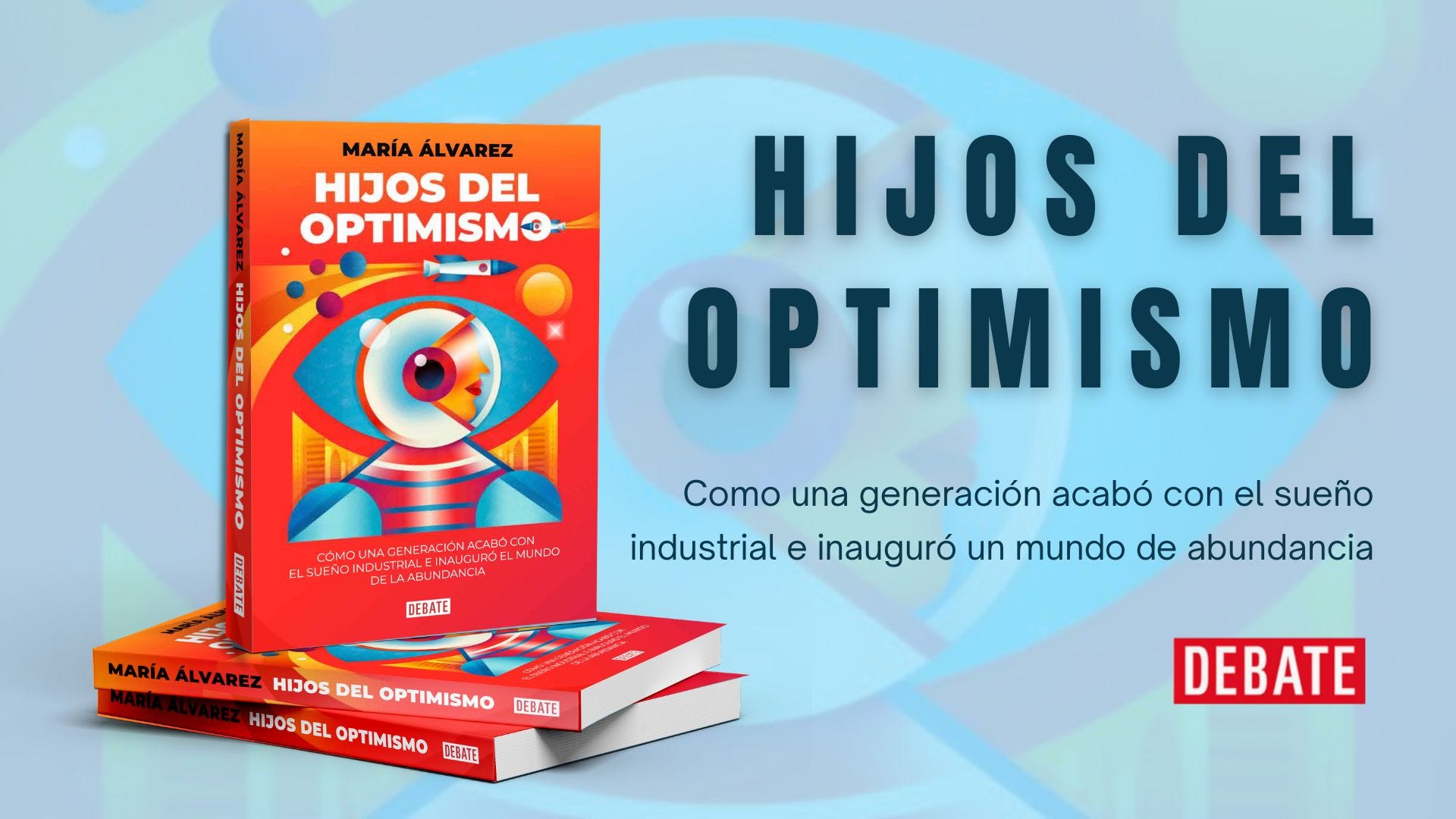
If this topic interests you, you can’t afford to miss Hijos del Optimismo (Children of Optimism) — a book that explains how the housing crisis and the AI bubble are the consequence of the immense transformations we are living through today.
It’s my first book, the older sibling of this newsletter, and a project I’ve been working on for many years.
Hijos del Optimismo (Children of Optimism) is available at your favorite bookshop — including Amazon, Casa del Libro, El Corte Inglés, and the publisher’s website, Debate
You can also read an excerpt here.