


The original (Spanish) version of this article can be found here.
First, an announcement!
This Thursday, May 28th, I’ll be in Valencia presenting Children of Optimism. It’s going to be a wonderful evening, because we’ll be joined by Enric Nomdedeu — who, besides being hilarious and a great friend, is a brilliant thinker who developed much of the thinking around the four-day work week in Spain.
As if that weren’t enough, the event is hosted at the eldiario.es space in Valencia, and we’ll be joined by Sergi Pitarch, its editor.
So you can’t miss it. I’ll leave the invitation link to share on Substack, Twitter, Instagram, and Bluesky.
This week I’ve been a little rattled. In Spain, a former president has been charged with corruption, accused of leading a network that collected commissions in exchange for political favors. Contrary to what one might expect from an accusation of this magnitude, the judicial order is far from conclusive: it makes claims it doesn’t fully substantiate and leaves many loose ends.
Faced with the uncertainty, Spaniards appear to have split in two — between those who take the order at face value and believe this man is the capo of a criminal network, and those who believe the opposition conspired with the judge, the police, and the prosecution to stage a frame-up and bring down the current government, whose party the accused belongs to. There are even those who think this is a coup orchestrated by the United States.
And I — despite the fact that, as you know, I’m an optimist to my core — read all of this and start to tremble. Because what I see is not a divided society. Not really. Quite the opposite. Both sides in this debate are making the same argument. Everyone — the media, the influencers, the politicians of every stripe — takes it as given that we live in a system that is rotten to its foundations, where the most senior institutions of the state pursue hidden agendas and systematically break the law to advance them. Whether you think the corrupt party is the former Prime Minister or the judges and the police is beside the point.
And people aren’t stupid. Nobody misses the fact that for any of this to be possible, one person wouldn’t be enough — it would require a network, a complete structure filled with civil servants, politicians, and journalists to sustain it. If any of these theories were true, it would mean that democracy doesn’t work in one of the most important states in the Eurozone. Or, put another way: that democracy doesn’t work. Full stop.
So I have a second hypothesis — different from the one that says all the elites in my country are corrupt. A different hypothesis, but one that is, unfortunately, no less frightening. I don’t think there is a case against the former Prime Minister. But neither is there a conspiracy. What has happened is that it has become believable — reasonable, even — to think that a former Prime Minister of a Eurozone country is the boss of a criminal organization. That idea now lives, rent-free, in the common sense. So thoroughly that a judge, a group of prosecutors, a police force, a crowd of journalists, and a large portion of society have all believed it without needing proof. What is happening is that the populist virus — that meme which preaches that all politicians are corrupt and all elites are parasites — has spread so far that it has seeped into the bones of our democracies and made any of the circulating explanations plausible.
So the real story, then — the one we are all part of, judges, prosecutors, journalists, politicians, influencers, and ordinary people alike — has become a self-fulfilling prophecy: most Spaniards today believe that democracy doesn’t work, and for that very reason, because we have come to believe it, it is starting not to work.
How did we get here? And how do we get out?
We have told ourselves many times that populism is the consequence of a widespread malaise produced by deteriorating economic conditions — as if the world economy were sick and the symptom were the rise of this ideology. As Bill Clinton once memorably put it: “It’s the economy, stupid!”
But I believe — and I want to demonstrate today — that it is the other way around: the global malaise gripping us is the symptom. Even the deterioration of living conditions can be explained as a consequence of this drift. The virus is a form of political entrepreneurship that was born in the protest movements that followed the 2008 crisis, but which has since spread into mainstream politics until it has infected every party and no small number of media outlets. That is what is poisoning the waters of civic life and turning them into a swamp.
Populism is the great enemy we face.
Today I want to convince you that there are ways to defeat it — and that they are within our reach.
Contractors
What must citizens do to belong to a country, and what does whoever is in power offer them in return? Modern societies are organized around an agreement that political scientists call the “social contract” — and it answers those two questions.
Before democracy, the social contract was something like: “If you obey the emperor, we won’t come to your house and hack you to death with machetes.” Since the lord also tended to consider himself a relative of God, the same idea could become slightly more sophisticated: “If you believe in the emperor, and therefore obey him, we won’t come to your house and hack you to death with machetes.”
As societies grew more complex and their structures more costly, the social contract evolved too. To obedience was added the obligation to contribute to the upkeep of the state and its armies — and so appeared the serfs of the Middle Ages, for instance, and the vassals. But well into the fifteenth century, with minor variations, the promise that ordered the world was roughly the same: obedience in exchange for staying alive.
But at the end of the Middle Ages, money and commerce made it possible for power to escape the feudal domains. Then came the first cities and the first governments that didn’t spring from military force and weren’t static — they fluctuated. That new world, so unlike the one before it, needed its own pact. What should not a subject, but a citizen do to contribute to society? And what could they expect in return? Since then, the history of Western civilization has been the search for an answer to that question.
Adam Smith’s success when he wrote The Wealth of Nations came from his ability to imagine one — because he invented the social contract of our time. To be worthy of consideration, he argued, people had two options: the rich must save and invest, rather than squander their fortunes on vanities and superfluous expenditure; the poor, who had no savings to contribute, must work to earn not just their wages, but the recognition of others.
And what would they receive in return? The magic of the “organization of labor” — the god of Smith’s Bible — would reward them with ever-growing, limitless wealth. Each year would be better than the last, and the productive system would give so much of itself that any man, however humble, would be guaranteed his place in the world. This was the social contract of infinite progress at the dawn of capitalism.
For a couple of centuries, that promise was kept — halfway. The organization of labor produced levels of progress never seen before. But capitalism, in its natural state, displayed a terrible tendency toward violence. It was very much like the weather: just as the atmosphere produces storms, hurricanes, and extreme temperatures with complete indifference to their consequences for human life, capitalism produced concentration, bubbles, and explosions that swept away entire societies. In their wake came humanitarian crises, wars, and the rise of totalitarian regimes.
It was in the middle of the Second World War that the world began to conspire to tame the rain-god of capitalism. In January 1941, US President Franklin D. Roosevelt proposed a new social contract: states would guarantee four freedoms — among them, for the first time, freedom from material want.
Citizens would no longer be left exposed to the elements. It would no longer be the market, or charity, or some other random meteorological event that would ensure a place in society for everyone who held up their end of the contract — it would be the state that took responsibility. Full employment, decent housing, healthcare, education, and pensions became obligations of power: its side of the deal.
By the end of the twentieth century, Roosevelt’s Four Freedoms had been running at full sail for forty years. That’s not to say there weren’t periods of crisis — but the world seemed like it would never stop growing and distributing its gains. Along the way, the Western countries had built and distributed hundreds of millions of homes, a similar number of cars and appliances, and alongside them the modern healthcare, education, and pension systems had been born. In every Western country, life had been transformed more than at any other moment in history up to that point.
Perhaps from sheer wear, perhaps from boredom, perhaps from exhaustion, or because the states had grown outdated in the process — at that point the world convinced itself that the state was no longer necessary. The market, on its own, could keep delivering. Government just needed to get out of the way. In the twenty-first century it would not be the state, but “society” itself that would sign a social contract with itself. That society would expect of its citizens not only that they work and pay taxes, but that they be active participants: they must train, study, develop — as Reagan put it — “the talents God gave them.” For the first time, responsibility was placed on the shoulders of families to make decisions about their own participation in society, and only in exchange for that effort would they receive. Effort was replaced by merit as the mechanism of participation, and in return it was promised that their children would no longer be factory workers — they would be intellectuals: physicists, mathematicians, lawyers, engineers, astronauts. And so arrived the last great social contract of the contemporary world: what was called the “information society,” and what today is falling apart.
As David Graeber puts it, and I repeat like a broken record: “The social contract of the Cold War didn’t just consist in offering a comfortable life to the working classes; it consisted in offering them, at least, a credible possibility that their children would stop belonging to the working class.”
That was the last great promise of the twentieth century.
From Cooks to Food Critics
There was a day in 2008 when that social contract went up in flames before our eyes. When Lehman Brothers — one of the world’s leading investment banks — declared bankruptcy, it revealed that the entire international financial architecture had been building castles in the air. “Society,” in that part of it responsible for creating a solid economic system capable of generating value, was not holding up its end of the bargain it had made with itself.
The international financial system then collapsed like a hundred-story tower and triggered an avalanche over the global economy. But by then there was no longer a state to go back to and demand anything from: decades earlier, that system that provided identical homes and goods for everyone had been dismantled.
In the social contract of the “information society,” states had been relegated to correcting the system’s failures: either redistributing part of the gains to those left out of the distribution, or liberalizing the economic sectors still anchored in the statist past. To fit into that role, the political left and right had undergone a critical mutation: they had stopped being organizations dedicated to proposing and pushing the world in new directions, and had transformed themselves into guardians of the existing order. As if artists had become art critics.
And between the late 1980s and 2008, that appeared to be a great plan — probably because life is much more comfortable as a restaurant critic than as a chef. But the problem is that to critique someone else’s recipe, you need someone else to be doing the cooking. The parties of the twenty-first century, in order to fulfill their watchdog function, needed the world to keep growing at full steam. To keep working. None of them, on their own, knew any longer how to produce economic growth — only how to correct its problems.
To this day, the two great ideologies of capitalism are anchored in that same place. One with deregulation, the other with redistribution. But without growth, without an economic system that works on its own and produces profits so infinite that one can simply sit back and point out what isn’t going well, they have nothing to offer.
So who signs the social contract today? As far as I can observe, most citizens continue to get up every morning to hold up their end of the deal. Who takes responsibility for the part that power was supposed to fulfill? In truth, nobody signs it. The best explanation for the malaise that afflicts this historical moment is this: politics has shirked its responsibility, and we are traveling in a car that nobody is steering.
Is there a politician in the world today who would dare promise, as Roosevelt did, that the state will ensure no one goes without? Anyone who, like Thatcher, would promise a “property-owning democracy”? Anyone who would commit to taking us to the Moon, like Kennedy?
None. The best promise politics has managed to articulate in the past fifteen years is “affordability” — which is, once again, the promise of the machete: if you obey and pay your taxes, you won’t end up living on the street.
It is that absence, that political and intellectual orphanhood, that has driven us into the arms of populism. That empty space is what fills today with the liquid that oozes hatred.
They Call It Democracy, and It Isn’t
There are no better critics than those who never have to cook. That frees up time to think about what someone else is cooking. So in the late 1990s and early 2000s, a lineage of very lucid intellectuals — separate from the mainstream left — gained enormous prominence by theorizing that democracy doesn’t work. Toni Negri, Michael Hardt, Noam Chomsky, and Naomi Klein, among many others, created an entire literary genre dedicated to the most refined art of total critique. It was called the “anti-globalization movement” because “everything-that-goes-wrong-ism” wasn’t very catchy.
And they were right, about many things. Their reproaches and their demands for purity were legitimate, accurate, and even healthy for a democracy — when exercised from a position subordinate to power. Ideals are for that: for keeping the destination clear, even when we know we’ll never fully reach it. That’s why they’re called ideals.
In 2008, that diagnosis jumped from the seminars into the streets. The protest movements that followed the crash — from Occupy Wall Street to Spain’s 15-M — took the theory and distilled it into a slogan anyone could chant: us, the people below, against them, the people above.
But ideas are dangerous: they’re contagious, and this one was open-source. “Us versus them” was a template into which anyone could write the name of their preferred enemy.
The first to recognize the goldmine were the entrepreneurs of the new right. People like Steve Bannon understood before anyone else that that anti-elite mold could be used for anything — you just needed to swap out bankers for immigrants, or for Brussels, or for “the globalists,” and the machine kept working just as well. The left pointed at capital; the right pointed at outsiders. But the grammar was identical: the pure people on one side, a corrupt elite on the other, and an entire system designed to swindle you.
What began as a tool of the most alternative ideology turned out to be too good, too cheap, and too effective to stay there. And the traditional parties — which had given up cooking and only wanted to critique the neighbor’s recipe — found in populism the greatest form of criticism ever invented. So they adopted it too.
And so critique ceased to be the healthy function of a segment of society operating at the margins, and became the only language of the center. Populism ended up contaminating all the waters, and all of us — myself included, I’m not exempt — ended up as critics of the existing order. Today, if you open a newspaper, you can be fairly certain of finding zero new ideas and a million complaints. If you tune into a political party, you’ll hear nothing but reproaches leveled at the other side. The truth is that what we call “elites” — and there, in all likelihood, both you and I find ourselves — have abandoned the ambition to lead in order to dedicate ourselves exclusively to pointing fingers at whoever is to blame for our troubles, with the most exquisite of pens.
Left to their own devices, those who once looked to politics and the media for visions of the future are, frankly, in the mire. Every loudspeaker reminds them that everything is going wrong: climate collapse, economic collapse, the end of the West, the end of birth rates, of immigration, of progress, of welfare. And now, on top of all that, artificial intelligence is coming to take our jobs — or simply to exterminate us. You look around and there is nothing but prophets of disaster. Not a single person daring to say what we build tomorrow.
And so we have made real the idea that everything is broken. And if everything is broken, there must necessarily be someone responsible. The only small way to participate in society is to pick a side and grab a rifle. Politics has been reduced to exactly that — a distribution of enemies.
The Politics of Impurity
That is not the role of political parties. Or it shouldn’t be. Of course, all complex systems have a great deal that needs fixing — errors are not an anomaly but a property of their nature. That is why systems that work don’t aspire to perfection: they are built with slack, with margins, with redundancy, taking for granted that something will always fail. Impurity is not a symptom that the system is rotten; it is simply how anything complex enough to be alive stays standing.
The job of politics should not be, therefore, to point fingers at impurity — anyone can do that. It is the other thing, the hard thing, the thing we have stopped asking of it: to propose. To propose a new world. To propose going to the Moon.
What to Do?
But I don’t work in politics, and I hate handing out prescriptions I’m not willing to take myself. Besides, it doesn’t matter what politicians do — because the social contract of the twenty-first century is signed by society with itself.
So here are three things I believe those of us outside of public life can do to change the direction of things. To escape this populist spiral. And I am committing to carrying them out from now on — especially in this newsletter.
The first: flee, as from someone who doesn’t wear deodorant, from every single formulation that attributes a negative characteristic to a social group. Not boomers, not immigrants, not politicians, not billionaires, not civil servants, not young people, not Black people, not white people, not men, not women — none of them can be held responsible, as a collective, for anything. Because all of these are ideological constructions: bodies that exist only in our heads, and that serve only to stigmatize, to dig trenches, to convince ourselves we’re better than the rest, and to hate.
The next time someone tells you that such-and-such social group is such-and-such thing, your expression should be the same as if they were saying it about Black people, or Jewish people — because that is exactly what they are doing. No, “politicians” are not corrupt. No, “judges” are not either. Not the ones on the left, not the ones on the right.
The second: stop thinking that the other side is evil. This is harder than it sounds, because it requires stopping thinking that we are good. Surprise: we are not. No more than anyone else. People act for reasons that have their own internal logic, and you, in their situation, with their biography, their concerns, their intellectual and emotional capacity, and their fears, would probably do the same. Most of the things that seem aberrant to us are simply the product of the culture in which people are embedded — and if we were embedded in that culture, we might be the same way.
The third: to take on, as intellectuals — which we all are, each in our own measure, even if only on our social media feed or in our own home — a commitment to the social contract. We need to start pushing the world forward again, to return to an agenda of abundance. And this is not going to happen in a vacuum: nobody is coming to save us. Let’s read those who propose and build things, let’s share their projects, let’s stop feeding hatred, let’s draw a line in every sphere of life and start rebuilding a common space in which everyone has a place.
It is not the politicians. It is not the judges. It is not the immigrants, or the billionaires. What is pushing us toward a worse place is ourselves. And it is within our power to change course.
If you are also an abundance thinker, you will like Hijos del optimismo (Children of Optimism). It is my first book, the older sibling of this newsletter, and a project I have been working on for many years.
You can already order Hijos del Optimismo on Amazon, La Casa del Libro, El Corte Inglés and the publisher’s website, Debate.
You can also read more about me and the story that inspired me to write it
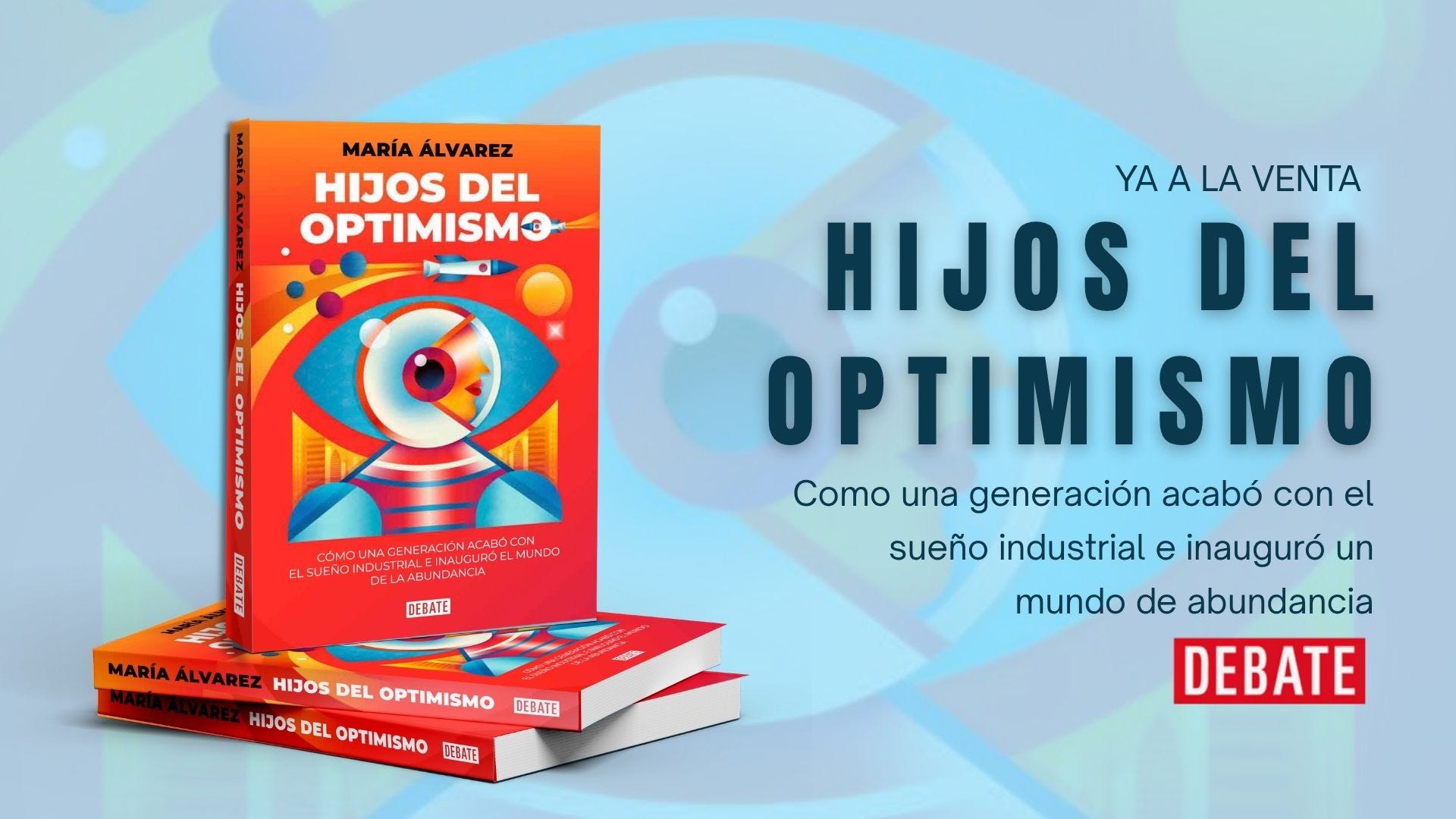
Photo by Elvis Bekmanis on Unsplash