The original (Spanish) version of this article can be found here.
In H. G. Wells’s original War of the Worlds, he imagined extraterrestrials invading the Earth.
The visitors in question were enormous brains, roughly the size of a bear, set upon minuscule — by comparison — cartilaginous tentacles, the atrophied vestige of an earlier time when they had evidently had bodies. Unable to support their own bulk, these beings transported themselves from place to place perched atop telescoping three-legged machines.
Wells’s Martians came to Earth in search of a new home. Their planet was cooling rapidly and threatening to become uninhabitable. It wasn’t that they were evil. They bore us no particular grudge. But from the height of their tripods, they could not empathize with our species, in the same way that we feel no particular consideration for cockroaches, or mosquitoes, or the ants that insist on returning every spring to houses with gardens. Hence their insistence — nothing personal — on killing us all.
Wells lived at the end of the nineteenth century. He could never have imagined that 150 years later, you wouldn’t need to venture into outer space to encounter people living on entirely different planets.
And yet here we are. Today we live surrounded by people who are thousands of mental miles away from us. We get on the subway and a young man sits down beside us, convinced that civilization is collapsing and preparing to survive when the moment comes. In the next seat, an Erasmus student daydreams about a future — her future, at least — that will be bright. In the space between the doors, a passenger who blames migrants for everything he dislikes is pressed up against another who still believes the world moves to the rhythm of class struggle; meanwhile, at the other end of the carriage, a woman who denies climate change accepts the seat offered by a man who thinks it’s already too late to prevent it. You start a conversation with a stranger and halfway through you realize it’s impossible to continue: you don’t even start from the same reality.
Should this surprise us? Reality has never, strictly speaking, been a shared thing. Each of us carries our own version, shaped by the untransferable perspective that life gives us. But during the period in which the West — with its political parties, its mass media, its churches, its trade unions, and the thundering narrative of progress — controlled the levers of the global public sphere, we managed to convince ourselves that reality was like Beyoncé: one of a kind.
When all those institutions began to cool at the end of the twentieth century, we didn’t know what to do. Then, like Wells’s Martians, human beings began a migration in every direction until we found ourselves settled on many different planets — echo chambers made of algorithms and niche media outlets to which we pay a subscription to have our every belief confirmed. Since then, without tools for intergalactic connection, we live a little more each day trapped in our own world, isolated from others as though we were a collection of brains encapsulated inside a machine.
The result is fertile ground for the merchants of hatred, who have spent 25 years trying to drive us toward war: toward the second war of the worlds.
Donald Trump is their great leader.
Trump, the World-Builder
In that twentieth century where every institution broadcast the same story, the role of politics was to have an opinion — a “position,” as the insiders called it — on the issues. Left and right debated how to organize society, but the society they were debating was essentially the same one. Today, by contrast, some have discovered that enormous success can be had by inventing a different society of your own — a vision of reality that can be patented so no one can take it away, tailor-made to the emotions of your voters.
Donald Trump is the finest embodiment of this phenomenon. The businessman has used his experience as a developer of pharaonic real estate projects to become a world-builder — one who has spent 40 years extending his own worldview wherever he goes, so that others may live inside it.
Donald Trump has spent his entire life inviting every American to come live in his world. Forty years ago, he took out full-page ads in several major newspapers to extend that invitation
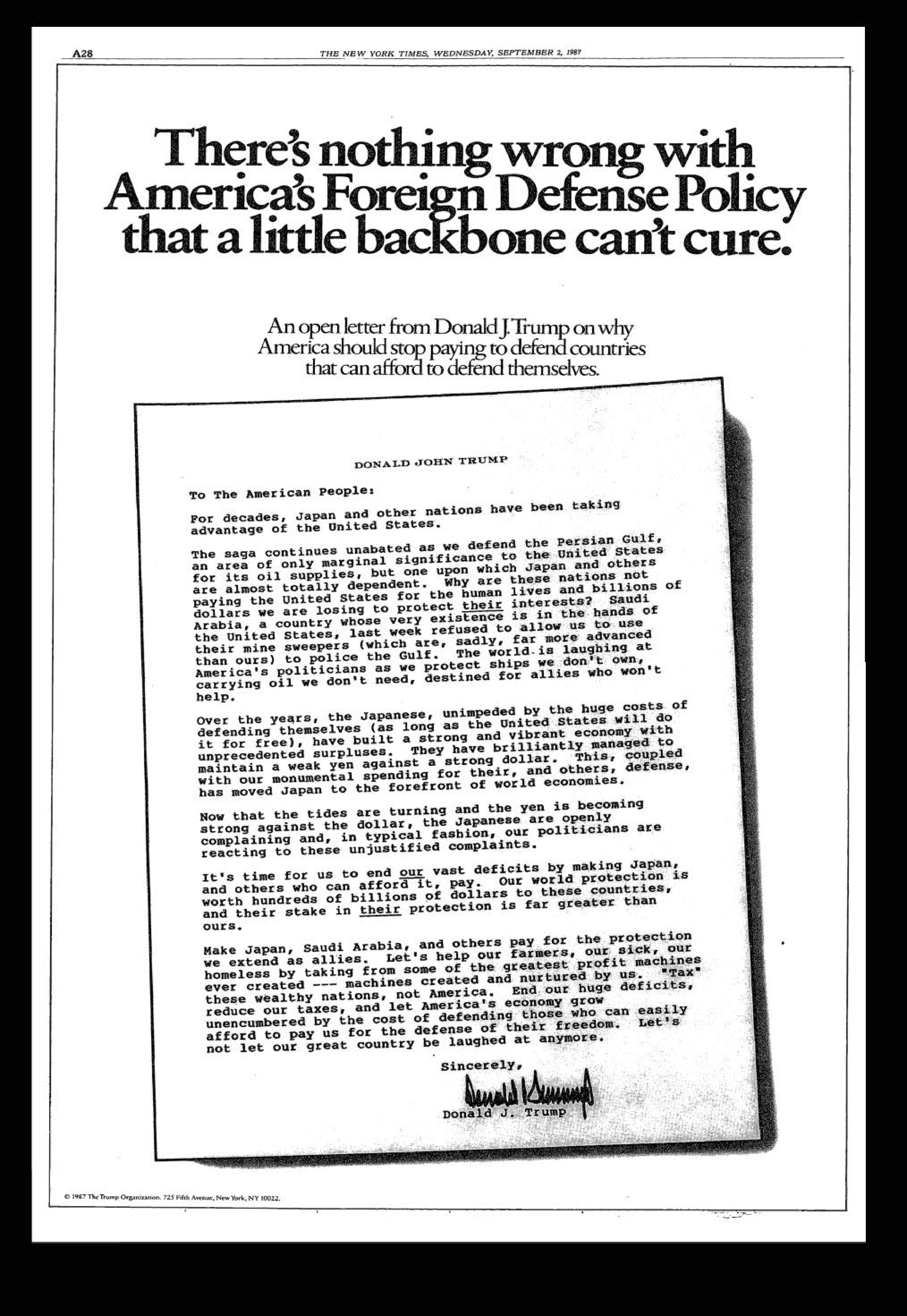
This is why he is so fond of those rambling speeches that go on for hours and are incomprehensible from the outside. Why does he leap, mid-sentence, from grocery prices to China, from China to immigration, from immigration to the last fifty years of American history, and from there to Joe Biden and oil and the COVID vaccine, all in the same breath? He isn’t rambling. He isn’t crazy. He is building a world — complete, immersive, self-sufficient — in which everything has its place, and all the stories, however scattered they may seem from the outside, confirm the same truth.
In Trump’s world, the United States is the helpless victim of a swindle. It was a prosperous country until a radical and corrupt elite — “the swamp” — abandoned it to its fate in order to enrich themselves at its expense. In the hands of these traitors, innocent American citizens are suffering the consequences: their living conditions have deteriorated, their expectations of progress have been cut short, and they themselves have been displaced from the center of society by a handful of wokes and whatever minority happens to be dancing to the tyrants’ tune.
The Revenge of the Suckers
In a political innovation worthy of a spin-doctoring textbook, those innocent citizens are no longer the “hard-working Americans” — the industrious workers who had been the classic archetype of Western politics for decades. They have been replaced by a different specimen, whose defining virtue is obedience: the “law-abiding citizen.”
Of course, nobody is going to ask for your driver’s license to check how many points you have left before certifying you as one. A law-abiding citizen can carry an unpaid child support judgment without losing their credentials. In Trumpland, good citizens are those who identify with order — not the swamp’s order, naturally, but the order of Trumpism. Loyalty to Trump is what confers citizenship.
The result is a worldview that has room for all those Americans who no longer define themselves through their jobs and have no prospect of doing so again. Unlike the mainstream framework, which only has space for people who are part of the productive system, the version of reality Trump has built has room for what Aaron Bastani calls “the unnecessariat”: those who live on subsidies, the poorly retired, the badly employed, those who survive on odd jobs or some form of rent. Anyone at all — with the single condition that they live in the world that has been built for them.
Trump’s law-abiding citizens have a problem. Their country has become the patsy of the international system. Those that the swamp called “allies” are, in reality, a bunch of freeloaders who have spent decades taking advantage of American generosity — getting their military protection for free while selling their cars, their chips, and their appliances into the American market at premium prices. They’ve been swindled. And worse: laughed at.
This idea of national humiliation as an open wound is the other great political innovation of the Trump universe. That feeling of being conned — that everyone else is getting paid while you foot the bill, that you’re the sucker, the mug, that someone out there is laughing at you — is one of the most widespread feelings of our time. Trump was the first Western politician to take it seriously instead of dismissing it.
That is why, in Trump’s world, being good is the same as being stupid. And that is why the keystone of the Trumpian world is tariffs — the revenge of the suckers, in the form of punishment: a “tax” levied on every other country to rebalance the scales.
Political Fan Fiction
World-builders didn’t start in politics. In the early 2000s, a pioneering movement emerged around Harry Potter on the internet: entire communities organized in forums to expand Rowling’s universe with their own characters and stories, created by users. Spin-offs began to appear in which a minor character became a protagonist, or new plot lines that didn’t exist in the original books, or maps and illustrations of corners barely hinted at in the novels.
This was called “fan fiction,” and Henry Jenkins describes it as “a way in which culture repairs the damage caused by a system in which contemporary myths belong to corporations rather than to the people.” In other words, it is people’s reaction to reclaiming the stories and characters that populate mass culture. Today, fan fiction is everywhere — it has taken over multiple fiction franchises, and more and more products are not stories but complete universes where fans are simultaneously authors and readers.
The success of today’s political worlds also rests on the fact that they have many authors — many spin-offs. They are cosmologies built by influencers, social media users, journalists, and politicians. That is how anyone can enter a complete and complex universe, far more extensive than any single person could ever build alone.
But the consequence is that these worlds can survive their creator. They can even leave them behind and take on a life of their own.
The Rise and Fall of Boris Johnson
I have said many times that the country that previews what will happen in the years ahead is the UK. The cycle all Westerners are living through — what we call the “Industrial Era” — was born there, among the banks of London and the textile factories of Dundee, in the Scottish Highlands. That part of the world has been burning through phases ahead of the rest for 250 years. This is no exception.
One of Trump’s first triumphal appearances as a political actor took place in the United Kingdom. In the 2000s, when the cities of northern England were already devastated by drugs and the Midlands had lost their purpose, a generation of populist politicians found great success by building the idea that elites — European ones, in this case — were to blame for the country’s decline. That movement eventually pushed David Cameron’s government to call — and lose — the Brexit referendum. Trump was involved almost from day one and was one of its principal champions from the other side of the Atlantic. But the most effective of them all was Boris Johnson, who ended up as Prime Minister as a direct consequence of that adventure.
Johnson is a larger-than-life character — a conjurer capable of producing the illusion of two people at once: the snob who recites passages from Homer, Thucydides, and Shakespeare, and a slightly disheveled everyman, hair perpetually tousled, as if he’d just been bundling with another drunk outside a pub.
Johnson’s rhetoric was a carbon copy of Trump’s: he — an aristocrat educated at Eton — convinced ordinary people that he was on their side. He painted professional politicians as fraudsters and presented himself as a likeable trickster, a rogue willing to infiltrate the institutions and blow them up from within. And people adored him precisely for it — for how he trolled the political class, laughed at the rules, and drove the “elite” to distraction. Every provocation was a small victory for the people against the establishment.
Until it stopped being funny. During the COVID lockdowns, while the rest of the country said goodbye to its dead over video calls, Johnson was throwing parties in Downing Street. On the eve of the funeral of Prince Philip, who died during those days, someone released a photograph showing Queen Elizabeth II saying farewell to the man who had been her husband for seventy years. That image — the widowed queen, hunched and masked, sitting alone in the chapel at Windsor — became the perfect countershot to Partygate, and Johnson’s poll numbers collapsed. His popularity, which had survived lies, sex scandals, and even the unconstitutional suspension of Parliament, fell away overnight. People had finally understood that he was not a rebel hero fighting the elites: he was simply another con man, another amphibian from the same swamp.
The joke was over. Johnson was forced to resign. The Conservative Party held on by the skin of its teeth for a few more months, burning through three different Prime Ministers and pushing the world’s oldest democracy to the edge of financial collapse — until it had no choice but to call an election and lose that too. Labour swept the board.
Donald Trump is living through his Johnson moment today.
Trump, Evicted from His Own World
In Trump’s world, Donald was never alone. The subplots were supplied by an army of unofficial authors: Tucker Carlson and his narrative about the twilight of the West; Joe Rogan, broadcasting from an apparently apolitical podcast; Steve Bannon and his war against the “deep state”; Charlie Kirk mobilizing college students; and even Candace Owens, who attempted a translation of the worldview for the African American community. Beneath all of them, thousands of anonymous accounts filled in the corners of Trump’s world with supporting characters, internal lore, and in-jokes only intelligible to those who had been living inside it for years. The result was an expanded universe so dense that nobody needs to listen to Trump anymore to inhabit it.
In recent months, that universe has been serving Donald Trump with an eviction notice. It began with Tucker Carlson — the former Fox News prime-time star and probably the most influential ideologist of cultural Trumpism, who had said at the Republican convention in July 2024 that Trump had survived the assassination attempt in Butler through “divine intervention,” that God had saved him because he had a plan for him. Twenty-one months later, that same Carlson was suggesting on his podcast that Trump might be the Antichrist.
The rupture, which had been brewing since June 2025, exploded in February when Trump ordered — under the influence of the Israeli Prime Minister — the attack on Iranian nuclear facilities. For Carlson, it was a mortal betrayal. The central promise of Trumpism had been to extract the United States from the endless wars of the Middle East, not to start a new one.
A few weeks ago, Carlson published a video in which he apologized to his audience. He felt complicit, he said. He had campaigned for Trump and had helped deceive millions of people. He would live “tormented by it for a long time.”
Alongside Carlson, Candace Owens, Megyn Kelly, Alex Jones, and Joe Rogan have all begun to openly criticize the administration’s drift. And while it remains to be seen what effect these desertions will have on the November election results, the pattern is the same one we saw with Boris Johnson: none of his former allies have renounced the Trumpist world — quite the opposite. They accuse Trump of having betrayed the universe they helped build. Carlson says it in so many words: the problem is not “America First” — the problem is that Trump has stopped being America First. The worldview survives the cosmologist, and the supporting authors, who have spent years building the world, are beginning to behave as guardians of an orthodoxy that Trump no longer embodies.
The most likely scenario is that more and more voices will expel him from his own world.
What will happen then to the populist worldview? Will we return to a world of trust and rosy optimism? Will the Republican Party be destroyed for a generation, leaving Democrats to win indefinitely?
The answer, once again, is found in the United Kingdom.
The Return of Populism
Destiny is capricious, and mental worlds are remarkably resilient. Two years after Labour won the UK election, this very week, a new wave of populists — Reform UK, featuring the not-so-novel Nigel Farage — won the local elections by an enormous margin, waving exactly the same banners Johnson once flew.
When voters discovered that the Premier was not the legitimate builder of the world they were living in, they kicked him out. But they kept the world. British populist fan fiction was strong enough to survive the cosmologist. The Johnson universe kept running without him — and it is still alive, still expanding, still finding new avatars to embody it.
The lesson the UK leaves us is this: political cosmologies, ideological worlds, do not depend on their leaders. And for a reason: when one of those politicians — or anyone, really — manages to build a complete reality, people stop following that person in the traditional sense and begin, instead, to inhabit the world they have drawn for them. They start making vital decisions in accordance with that narrative. Take the young men who follow Joe Rogan and other far-right podcasters: they have also been convinced that society has gone soft and lacks discipline. And the way they practice discipline is by going to the gym. They start going every day. They change their diet to meet their goals. They build a circle of friends around the same interests. They may find a partner along the way. The worldview has seeped into their bones.
Just as it was impossible, forty years ago, to convince someone that reality was not what the major media were publishing, today it is impossible to convince a person that reality is not what their podcast or their go-to online outlet repeats to them every morning. What people are acquiring is not opinions. It is an identity. No amount of data, no accumulation of arguments, will make a person stop inhabiting their world.
Like the Harry Potter fan fiction universes, political worlds, once built, sustain themselves. I believe this is a phenomenon that will repeat itself across every country. Even if the first wave of populist parties collapses — Trump included — they will return with new faces and new names.
Unless we do something to prevent it.
How to Defeat Populism
Populism has been defined in many ways. Here is another. What we call “populisms” are broken-reality parties: organizations that build a worldview of their own, in opposition to that of twentieth-century liberal democracy, and populated by two essential figures: an extractive elite and a deceived people.
With minor variations — which consist, essentially, of whether politicians or billionaires are held responsible for the decline — all populisms, left and right, without exception, share the same worldview. That is why they reinforce each other. That is why we are beginning to see voters transition from left-wing populism to right-wing populism: because in that transition, people don’t need to leave the worldview they inhabit — they simply choose different villains.
You cannot defeat populism by attacking its leaders. First, as we have seen in countless cases, because when opposition parties try to delegitimize a populist leader by accusing them of corruption or of undermining the constitutional order, they do nothing but strengthen them. Exactly as they had been told, the leader of the day is an effective battering ram against the swamp — and the swamp rebels against them.
But above all, because — as we are seeing in the UK — after one populist wave, another will come, for as long as its worldview remains alive and keeps growing more hegemonic. The only way to defeat populism is to challenge its cosmology. And the best thing we can do for that is to rebuild trust — to stop behaving like Wells’s Martians.
To step down from the tripod. To stop looking at the other passengers in the carriage as though they were cockroaches that deserve to be exterminated, and to recognize that they are human beings inhabiting a planet as precarious and provisional as our own. To believe again — against all evidence — that it is possible to speak with someone who thinks differently without turning the conversation into a battle for survival. Wells imagined an invasion that came from outside; ours comes from within, and it is not brought by Martians — it is brought by us, every time we decide that someone is so monstrous an enemy that they don’t deserve to be heard. The second war of the worlds cannot be won by defeating anyone. We will win it when we stop fighting it.
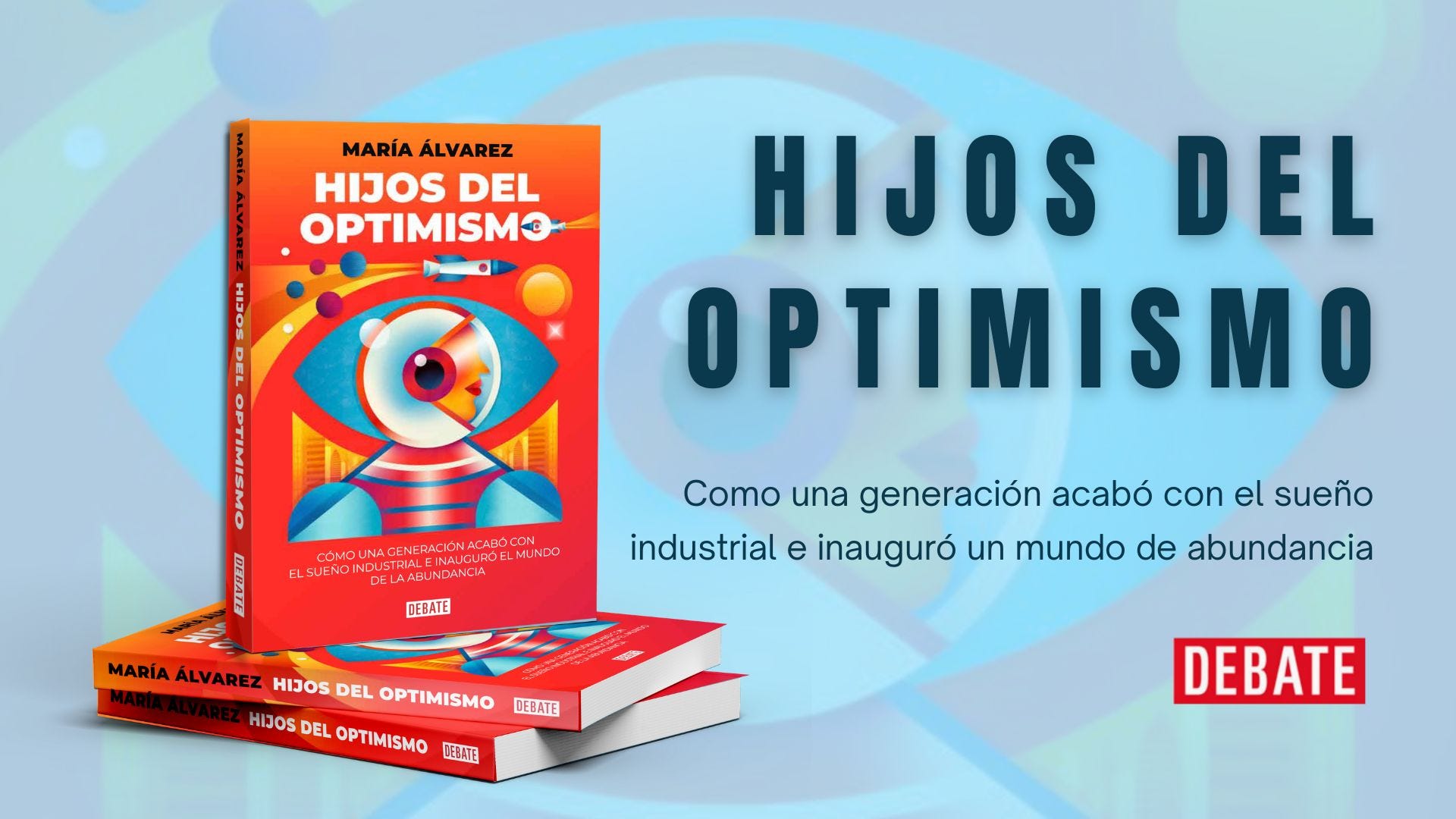
If this topic interests you, you can’t afford to miss Hijos del Optimismo (Children of Optimism) — a book that explains how the housing crisis and the AI bubble are the consequence of the immense transformations we are living through today.
It’s my first book, the older sibling of this newsletter, and a project I’ve been working on for many years.
Hijos del Optimismo (Children of Optimism) is available at your favorite bookshop — including Amazon, Casa del Libro, El Corte Inglés, and the publisher’s website, Debate
You can also read an excerpt here.