


This 3,000-word newsletter unlike anything you'll read anywhere else lands in your inbox for free — because information wants to be free. But producing it takes work. You can help me prove that abundant goods can still be sustainable by choosing a premium subscription or picking up my first book, Hijos del Optimismo (Children of optimism).
The original (Spanish) version of this article can be found here.
I don’t know about you, but I can’t shake the feeling that we’re living in Groundhog Day. With one difference: instead of a charming rodent, what keeps showing up every morning is Abaddon, the angel of the abyss, commanding an army of locusts with human heads, lion’s teeth, scorpion tails, and the specific mission of tormenting mankind until we seek death and cannot find it.
Another war. Gas prices spiking at pumps thousands of miles away. Governments worldwide scrambling to cushion the blow. Stock markets in free fall. A recession looming. How many front-page headlines have we racked up so far this year?
But if you step back and look closely, there’s a pattern in the middle of the chaos. We’re living through the final weeks — maybe the final days — of a 17-year cycle that has run its course. The political and economic framework that carried us to 2026 is on the verge of collapse, its gears grinding under the weight of a reality that won’t let them keep turning.
In recent hours, the stars have aligned. A cascade of political and economic events is threatening one final, spectacular implosion — the simultaneous collapse of the political cycle and the economic cycle. The simultaneous collapse of Donald Trump and AI.
No. I’m not exaggerating. The signals are stacking up everywhere: Trump’s increasingly erratic maneuvering, the quiet deflation of US markets, Bitcoin’s price crash, and rising bond yields are all tolling the bell on the final movements of a cycle.
Here’s how it sounds:
THE END OF THE POLITICAL CYCLE: TRUMPISM IS DEAD
To make sense of this mess, we need to start with one question: Why did Trump attack Iran?
The answer: because he was cornered. The Supreme Court had suspended his signature policy — the one that had propelled him to the presidency twice — tariffs. He was mired in a debate over whether he owed Americans refunds on what they’d overpaid. Meanwhile, his approval ratings were in free fall ahead of midterm elections he looks set to lose badly. Trump, a master of capturing attention, needed a new lifeline — a new scandal, a new global crisis to dive into. He found it in Iran.
His plan probably wasn’t to stumble into this irreversible quagmire. He likely thought he could assassinate the Ayatollah and be out of Tehran in a couple of days, the way he’d handled Venezuela. Or he’d been fed bad intelligence and hadn’t accounted for the regime’s resilience, nor the economic fallout back home. Doesn’t matter. The point is that Trump — with no real agenda, backed into a corner — has careened from crisis to crisis like a true kamikaze, until he finally crashed into the immovable wall of the ayatollahs.
As we’ve covered before, regimes like Trump’s, in their final phase, tend to go one of two ways: they either consolidate and find some stability, or they launch into an increasingly desperate, agonizing forward flight. What we’re watching is that Trumpism has failed to find that equilibrium — and has chosen option B.
Donald Trump came to power wielding a story: that the cause of the decay Americans were feeling (a decay carefully stoked by alt-right influencers in the years prior) was an unfair deal that soft elites had cut with the rest of the world. The fix was simple — reorder the balance of power, put America First, make it Great Again. None of it has materialized. He’s deployed every tool at his disposal — tariffs, threats, even the kidnapping of foreign heads of state — to force the world to pay what he claims it owes, and it has produced zero meaningful effect on the American economy, which sits, at best, exactly where it was under Biden.
In other words, Trumpism doesn’t work. It cannot make America Great Again. What was once a fairly successful political common sense has curdled into a fringe obsession believed only by the most fervent devotees. It’s spent.
Today, there isn’t a single analyst in the world who isn’t already planning for the post-Trump era.
NO MORE TACOs
One of Trump’s most powerful weapons throughout all of this has been the blind confidence the big money had in him. Since he took office, the world of investment funds, banking, and big business had concluded that the Republican was one of their own — a man with the sensibility and track record of any other billionaire. No matter how much noise he made for the New York Times, the people who move markets knew that when things got dicey for Wall Street, Trump would always do whatever it took to course correct.
And Trump had been proving them right, time and again. Every time his antics rattled stock markets or bond markets, he backed down — often in fairly humiliating fashion. So much so that this pattern has its own name: TACO (Trump Always Chickens Out).
Riding that confidence, US markets had been locked in an “all news is good news” loop since Trump’s inauguration: when employment and growth data looked strong, stocks rose because it was good news; when it looked weak, stocks also rose, because markets expected Trump to pressure the Fed into cutting rates to compensate.
But then we ran into the ayatollahs. The stubborn reality of a regime that has no intention of negotiating the way Venezuela did, combined with the damage already done to oil production infrastructure, means that the last two TACOs — a 5-day ceasefire announcement followed immediately by a 10-day one — have done nothing to calm markets.
We’ve run out of TACOs.
THE FINAL GASP
Beyond the specifics of the energy crisis this fool has dragged us into, what the death of the TACO effect reveals is that Trump’s political momentum is finished — and at the worst possible moment. In recent months it has become increasingly clear that the American economy was already slowing down, even before the war with Iran. Some very influential voices — including the CEO of BlackRock, the world’s largest asset manager, and the President of the ECB — are sounding the alarm about a real threat of global recession in the coming months, a possibility now priced a between 30% and 50% for the US alone.t
Meanwhile, US Treasury bonds are straining, Bitcoin has lost half its value over the past several months, and gold… nobody quite understands what’s happening with gold anymore.
But what’s really got me gripped is the shift in market behavior.
Both the S&P 500 — the broad US market index — and the Nasdaq — the tech index — had been on a steep upward trajectory ever since ChatGPT burst onto the scene at the end of 2022. (The jagged dip in April 2025 was the scare from Trump’s first tariff threat, which he then walked back in his first TACO.)
But in recent months — and with growing intensity in recent weeks — markets have broken their upward trend and are heading decisively south. The Nasdaq is down 10% since October, while the S&P 500 has shed 11% from its January peak.
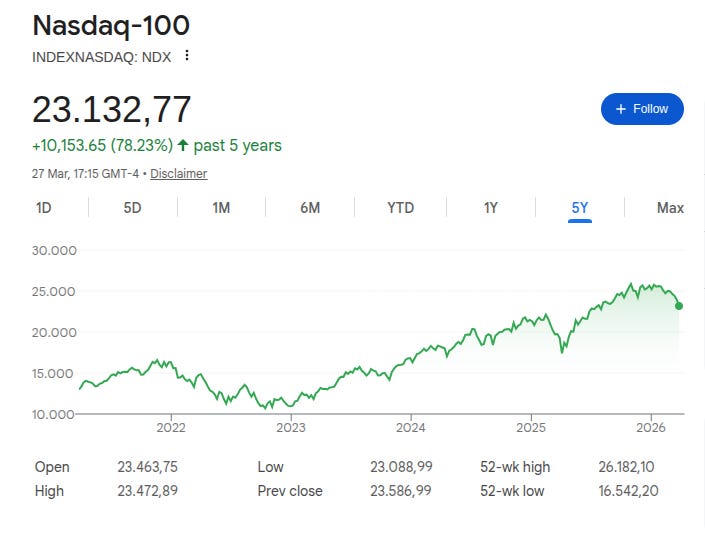
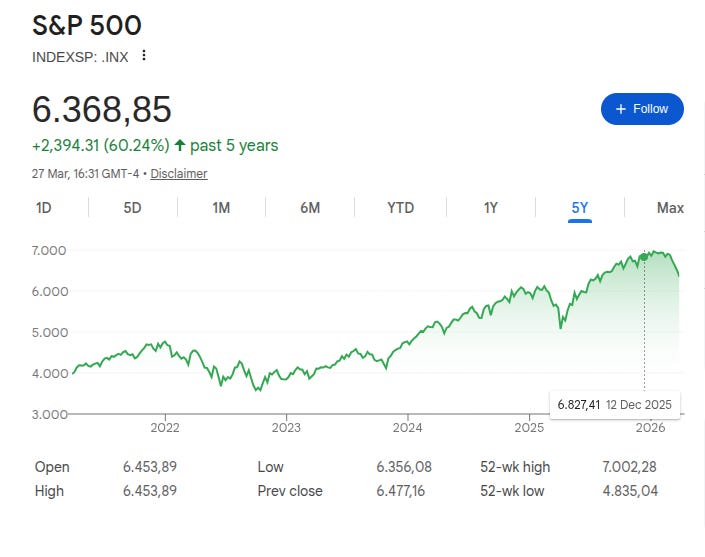
This wouldn’t be remarkable in any other context. Markets go up and down. But what defies explanation is that this is happening in direct contradiction to the pattern of absolute confidence investors had shown in Trump — and at the very moment when Big Tech is posting the best results in its history.
In the final quarter of 2025, America’s tech giants published earnings that would have looked like science fiction just three years ago. Apple, Microsoft, Alphabet, NVIDIA, and Meta all beat analyst estimates by an average of 11.2%, combining for $178.4 billion in quarterly revenue — year-over-year growth of 18.6%.
And yet their stock prices keep falling. To almost everyone’s bewilderment, this combination — extraordinary results followed by a market sell-off — has become the defining pattern of today’s markets.
How is that possible?
AI’S GREAT MISFIRE
Hold on. Weren’t we supposed to be on the cusp of a new industrial revolution — one that would reshape one in three jobs worldwide and add several percentage points to GDP every year? Weren’t those multinational earnings the proof of a revolutionary technology that was going to transform everything? How can anyone seriously be talking about recession?
What on earth is going on?
What’s going on is this: just as Trump has reached the end of his forward flight, the same slap of reality has landed squarely on AI.
I won’t wade into any debate in this article about the limits of what we’ve bundled together under the label of “AI.” But let’s talk about the promises its boosters have been making for years:
First, we were told AI would eliminate 300 million jobs and that two out of every three roles would be at least partially automated.
Then someone announced that the path to “artificial general intelligence” — capable of replacing humans at any task — had been clearly mapped out.
Then that all cars would be driven by AI.
Or that it would wipe out the entire legal profession.
Or that it was “the next frontier of productivity.”
And just when we thought there wasn’t a single hype-stick left to throw on the fire, in recent weeks the talk has turned to how a new wave of agentic AI could replace software developers entirely.
Not one — NOT ONE — of these things has come to pass. Maybe it’s worth revisiting how much credibility we extend to these so-called “experts.” But I don’t want to get lost in that rabbit hole. The truth is, it doesn’t actually matter whether any of these things ever happen or not.
What matters — the reason a bubble burst feels not just possible but inevitable in the coming days — is that three years after the launch of ChatGPT, AI still has no business model. It still has no product it can sell at a scale that even begins to justify the trillion-dollar investments being made on the hope that it might eventually be useful for something.
Like Google Glass. Like the Oculus. Like the Metaverse. Like NFTs. AI is miraculous in theory and could be genuinely transformative — but there doesn’t seem to be many people willing to pay for any of it.
What’s become increasingly impossible to ignore is that the results these multinationals publish quarter after quarter rest on a web of circular agreements so incestuous they’d make the Habsburg family tree look like a picture of genetic health. To date, AI has created no real added value. What exists is money spinning so fast, and in such tight circles, that the sheer velocity makes it look like a lot more than it is.
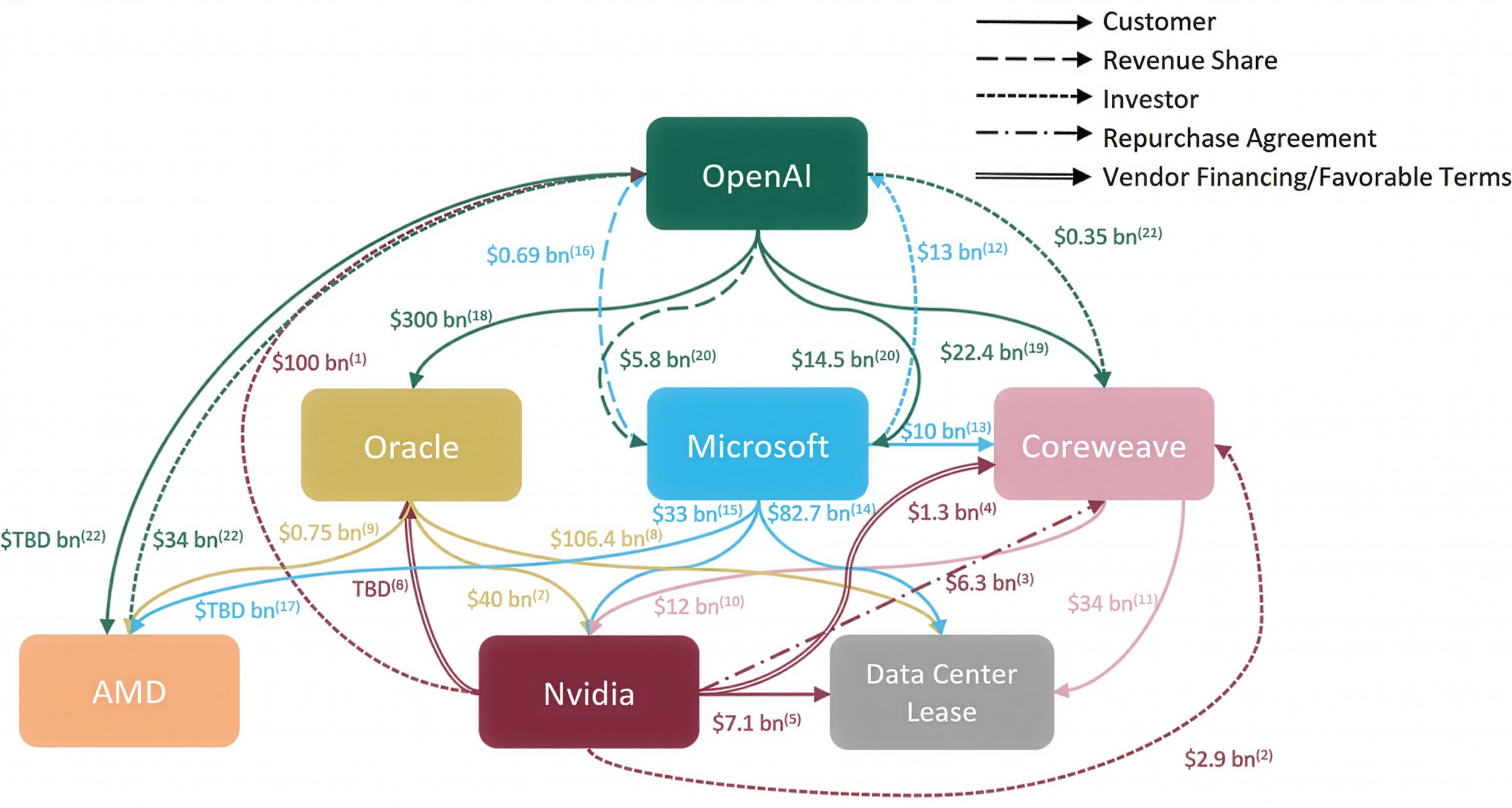
And what is now beyond dispute is that, whatever AI does, it will not generate economic growth. If it succeeds and delivers on any of its promises, it will produce the opposite result: replacing vast numbers of workers without creating anything new that generates jobs elsewhere. In other words, even if AI succeeds, what it will achieve is a smaller economy, not a larger one. Will it boost productivity? Perhaps in some companies — but that counts for very little if it keeps its promise of gutting entire sectors of the economy in return.
Just as it happened to Trump, AI has now had its own encounter with reality — and reality has left it exposed: its promises of generating economic growth simply don’t hold up.
Just days ago, the CEO of the world’s leading AI company, Jensen Huang, trotted out the AGI story once more — and it landed exactly the way Trump’s TACOs have been landing lately. Nobody believed him.
THE PERFECT STORM
Here’s the thing: just as the US has its midterms this year, AI has its own version of an election — except it won’t be decided at the ballot box. It’ll be decided in the capital markets.
Within a few months, the three biggest startups in the sector — SpaceX, OpenAI, and Anthropic — are set to go public at astronomical valuations: over $3 trillion combined.
Market analysts rarely agree on anything. On this, there is near-unanimity: there simply isn’t enough money in public equity markets to absorb all three. If they all go through, it would be “like dropping a boulder into a fishpond” — it would drain the water and crater the valuations of every other company alongside them.
What’s more, none of these companies has revenue figures that come close to justifying their valuations. And going public means a full financial striptease in front of regulators — their opaque books thrown open for the entire world to see. The problem is they have no alternative. Because private investment certainly doesn’t have enough runway left to sustain these valuations either.
The AI IPOs are to the economy what the American midterms are to global politics: the moment of reckoning for the model that brought us here.
This, in my view, is what the market sell-off and the death of the TACO effect are reflecting. Trump and the AI bubble have weeks left, not months. I’d go further: the bubble has already burst — that’s why valuations are deflating. The only reason it isn’t exploding more violently is that, as the Financial Times noted recently, investors have nowhere else to go.
In the days and weeks ahead, we’ll watch this same process enter a far more acute phase. Perhaps the outright collapse of the stock market. Perhaps Trump finally following through on pulling the US out of NATO. Whatever form it takes, it will be the final gasp of a model that is dying.
REASONS FOR OPTIMISM
Regular readers know I don’t like leaving things on a note this bleak — mostly because I genuinely don’t believe this is a moment for pessimism. If anything, the opposite: an extraordinary window of opportunity is opening up in front of us.
Because the apparent collapse of everything around us is, in large part, a mirage. What is shaking is not society itself. The things that actually matter for human life — the indicators that, a hundred years from now, will tell whether our era was one of progress or regression — are doing just fine. Science continues to advance at breathtaking speed in the treatment of cancer, Parkinson’s, and Alzheimer’s. We keep producing more with less, and as a result, we continue — albeit not nearly fast enough — to reduce poverty and child mortality. And in recent years, we’ve been handed another reason for hope: the staggering progress of renewable energy is making a world free from fossil fuels feel genuinely within reach, one where abundant, clean energy is the norm.
What is breaking down is the economic project we’ve lived inside for the past 25 years. What we called the “knowledge economy” never worked — and today it is cracking apart because it always had an irresolvable contradiction at its core.
The economy is, at its most fundamental, the part of human activity that deals with scarcity. Things have economic value precisely because they are limited — because not everyone can have them. Oil is worth money because there’s a finite amount of it. Knowledge works in exactly the opposite way. When I teach something to someone, I don’t lose it. When a song is digitized, a million people can listen to it simultaneously without any one of them taking anything away from the others. Knowledge, once created, can be reproduced and distributed at virtually zero cost. Its natural tendency is to escape every attempt to turn it into a commodity and become free — and when it does, the entire economic activity built around its artificial scarcity collapses.
When the West made the most ambitious decision in its history — sending an entire generation to university, the first in their families to set foot in a lecture hall — it planted the seeds of its own economic model’s destruction.
In the decades that followed, those same young people, armed with knowledge and the internet, rendered entire economic sectors obsolete — one after another. It happened to music, to film, to journalism, to retail, to traditional banking, to large swaths of travel and tourism, and to dozens of other professions. In every case, the pattern was identical: the further knowledge spread, the more the ability to profit from its scarcity shrank.
Hence the deepest irony of our time: the more successful a knowledge society becomes — the more it educates its population, the more it innovates, the more freely it shares information — the more it destroys its own economic foundations. The “knowledge economy” was always, in a very precise sense, a contradiction in its own terms. An oxymoron.
The conclusion was always inevitable, even if it still isn’t obvious to everyone: in the twenty-first century, as knowledge has advanced, the economy has contracted. Today we see the most brutal expression of this process in artificial intelligence: if the promise of universal knowledge is ever truly fulfilled, it wouldn’t just make one sector redundant — it would threaten to make human work itself redundant.
The crisis of Donald Trump and the crisis of AI are, at their root, the same phenomenon. The industrial world of the twentieth century handed off a mandate to the “knowledge economy”: take care of its two main actors — capital and labor. But the knowledge economy failed to offer either of them an equivalent place to the one they’d held in the old world. Today, capital has nowhere to go — which is why it keeps producing one bubble after another. Labor, meanwhile, has lost the central role it once had. At least for a significant portion of the population. And it is that vast, displaced minority that is fueling Trumpism across the globe.
With the “knowledge economy,” it isn’t the things that truly matter in society that are shaking — it’s our beliefs. What’s collapsing are the rules of the old world. This is the end of an ideological cycle, of a system that never worked, that has been limping along for 25 years, and has now entered its death throes — producing one tragedy after another.
But is this really a threat? Wasn’t it always our final goal? Wasn’t this what we dreamed of — freeing ourselves from the tyranny of scarcity and toil?
If we can understand this moment — and stay united, clear-headed, and purposeful, the way we did during COVID, during the invasion of Ukraine, during the World War and the reconstruction of Europe 75 years ago — we will find that we have never been better equipped to face the challenges ahead than we are right now.
We are a society of extraordinary knowledge. We live longer than ever before. We have built solid political agreements that have allowed us to live in peace for decades. And we can build new ones. We have the intelligence and the capacity to move forward and find solutions to whatever stands in our way. No matter how savage the coming crisis; no matter how erratically the strongmen in the US, Israel, or Russia keep lurching from one disaster to the next — if we commit, if we come together, and if we give it our very best, there is nothing to fear.
If you enjoyed this article, you’ll love Hijos del Optimismo (Children of Optimism). It’s my first book, the older sibling of this newsletter, and a project I’ve been working on for years
.