


The original (Spanish) version of this article can be found here.
Amancio Ortega has just become the world’s largest real estate magnate. According to Forbes, the founder of Inditex now holds 200 properties across 13 countries, valued at €21 billion.
This should make no sense. Why would a businessman who controls one of the most successful companies in the world invest in buildings? Shouldn’t it be far more profitable to keep investing in his own company?
The absurd answer is: NO.
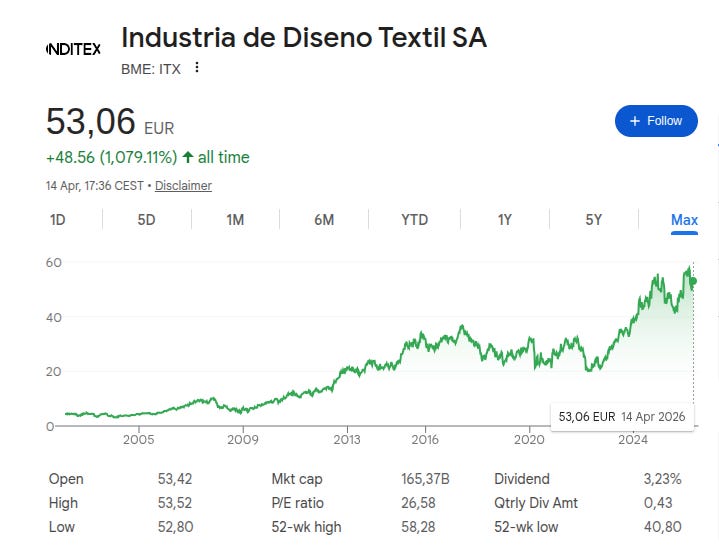
Inditex went public in 2001. Since then, its sales have multiplied by 12, its operating profit by 18, and its market valuation by 17. Its shares are worth ten times more than they were 25 years ago. Throughout that entire period, the company has never issued new shares — but it has paid dividends every single year.
It is those profits — which in Ortega’s case amount to more than €21 billion over those 25 years — that the businessman is using to buy properties and stakes in utility companies across Europe.
In other words: Inditex does not need outside capital to keep growing. Its own business generates enough cash flow to cover operating expenses, pay dividends, make the necessary investments, and still keep growing at full speed.
That is why Amancio Ortega has nothing better to do with his money than put it into property.
Inditex is clearly an exceptional company — highly profitable and superbly managed. If you press me, I’ll admit that Zara isn’t just a fashion brand: in the future it will be studied as a form of art. (I neither confirm nor deny that this is what I tell myself every time I pull out my card to add another, ahem, piece to my modest ahem collection.) But the point is that Ortega’s situation is far from unique. His is not the only company producing more profit than it can productively reinvest.
Quite the opposite. What is happening to the world’s richest man is happening to everyone else too: we are drowning in savings we don’t know what to do with. That is why the entire world is pouring money into real estate, which now accounts for 60% of global wealth
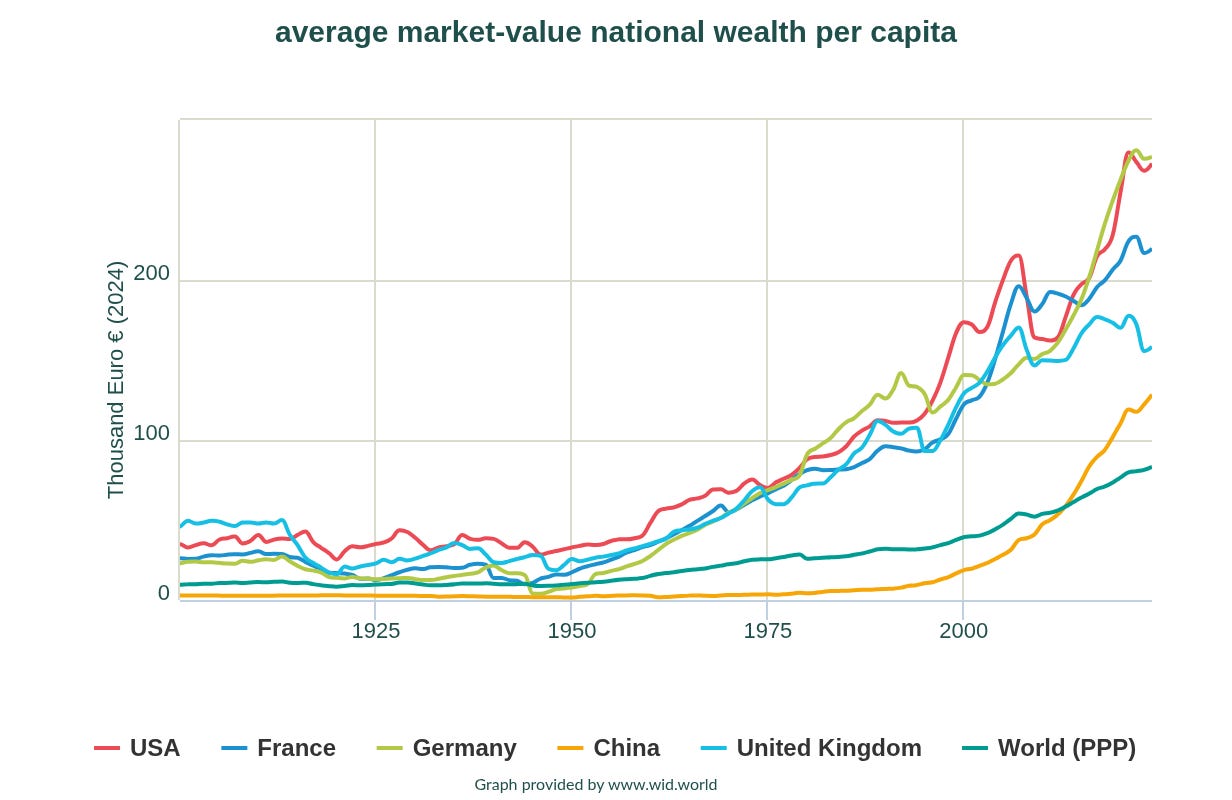
Over the past 25 years, global wealth has gone from representing 3 times to 6 times world GDP — in other words, it has doubled relative to the size of the economy.
Meanwhile, in the digital economy, productive investment opportunities for all that wealth are becoming increasingly scarce. Put as simply as possible: Inditex’s online stores, which today account for a quarter of the group’s sales, do not require anywhere near the capital investment that would be needed if those same sales had to take place in physical shops.
We are buried under a mountain of savings. And yet, in the twenty-first century, capital is playing an ever-smaller role in the economy.
The reason is that ever since digital technology began reshaping the economy — first in the dot-com bubble, then in the subprime crisis, then during COVID — governments have thrown themselves into injecting monetary stimulus (liquidity) to prevent the outcome that would have been the natural consequence when digitalization made vast swaths of the economy unnecessary: deflation and degrowth.
To avoid having to explain to citizens that the growth that had made possible the great social contracts of the twentieth century — pensions, savings, rising property values, the “American dream” — had come to a halt, we have spent 25 years injecting artificial money into the system.
That is why wealth keeps growing even though productivity is stagnant. That is why assets that can still sustain some cash flow — real estate, infrastructure, energy companies — keep appreciating. The bubble currently inflating in US stock markets, the rise of Bitcoin and cryptocurrencies, and the staggering appreciation of gold in recent months are all symptoms of the same underlying problem.
Meanwhile, at ground level, for the people who keep having to pay more for the same goods — in order to reward the owners of all that accumulated wealth — the lived experience is that life is getting more expensive and more difficult.
There is, though, another way to look at it. One that is even more vertiginous, but that ultimately explains what is happening far more clearly.
Instead of thinking that assets — homes, buildings — are appreciating and becoming more expensive, we can think of it the other way around: money itself (not any particular currency, but money as a whole) is worth less and less. It is being devalued. If we assume that the underlying value of assets hasn’t changed, then what is actually happening is that we need to hand over ever-larger quantities of money to acquire the same thing.
This explains why so many people feel that it is they who are being devalued. Their work, their position in the world — still measured in money — is losing value. And that’s true. With the value a person could produce through their labor 50 years ago, they could access a certain number of assets. Today they can access half as many, or fewer. Is the asset appreciating — or is labor depreciating?
One might conclude that this is a catastrophe. We’re being devalued, and there’s nothing we can do about it!
But that’s not quite right.
Money isn’t losing value because of some malevolent force. It’s losing value because we are increasingly interested in things that have no economic value — meaning, no scarcity. We no longer care about filling our shelves with china figurines or replacing the sofa every two years. We’d much rather travel widely than own a single beach house. And we are increasingly drawn to conversation with other people, to learning, to watching series, listening to music, reading, being with friends and family. To living.
What is happening is that we are increasingly transacting in a different currency: attention. And that “nomy” — not an eco-nomy but a pluto-nomy — is thriving. It is remarkable how many people, in recent years, have a project running alongside their day job: a Substack, a magazine, a summer festival they organize, a reading group, a running club. Or whatever it might be.
And the problem is that, seen through the lens of the twentieth century, these things are still considered a distraction from the real task of mankind, which is work. But that is no longer the case. The world has changed, and it will keep changing. Those projects, those learning journeys — they are the investments that will appreciate in value in the future.
If this topic interests you, you can keep reading in my first book, Hijos del Optimismo (Children of Optimism), now available on Amazon, at Casa del Libro, on the Debate website, or at your favorite local bookshop
.