


The original (Spanish) version of this article can be found here.
Open the hood of your car. Look at the engine. Do you understand it? No, but you might keep looking at it for a while, waiting for a revelation. Now open the hood of the world, look at the jumble of calamities and explosions of joy that make it up. Do you understand it? No, but you keep leaning over it, to see what happens. That’s what we do every time we open the newspaper: see what happens, where the hell that noise comes from, like a car about to break down.
— Juan José Millas, ‘¿Hay o no hay avería?’(Is there a breakdown or not?), El País
Last week, following a post in which I argued that the world must choose abundance in order to put an end to hatred, Daniel Arjona published a review of the proposals put forward by the nascent abundantist movement, closing with a challenge: Is abundance compatible with the soaring electricity consumption of artificial intelligence? Or will those of us who believe in abundance crash headlong into that “thermodynamic reality” of technology before we have even left the starting grid?
I do not believe that AI will derail abundance. But the question strikes so deep a nail that I cannot help but wade in. The dichotomy between the scarcity that AI threatens to impose and the abundance it promises points directly to the reason why the twenty-first century feels like a car whose engine has failed without anyone being able to identify the cause.
This piece attempts to explain why the promises of scarcity work — and how the architects of AI have managed to turn it into the greatest such promise we have ever made, and perhaps the last.
The Two Gods of Capitalism
Human beings had always promised themselves a future of abundance. For as far back as historical memory reaches, and until just a few years ago, we believed in paradise. In salvation. In an existence beyond scarcity and earthly misery — even if it had to wait until after death.
And so, when capitalism came to occupy the place of religion in the moral order, it took great care to keep that promise intact:
“It is the great multiplication of the productions of all the different arts, in consequence of the division of labour, which occasions, in a well-governed society, that universal opulence which extends itself to the lowest ranks of the people. Every workman has a great quantity of his own work to dispose of beyond what he himself has occasion for; and every other workman being exactly in the same situation, he is enabled to exchange a great quantity of his own goods for a great quantity, or, what comes to the same thing, for the price of a great quantity of theirs.”1
The god of capitalism — no longer called Allah or Jehovah, but the “division of labour” and the “invisible hand” of the market — also promised a modern version of paradise: a future of plenty for all mankind.
It was this convergence that allowed us to enter the modern era without losing our faith — sustained by the same worldview that had guided us for millennia: that human beings, if we act virtuously, can earn our place in heaven. The impure, the heretics, and the unbelievers will receive their just punishment in hell — or in poverty. Carrot and stick.
Yet capitalism introduced, perhaps without fully realizing it, a profound mutation of that ancestral principle. The new order did not abolish God — but it split him in two. From that moment on, we prayed to two distinct deities: one that promised abundance, and one that announced scarcity.
The God of Abundance: The Assembly Line
Adam Smith’s favourite deity was the “division of labour.” The Scotsman was captivated by human organization and by the inexhaustible power of industrialization to accelerate material progress. His divinity was a being of abundance — one that multiplied everything it touched. “If a worker, on his own, can perhaps make ten pins a day,” Smith argued, “on an assembly line he can make thousands.” Industry was the modern miracle of the loaves and the fishes.
But for those workers to reach paradise, their labour had to be compensated. Someone had to recognize the value of what they produced and be willing to exchange it for the fruits of others’ work. The god of productivity, on its own, could not close the circle. It needed another god: that of the market. And this one, unlike the god of industrial production, was a god of scarcity.
The God of Scarcity: The Market
A good can only have a price if access to it is not free — if it is scarce. For me to want to buy something from someone else, that good cannot be freely available to me without payment. In economic terms, its consumption must be rivalrous: either the buyer consumes it, or I do. Only then can it be exchanged. The market is, in essence, the mechanism by which both parties agree on its price.
Scarce goods — such as cars, washing machines, and vinyl records — are easily traded in markets. But when goods are abundant — like the light from street lamps or public health — it becomes impossible to charge for them. That is why markets cannot provide them. So much so that even the most hardened theorists of capitalism eventually came to support the creation of the modern state to take responsibility for some of them.
(I explain this in much greater detail in this article and this one).
The Schizophrenia of Capitalism
Capitalism has thus existed, from its very birth, in a state of genuine schizophrenia — in an all-out battle between its two great gods. On the one hand, it promises that human organization can make goods abundant. On the other, it requires that goods remain scarce in order for markets to continue to exist.
The consequence is that our economic system — upon which we have staked the future of society — has advanced from its beginnings by devouring itself. Industries are born, grow, and reproduce, making goods ever more abundant. But the more abundant goods become, the more they lose their market value — until, one day, driven by their own improvements and innovations, their production becomes ubiquitous, they are “commoditized,” and they cease to be profitable. Industries thus render themselves unnecessary and ultimately disappear.
How did capitalism survive two hundred years of this tension? Should it not have collapsed? Should it not have exploded, supernova-like, from its very success? This is something that perhaps deserved more scrutiny in the twentieth century — but, then again, no one asks where the manna falling from the sky comes from. And so, for as long as the economy ran at full capacity, no one saw this as a problem. On the contrary, a very famous economist, Joseph Schumpeter, devised an idea to explain it and gave it a name so catchy that no one ever thought to question it again. The engine of capitalism, he said, was the “creative destruction” of the economy.
The Magic of “Creative Destruction”
Old industries, as they disappeared, released workers and capital back into the economic atmosphere. That surplus, in time, became fertile ground from which new industries — more innovative, more productive, capable of absorbing that labour and capital under better conditions — were born. This is how the automobile replaced the horse, petroleum replaced coal, and the electric motor replaced the steam engine. Capitalism was magical. The abundance of one thing created new scarcity somewhere else, and everything — the assembly line and the market — continued on its way.

Fascinating. Because that was in 1942, and since then no one has ever managed to demonstrate that this relationship actually exists; no one has been able to identify the mechanism by which the destruction of some industries gives rise to others. “Creative destruction” never ceased to be a theory. A hypothesis. A narrative. And yet, by the end of the twentieth century, that narrative was shaping economic policy, justifying the forced deindustrialization of the Western world, displacing entire populations, and transforming the face of nations — all in the name of industrial “restructuring.”
At precisely the moment — and what terrible timing it was — when it became clear that it had stopped working. That engine of capitalism had been turning for roughly 225 years when, twenty-five years ago, it seized up and ground to a halt.
Since then, since the turn of the millennium, the creative destruction of the economy has been conspicuous by its absence. The old industries — local commerce, postal services, travel agencies, newspaper kiosks — keep dying. But the new ones that should be rising in their place produce neither enough employment nor enough economic activity to offset the losses left behind by those that disappear. As a result, Western economies began to stagnate toward the end of the 1990s.
The Bubble That Never Ends
And so countries embarked on a forward flight that has now lasted twenty-five years. First, they surrendered to the siren song of the dot-coms, trusting that the internet would deliver the productivity revolution they had been waiting for. It did not. Instead, when the bubble burst, the US Federal Reserve began applying the prescription that has brought us to where we are today: injecting artificial money into the economy — monetary stimulus — to keep it from stalling completely, sustaining it on life support until the promised technological revolution would arrive and return us to the path of growth.
But that did not happen either. Instead, all that fresh money found its way into the mortgage market and produced a second bubble, which burst in 2008. And although the world was by then growing acutely aware that something more serious than a simple crisis was underway, the prescription was the same: more liquidity to revive an economy that had been in cardiac arrest since the start of the millennium.
And so we have arrived at 2026 after twenty-five years of injecting ever more money in the hope of reviving an economy that keeps deflating — like a balloon, literally, with pressure pumped in on one side while it escapes from the other. This is the reason I say, without any fear of being wrong, that AI is a bubble that will burst in 2026. And I can say with equal confidence that, if we do not change course, there will be another bubble after it, and another, and another. Because what is happening to the world is that it keeps producing more and more abundance — but can no longer produce scarcity.
The Century of Abundance
One of capitalism’s two gods — the god of the assembly line — is running at full capacity. We are able to do more with less than ever before, and the world has never been so abundant.
Despite the dizzying growth of the global population, we today produce 50 % more calories per person than in 1960 — and 4.5 times more energy. We have cut illiteracy from 60 to 12 %. Today five billion people are connected to the internet, and there are 1.12 mobile phone lines per person worldwide. According to the Simon Abundance Index, life in 2026 is 518.4 times more abundant than in 1980. It is little wonder that global life expectancy has risen by 25 — 25! — years.
More striking still: every new innovation that emerges is born abundant — email, digital information, social media content, artificial intelligence. As a consequence, the god of the market — the one that paid wages, provided returns on investment, made it possible for companies, tax revenues, and all the other economic mechanisms of the modern state to exist — is growing ever more enfeebled.
A simple example. CD sales reached all-time highs in 2001, then plummeted, all but vanishing before 2010. Music streaming revenues did not match the business volume of CDs until fifteen years later, in 2015. And yet, in the music industry in the United States, barely more than half as many people are employed today as were in 2000.
Why? Because there is no scarcity. On the contrary: music is everywhere. For the same price we once paid for a single CD in 1990, we now get a month’s subscription to a platform that offers us every piece of music in the world. People spend hour after hour on Spotify. Meanwhile, the revenues and jobs that depended on music being scarce — record shops, manufacturers, distributors — have vanished.
The same story repeats itself across every other sector: search engines, accommodation platforms, e-commerce, messaging services, social networks, and cloud software have all created products and services that are abundant, accessible to millions of people simultaneously. But, as with music, that abundance of goods does not generate employment or material wealth in proportion to the scale of its consumption — because the remuneration of labour and capital was tied to scarcity, to the existence of a market.
This is the schizophrenia of the contemporary world. This is the arrhythmia at the heart of late capitalism that has the world on life support. The reason why, as the writer Millás puts it, “the engine of society is making a strange noise.” In the eternal contest between capitalism’s two gods, the god of abundance has the other pinned against the ropes and is delivering a beating.
The Scarcity Rebellion
Although it has never been explained in quite these terms, today almost everyone senses that this is true — you may well be feeling that “aha” moment right now: I’d never seen it that way before, but it’s obvious.
The problem is that, without a social contract different from the one we had in a world of scarcity, many people have come to see abundance as a threat. They find themselves in a kind of schizophrenia of their own: on one hand, they want access to the benefits of this new world — Amazon’s low prices, cancer treatments — but on the other, they are terrified that this drift will harm them. From that intuition springs the fear of the future, and of everything associated with progress.
And so we collectively refuse to accept that we live in a world of abundance — because, as Upton Sinclair put it, “it is very difficult to make a man understand something when his salary depends upon his not understanding it.” And it so happens that a great many people’s “salary” depends on the world not being an abundant place.
Starting with workers. Taken to its logical extreme, abundance would eliminate a large portion of work — more than it has already eliminated. If, for instance, we were to maximize food production by supporting the technologies that allow proteins to be cultivated using bacteria, we would permanently resolve food insecurity, drive down meat prices dramatically, free up vast tracts of land for reforestation, and avoid the emission of thousands of tonnes of CO₂ into the atmosphere. But we would also eliminate hundreds of thousands of jobs in agriculture and livestock farming — and, with them, the trade unions and all the power structures built upon those jobs.
And with political parties. Because the political currents of the twentieth century were always something like different churches worshipping at the altar of capitalism’s god — some at the god of the factory, others at the god of the market. This is why, in my view, every political movement has stopped speaking about the future and has turned scarcist, retreating into frameworks that still describe the world as though it were a place of scarcity — immigration, redistribution, the planet’s “limits,” degrowth, inequality, the unsustainability of public services, debt, and so on. This is why they are far more interested in perpetuating shortages — of housing, for example — in order to position themselves as saviours of their followers, than in exploring the opportunities that abundance offers.
But the great casualty of abundantism is none of these actors. Workers, before anything else, are people — and society can reorganize itself (and will) to ensure that there remains a role and a place for every person in an abundant world where work plays a secondary part. And political parties can reinvent themselves, or new ones can emerge.
The real corpse stinking out this funeral is that of capital. What place does capital have in a world of abundance?
In Search of Scarcity
This is what one of the world’s leading consultancies has to say:
“In an economy increasingly driven by intangible assets such as software and other intellectual property, a surplus of savings has struggled to find investments that offer sufficient economic returns and lasting value for investors. Instead, these savings have found their way into real estate, which in 2020 accounted for two-thirds of net wealth.”2
In other words: none. As the world became abundant toward the end of the 1990s, capital ran out of places to invest. It then launched a desperate search for new pockets of scarcity. First it sought them in the dot-com stock market. Then it took refuge in real estate. Around 2015 it returned to the stock market, this time in pursuit of “unicorns” — technology companies like Airbnb and Uber that promised stratospheric returns by demolishing entire sectors through the act of making them abundant.
One corner of the internet set out to create the first scarce digital asset: Bitcoin — “the only scarcity in the world.” Since then we have witnessed several more or less successful attempts to manufacture artificial scarcity: NFTs, which tried to replicate Bitcoin’s trick; the Metaverse, conceived as a form of digital “real estate” controlled by Meta; and all the things that have periodically come into fashion by convincing audiences of their scarcity — rare earth minerals, chips, and the rest.
All of these share the same value proposition. In an increasingly abundant world where generating a return on capital has become exceedingly difficult, the product on offer was always the next scarce thing — the next scarce thing — from which a return might finally be extracted.
Sam Altman’s Holy Grail
AI is the latest and most sophisticated version of that scarcism — an almost perfect story, exquisitely modern, built upon three lies:
AI was “intelligent” and could “replace humans.”
It would therefore displace millions of jobs — and, by extension, boost productivity, the touchstone of this entire narrative.
The key to its success was not the technology itself, but scale: the sheer quantity of processors any given market player could concentrate in its hands.
It was Sam Altman — almost single-handedly — who created this monster. It was he who first floated the idea that what we have been calling “AI” constitutes a form of intelligence. And it was he who, as it became increasingly evident that large language models are little more than stochastic know-it-alls, announced the imminent creation of “artificial general intelligence — coming soon.”
But his greatest invention, the one that turned the world upside down, as they explain very well in this post, was scale.
The fact is that AI is a technology as abundant as email. It is not, in reality, a single technology that anyone can patent, but a collection of general, shared principles being applied by many different teams. It ought to be about as investable as a programming language or a collection of recipes — which is to say, not at all.
But a group of scientists at OpenAI discovered that ChatGPT’s performance improved the more processors it used. “Scale” — the computational capacity of each LLM model — became the key to success with this new technology (which, let us not forget, we had already been convinced could replace human beings and therefore be enormously productive).
“He reinterprets the discovery of scaling laws as a kind of founding epiphany, and presents himself as someone whose career revolves around ‘scaling’ what works. An engineer who worked with him described a conversation in which Altman delivered a small sermon about his career, saying that scaling is the defining idea of his life.”
What Sam Altman grasped was that a technology born abundant — one that had been sold as capable of replacing humans, yet which could be marketed as scarce because it was bound to the physical computational capacity of each individual company — was the Holy Grail that capital had been searching for since the early 2000s. That elusive technological creature, with the soul of an algorithm and the feet of a high-capex real estate investment, was the perfect lure to set every investor salivating.
Scale — or, put another way, scarcity — was Altman’s great invention, the one that launched AI into the trillion-dollar bubble in which we now find ourselves. In 2026, the major AI players — Microsoft, Amazon, Google, Meta, and Oracle — are expected to invest more than six hundred billion dollars in processing capacity.
All the narratives built around this — from “hyperscalers” to the story of soaring electricity demand (which, incidentally, was already deployed in the Bitcoin era) — are far less established facts than they are reinforcements of that same promise: the last scarce technology, which the industry’s interested parties are determined to keep lodged in our heads.
It will last as long as it takes for the bubble to burst.
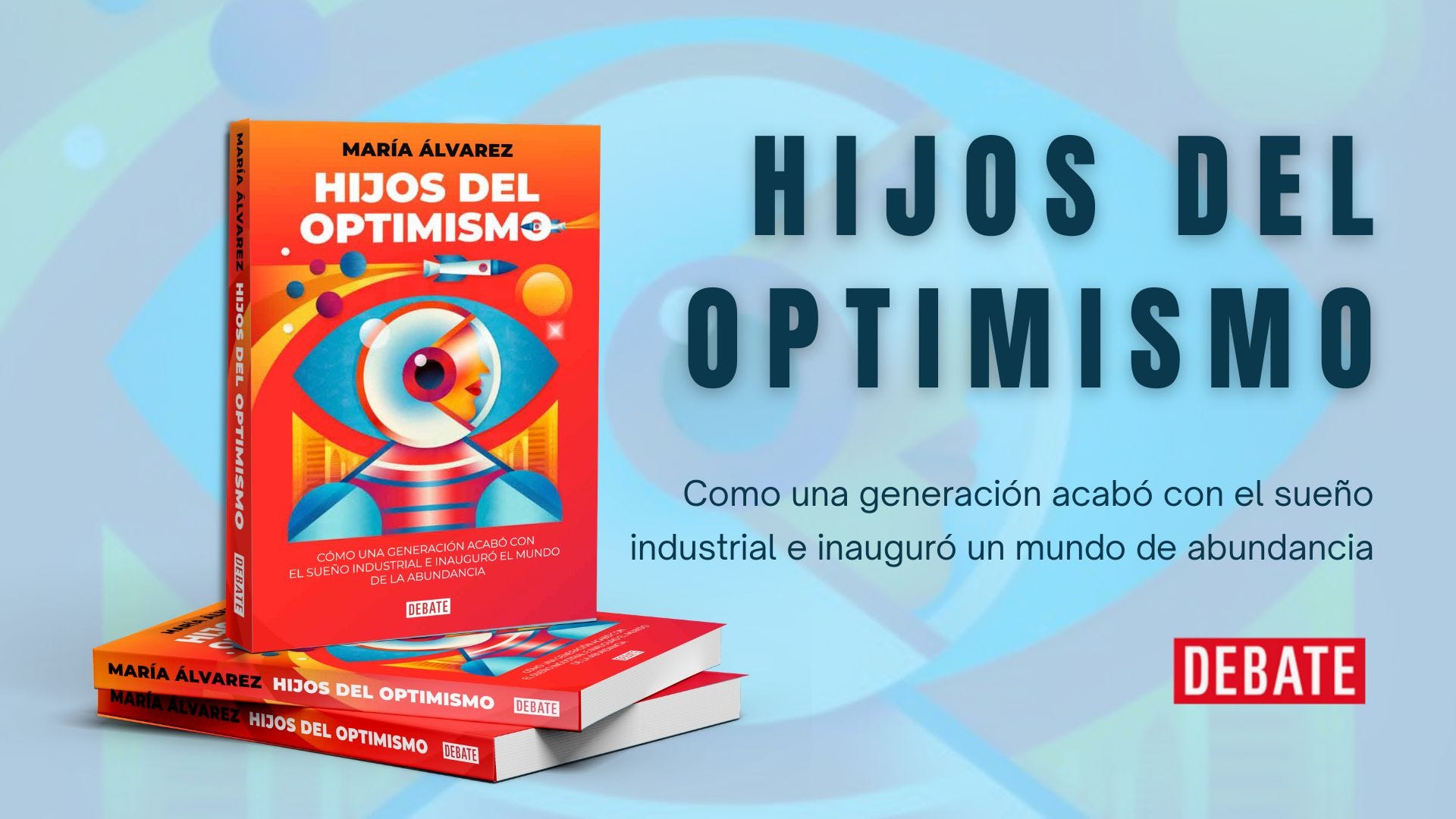
If you want to know why the world became abundant at the turn of the millennium, you’ll like Hijos del optimismo (Children of Optimism). It’s my first book, the older sibling of this newsletter, and a project I’ve been working on for many years.
You can already order Hijos del Optimismo on Amazon, La Casa del Libro, El Corte Inglés and the publisher’s website, Debate.
You can also read more about me and the story that inspired me to write it.
Adam Smith, La riqueza de las naciones. https://www.gutenberg.org/ebooks/3300
https://www.mckinsey.com/industries/financial-services/our-insights/the-rise-and-rise-of-the-global-balance-sheet-how-productively-are-we-using-our-wealth