


The original (Spanish) version of this article can be found here.
Early last year, Ezra Klein andDerek Thompson, two leading commentators on the American left, published a book with the same title as this blog: ‘Abundancia’. In it, they recount how the Democratic Party lost its way when it stopped building.

The Democrats had been ‘the party of working people’; they had promoted the infrastructure, industries and housing stock that transformed the lives of millions of people between the 1950s and 1980s. But then the ideological wind changed.
Politicians became convinced that the market, on its own, would be able to produce everything that was needed. Ronald Reagan, a Republican, successfully sold the idea that the government should simply get out of the way. So successfully, in fact, that even the Democrats bought into it. ‘The era of big government,’ declared Bill Clinton, ‘is over.’
So, the Democrats decided that their role would be to correct the distortions produced by the market. On the one hand, they would implement “demand expansion policies” — aid and subsidy programmes so that everyone could share in progress — and, on the other, they would pass laws to prevent economic interests from destroying ecosystems and communities.
Part of the party “specialised in the art of saying no” and ended up on the side of those who already had a secure life. Using this legislation, the “NIMBYs” (Not In My Back Yard) set about defending the status quo by demanding that any new construction project meet standards so high that they were unattainable.
As a result, the United States has been stagnant for a quarter of a century. Some infrastructure projects have been paralysed for decades and cities are collapsing due to a lack of housing. The world’s leading power lags behind other developed countries in terms of high-speed rail kilometres, and more construction is taking place in Republican states than in progressive ones. In California, the crown jewel of the Democratic Party, a small public toilet that was going to cost £1.2 million and take three years to build became a symbol of the tragedy.
Disappointed with this drift, many voters lost confidence in the party and began a march towards Republicanism that culminated in 2016 with Donald Trump’s first victory.
The way out of this quagmire, the authors conclude, is to regain the ambition to transform. To return to a ‘supply-side progressivism’ that multiplies infrastructure, transport, energy sources and, crucially, housing stock. To build and allow building so that people can regain their trust in politics.
Abundance is a great book, but it was published at a terrible time. It was written during Joe Biden’s term in office, when it seemed certain that the Democrat would win re-election. The text was a manifesto for a second term. But along the way, Biden had to withdraw, Kamala Harris took over, and the rest is history. When it went on sale, with Trump already in power, the book became a straw man (or paper man) on which half of the world’s political commentariat pounced.
But the fact is that a year has passed since then and no one has put anything different on the table. There has been a mountain of criticism of the book, yes, but nothing more than criticism: not a single alternative proposal, not a new framework, not an idea that aspires to govern reality. The ironic—almost obscene—thing is that its detractors have ended up embodying exactly what Klein and Thompson denounce: politics reduced to pointing fingers, discrediting and blocking. Lots of judgement. Zero action.
Meanwhile, the abundance agenda has been advancing and has ended up convincing both the right wing of the party and the new shining star of the left wing: Zhoram Mamdani. Even among some Republicans, there is talk of a ‘conservative vision of abundance’.
It has also crossed borders. In Spain, Jorge Galindo has recently published another good book, “Tres millones de viviendas. Cómo pasar de la escasez a la abundancia” (Three Million Homes: How to Move from Scarcity to Abundance), in which he finds similar arguments and points to the same culprits responsible for the paralysis. A coalition of interests—including investment funds, but also homeowners’ associations—blocks every public initiative on housing and infrastructure with obstacles and excuses (‘not here,’ ‘not like that,’ ‘not now’).
I have mixed feelings about these approaches. On the one hand, I love building things and even do it professionally, so I am convinced of the virtues of solving problems by doing.
But on the other hand, for me, abundance has much more to do with freedom than with the possibility of owning more things. In other words, true affluence lies in the end of work, in overcoming an economy based on scarcity, and in a new cultural horizon where we allow ourselves to be freer. If it is not that, and instead consists of a life identical to today’s, but with clean energy and housing that is 30% cheaper, I think it will be a bit of a let-down that will not inspire enthusiasm (at least for me).
But these are subtle differences, distinctions between families of an incipient abundantism that could perhaps be the subject of another article. What is relevant, and what Klein, Thompson Galindo and I agree on, is that in order to emerge from the current crisis, we must become abundantists: we must leave behind the worldview of scarcity that has been ingrained in us during this first quarter of the century.
The fact is that our world—the social and political structures we have created—has always been based on an idea of abundance that was at the heart of all the great traditions of the West.
In Christianity, that horizon of fulfilment had been with God, beyond death. When capitalism replaced religion in the moral order, it transferred that aspiration to earth, but did not take away its centrality: if we trusted in the organisation of labour, the expansion of productivity would lead us to an abundance very similar to that promised by the Gospel. Even Marxism remained a teleological doctrine: communism was a stage in which the development of the productive forces would make the struggle for resources unnecessary.
And if neoliberalism triumphed at the end of the 20th century, it was because it managed to embody that very promise. After decades of extraordinary economic growth, society had become convinced that nothing else was needed. The market alone would be capable of bringing abundance.
And so, although it took different forms each time, the belief that if we acted virtuously, we had the power to forge a future of affluence has accompanied us throughout our history. It is our philosopher’s stone. As relevant in the collective consciousness of the West as, say, equality or justice. We cannot live without it. At least, not in peace.
When, in 2008, the market collapsed and the last promises brought by neoliberalism evaporated, the West was left without a promise of abundance for the first time in... perhaps thousands of years.
A new promise then began to take hold: that of scarcity.
‘We had been living beyond our means.’
Overnight, from living in the boundless world of the early 2000s, we came to believe that we had gone too far. That all resources were finite and we had already spent more than we should have. Our survival now depended on being frugal, restraining our desires, giving up everything that was not essential. History had caught up with us, and all we could hope for was a future of effort, blood, sweat and tears.
In recent years, I have spent some time trying to trace who planted that idea in the collective subconscious. Who was responsible for making that mindset hegemonic in such a short time? I always thought it would have been Angela Merkel, or Jean-Claude Trichet — the then president of the ECB — or one of the many conservative politicians who later used that mantra to stir up an entire continent.
To my surprise — and perhaps to yours as well — it was not a right-wing politician who ended the dream of abundance. It was Barack Obama.
When Lehman Brothers went bankrupt on 15 September 2008, the American election campaign was in its final stages. Obama was the favourite in the polls. He probably did not want to take any risks. He was already an unusual enough candidate without getting himself into trouble over the economy. It may also be that at that time the left thought that economic growth was a neoliberal and right-wing thing. That a generation of politicians who had cultivated the art of morality saw the festival of opulence of the early 2000s as a deviation. I don’t know.
But the fact is that it was Obama who, in the third debate of the campaign, just weeks after the collapse of Lehman Brothers, uttered those words. On the other side of the screen, a bewildered global audience, searching for answers to what was happening, listened intently.
‘There is no doubt that we have been living beyond our means,’ he said.
“Senator McCain and I have differences regarding the need to invest in America and the American people.” […] “But what is absolutely certain is that once we overcome this economic crisis, we cannot return to our wasteful ways. We will have to embrace a culture and ethic of responsibility: all of us, corporations, the federal government, and individuals who may be living beyond their means.”
That’s how it was. With these few words, the most influential leader of the 21st century promised us scarcity. The future would be a time of ‘zero sum’, where in order to invest in one area, cuts would have to be made in another. Where the gains of some were the losses of others. What we could produce was limited, and efforts and exchanges did not create value, they redistributed it.
The crisis of political representation we experienced in 2025 can be traced, with terrifying precision, back to that statement. At that moment, the left and right wings of the 20th century, which had been promising heaven (literally) to their voters for 50 years, found themselves speechless, with nothing to say.
Then the right wing beat a retreat. Its model was crumbling in prime time. Beneath the artifice of the neoliberal ‘market’ lay a colossal banking scam that was destroying the lives of millions of people. When Nicolas Sarkozy sounded the alarm—‘capitalism must be reformed’—it was already too late. That right wing never regrouped after the rout. It was another creature—populist, illiberal, authoritarian—that grew strong in the trenches left empty by the democratic conservatives.
The left, meanwhile, was suffocating. Policies aimed at “expanding demand”, without the tax revenues of a buoyant economy and under the yoke of austerity, became impotent. The left went from promising a horizon of dazzling material progress to settling for tiny patches—setting minimum wages, providing rent assistance, lowering bus fares—in a stagnant reality.
The promise that politics makes to citizens at every moment in history ended up like the meme of the big dog and the little dog.

But the left resisted. Perhaps because its people are more accustomed to difficult times, perhaps because neoliberalism had not been their project. Its leaders held their ground and found refuge in a theory that had been born in Latin America, a place where they had had plenty of time to perfect the politics of scarcity.
‘Populism is always a foundational political force,’ explains Íñigo Errejón, perhaps its most brilliant ideologue, “although the people are always called by the same name, they are a different people each time because they are made of new materials. They are always made from the construction of a new general interest in opposition to the existing elites and the order they had built. And it is a general interest that is constructed from scraps or pieces of the set of unmet demands, unfulfilled expectations, or unattained desires, but it is more than the sum of its parts. It is not just all the grievances put together to protest against those at the top, but rather the construction of a new horizon based on those unmet demands.”
In contrast to the ideologies of the 20th century, which promised a better future, populism triumphed by promising the opposite: that the future would always be bleak and that there would be a never-ending struggle for resources. There would always be a “people” to take refuge in, but it would not be a happy and proud one, but rather one made up of dissatisfaction and grievances against an elite that, in some way, would always be stealing from them. The task of politics was not to offer a horizon of progress, but to give shape to the discontent in a single voice (that of the politician of the moment, specifically) and, above all, to point out the culprits.
I suppose at the time it must have seemed harmless. The ‘1%’, those billionaires against whom the populist left was building itself, were untouchable. Demonising a handful of people as powerful as they were invulnerable seemed a small price to pay in exchange for building a political subject — ‘We are the 99%’ — that recognised itself.
The problem is that myths and hegemonic worldviews are always transversal, because we all live together in the same society. Just as all 20th-century ideologies shared the belief that productivity would lead us to a world of abundance, all 21st-century ideologies, both left-wing and right-wing populism, share the promise of scarcity. When the left spread the idea that we live in a permanent scam perpetrated by ‘elites’ against ‘the people’, it left the door open for the culprits to be not necessarily billionaires, but for the same arguments to be used to turn ‘the people’ against the woke, or against immigrants, or against pensioners.
“In the United States, the United Kingdom, France, and Germany, zero-sum beliefs on both the left—for example, that people only get rich by making others poor—and on the right—for example, that immigrants succeed at the expense of natives—are related expressions of the same underlying worldview. That is, there are only a limited amount of resources, and therefore we must use restrictions, levies, and preferential treatment to balance the scales between winners and losers.”1
If populist movements—from Milei to Meloni, Trump, and some very influential currents on the left—are successful, it is because they share this worldview: because they reinforce each other. And, in the absence of any other alternative, they end up dragging the entire ideological spectrum along with them. That is why it is so difficult today to find a politician—or a media outlet—that does not devote all its energy to replicating this framework: to explaining to us who the bad guys are and why we are the good guys (‘the people,’ ‘ordinary people’) and how they are stealing from us.
It is in this shared narrative that the great crisis is brewing today. Because if the embodiment of liberalism was peace—the debate between different political options that sought to coexist in the same world—populism can only be embodied in war. In a zero-sum world, if we take the tension to the extreme, only one can remain; the only solution to problems is to die or kill. That is why all populisms need war in order to exist. Sometimes they are really at war (as in Ukraine, Venezuela or Palestine) and sometimes they pretend to be (as in the ICE raids or the rhetorical outbursts of European parliaments).
Some will argue that the left did not arrive at these conclusions of its own accord, but rather was pushed there by the need to confront the physical limits of the planet. This is not true. The symbolic core of the idea that ‘we have been living beyond our means’ is not really a criticism of a way of life or consumption: what this framework questions are our ‘means’. What scarcity claims is that we are powerless, irrelevant, inane, incapable of controlling our destiny and shaping the world around us.
That is why all populists present themselves as ‘strong men’, because they want to convince us that we are weak and need someone to protect us. That is also why all the themes of scarcity (‘the limits of the planet’, “immigration”, ‘the accumulation of wealth’) are presented as global phenomena, incomprehensible, ungraspable and unstoppable (except, perhaps, for strongmen).
And that is also why all populisms are anti-scientific (techno-pessimistic, they call it). Because they need to deny that we are capable and that today we have the best tools humanity has ever had to face the future.
The root cause of scarcity has nothing to do with the planet’s finite resources, but rather with confidence in our own ability as a human species to face all the challenges (including biophysical ones) that lie ahead. This is what is radically new about the 21st century and the promise of scarcity.
That is why a populist’s worst enemy is not another populist from the opposing camp: it is the abundantists. That is why the books by Klein, Thompson and Galindo have provoked an angry reaction (and mine, will follow the same path). The belief that we are capable and masters of our own destiny is kryptonite for scarcity thinking.
Is there no third way? Couldn’t we live in peace by accepting the premise of a scarce world? Couldn’t we come to terms with the idea that there is nothing more to distribute and settle for it, finding other forms of happiness that are not based on constantly expecting something new and better? I don’t know. Degrowth has had two decades to produce a new paradigm that excites people based on that premise, and it has failed to do so. For my part, I have no interest in that possibility. I believe that the ambition to explore is the best thing about human beings. It always has been, ever since we left the caves. It is certainly what I do best and what I enjoy most. If anyone has another idea, please let us know.
Meanwhile, the reality is that today the political front lines are no longer between the left and the right. The axis has shifted, and the ideological battle will be fought between abundance and scarcity. Those of us who aspire to a future of prosperity, peace and freedom need to rally around this new paradigm of abundance for the 21st century, so that the world can once again become a place of hope where there is room for all human beings.
There are very few occasions when reality offers us something as simple as a dichotomy, but this is one of them. Today, there are only two possibilities on the table: either embrace a new agenda of progress, or abandon ourselves to regression. Either peace or war. Either build or demolish. Either democracy or tribalism.
Abundance or barbarism.
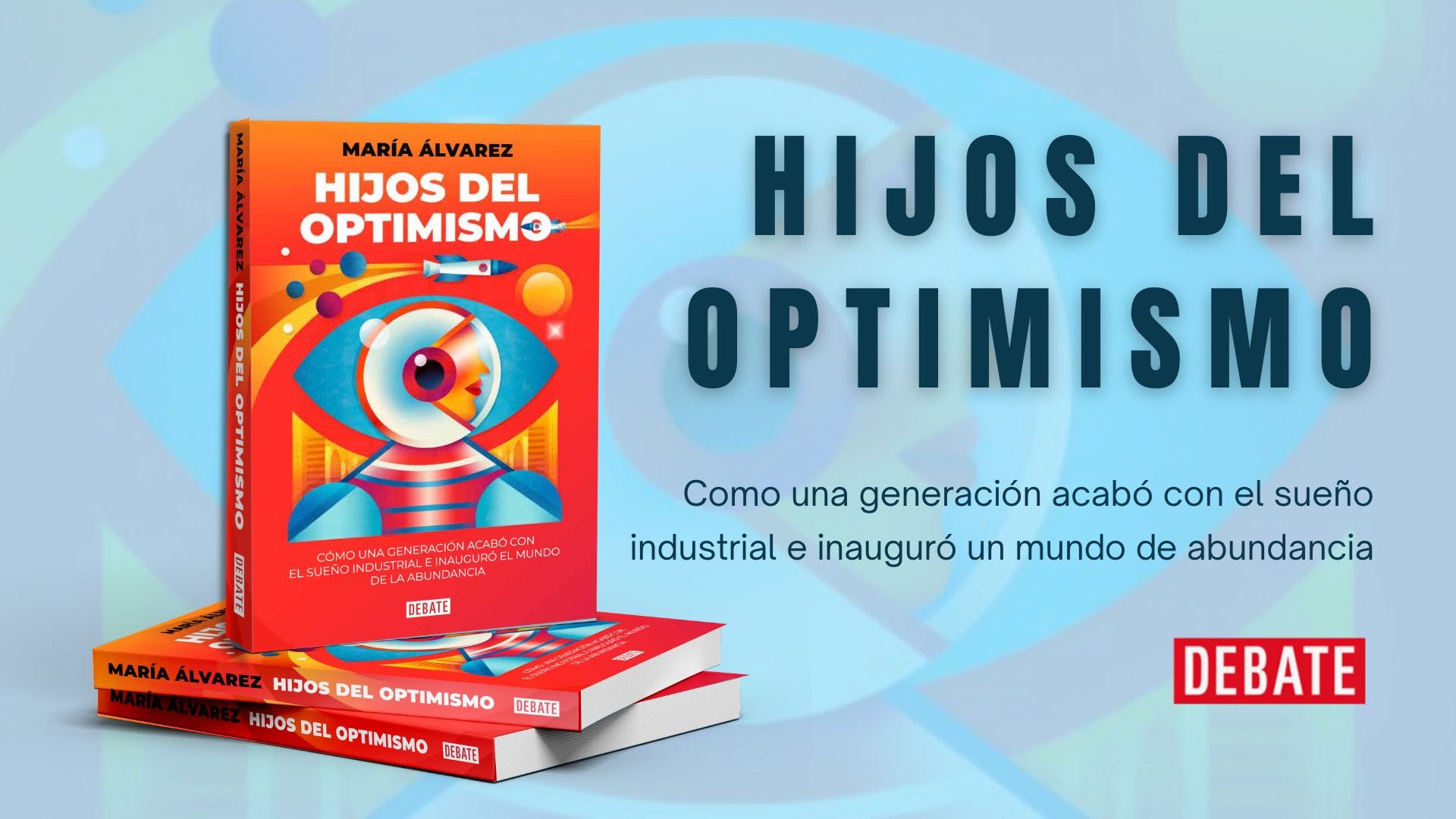
If you are also an abundance thinker, you will like Hijos del optimismo (Children of Optimism). It is my first book, the older sibling of this newsletter, and a project I have been working on for many years.
You can already order Hijos del Optimismo on Amazon, La Casa del Libro, El Corte Inglés and the publisher’s website, Debate.
You can also read more about me and the story that inspired me to write it.
* Abundancia is published in Spain by Capitán Swing and Tres millones de viviendas by Debate.
The photo accompanying this article is by Mateus Maia on Unsplash.
https://www.ft.com/content/30a49ab7-285b-4641-89f8-7375fc560ab9